
High cholesterol isn’t just a number on a lab report. It’s a silent threat that builds up over years, quietly narrowing your arteries until something critical happens-a heart attack, a stroke, or worse. The truth? Most people with high cholesterol feel absolutely fine. No chest pain. No dizziness. No warning signs. That’s why it’s called a silent killer. By the time symptoms show up, the damage is often already done.
What Exactly Is Hypercholesterolemia?
Hypercholesterolemia is the medical term for having too much cholesterol in your blood. Cholesterol itself isn’t bad. Your body needs it to build cells, make hormones, and digest food. But when levels get too high-especially the type called LDL, or "bad" cholesterol-it starts sticking to the walls of your arteries. Over time, this builds into plaque. That plaque hardens, narrows your blood vessels, and makes it harder for blood to flow. That’s how heart disease starts.
The numbers matter. According to the American Heart Association, about 93 million American adults have total cholesterol above 200 mg/dL. That’s nearly 40% of the adult population. But it’s not just the total number that counts. LDL cholesterol is the real concern. If your LDL is over 190 mg/dL, you’re in the severe range. If it’s between 160 and 189 mg/dL and you have other risk factors like high blood pressure or smoking, you’re already at elevated risk.
Familial vs. Acquired: Two Different Causes
Not all high cholesterol is the same. There are two main types: familial (inherited) and acquired (lifestyle-driven).
Familial hypercholesterolemia (FH) is genetic. It’s caused by a mutation in one of your genes-usually the LDLR gene-that stops your liver from clearing LDL cholesterol properly. This means you’re born with high levels. About 1 in 250 people have this condition, but most don’t know it. People with FH often have LDL levels above 190 mg/dL from childhood. In severe cases, especially with homozygous FH, levels can hit 450 mg/dL or higher. These individuals are at extreme risk. Without treatment, men with FH often have heart attacks before age 40. Women aren’t much safer-many face events by age 50.
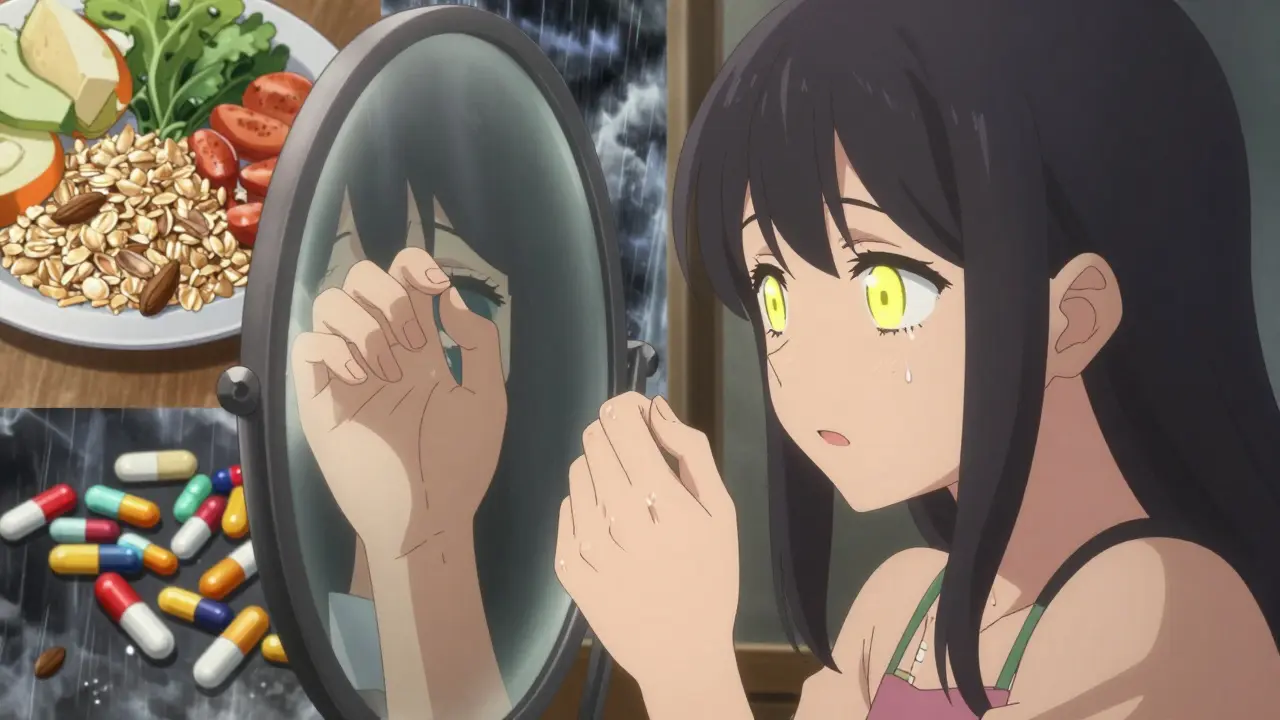
Physical signs can give it away. Look for fatty lumps on the tendons of your heels or knuckles-these are called tendon xanthomas. Yellowish patches around the eyelids, known as xanthelasmas, are another red flag. These aren’t just cosmetic. They’re visible proof that cholesterol is building up in your body.
On the other hand, acquired hypercholesterolemia comes from what you eat, how you live, or other health problems. Eating too much saturated fat, being sedentary, or carrying extra weight can push your cholesterol up. So can conditions like hypothyroidism, diabetes, or chronic kidney disease. Some medications, like certain diuretics or steroids, can also raise LDL. The good news? This type often responds well to changes in diet and exercise.
Why You Can’t Just "Eat Less Fat" and Call It Done
Many people think cutting out eggs or butter will fix high cholesterol. It helps-but not enough. Studies show dietary changes alone typically lower LDL by only 10-15%. The Portfolio Diet, which combines nuts, plant sterols, oats, and legumes, does better-reducing LDL by up to 30% in clinical trials. But even that isn’t enough for people with FH.
Here’s the hard truth: if you have familial hypercholesterolemia, lifestyle changes alone won’t cut it. You’ll need medication-often multiple medications-to get your LDL down to safe levels. The European Atherosclerosis Society says untreated FH can shorten life expectancy by 30 years. That’s not an exaggeration. It’s based on decades of tracking patients.
How Doctors Test and Diagnose It
A simple blood test called a lipid panel measures your cholesterol. It checks total cholesterol, LDL, HDL (the "good" kind), and triglycerides. You don’t even need to fast anymore-the U.S. Preventive Services Task Force updated guidelines in 2022 to reflect that. That makes testing easier and more accessible.
Who should get tested? Everyone between 40 and 75, especially if they have other risk factors. But if you have a family history of early heart disease or if you notice physical signs like xanthomas, get tested earlier-even as a teenager. The Dutch Lipid Clinic Network Criteria, introduced in 2022, helps doctors spot FH with 94% accuracy by combining family history, cholesterol levels, and physical signs.
What Treatments Actually Work
Statins are still the first line of defense. Drugs like atorvastatin (Lipitor) and rosuvastatin (Crestor) can cut LDL by 50% or more. They’ve been proven in massive trials like IMPROVE-IT to reduce heart attacks and deaths. But not everyone tolerates them. About 7-29% of people experience muscle pain or other side effects.
For those who can’t take statins-or need more help-there are other options. Ezetimibe (Zetia) blocks cholesterol absorption in the gut and lowers LDL by about 18%. Then there are the PCSK9 inhibitors-alirocumab and evolocumab. These are injectable drugs that can slash LDL by another 50-60% on top of statins. They’re expensive, but for people with FH, they can be life-saving.
And now there’s something new: inclisiran (Leqvio). Approved by the FDA in 2021, it’s an RNA-based therapy that works differently. Instead of daily pills, you get two shots a year. It lowers LDL by half and improves adherence dramatically. For someone who forgets pills, this could be a game-changer.
For severe FH, doctors often use triple therapy: a high-intensity statin, ezetimibe, and a PCSK9 inhibitor. It sounds intense, but for someone with LDL over 300 mg/dL, it’s not optional.

The Real Problem: People Aren’t Taking Their Medicine
Here’s the uncomfortable part: even when doctors prescribe the right drugs, people stop taking them. Only about half of statin users are still on their medication after a year. CVS Health found that many quit because they feel fine-or they’re scared of side effects. But here’s the thing: if your cholesterol is high and you’re not treating it, you’re gambling with your life.
Adherence is even worse in women and minority groups. NHANES data shows only 49% of women and 42% of Black adults receive statin therapy, even when they qualify. That’s not just a health gap-it’s a survival gap.
What the Future Holds
Research is moving fast. Scientists now use polygenic risk scores to find people at risk even if they don’t have FH. These scores look at hundreds of tiny genetic variations to predict who’s likely to develop high cholesterol over time. That means we could start treating people in their 20s or 30s, long before plaque forms.
Public health efforts are also shifting. The American Heart Association’s 2030 goal aims to improve cardiovascular health by 20%. That includes better access to testing, more affordable medications, and policies to reduce saturated fat in processed foods. Because the truth is, we can’t treat our way out of this crisis. We need to prevent it.
What You Can Do Today
If you’ve never had your cholesterol checked, get tested. It takes five minutes. If you’re over 40, or have a family history of early heart disease, don’t wait. If you’ve been told you have high cholesterol, don’t ignore it. Talk to your doctor about what type you have-and whether you need more than just diet changes.
Medication isn’t a failure. It’s a tool. And for many people, it’s the difference between a long life and a shortened one. The science is clear: lowering LDL saves lives. Every 39 mg/dL reduction means a 22% lower risk of heart attack or stroke. That’s not a small gain. That’s life-changing.
High cholesterol doesn’t announce itself. But you can stop it before it stops you.



Comments (13)
Mandy Vodak-Marotta
Okay but let’s be real-how many of us have actually gotten our cholesterol checked? I’m 32, I eat avocado toast daily, I run 3x a week, and I still didn’t get tested until my dad had a scare. Now I’m on statins. I thought I was healthy. Turns out, silent killer doesn’t knock. It just shows up with a crowbar.
Also, can we talk about how weird it is that we’re okay with checking our phones 200x a day but won’t check a simple blood test? I’m not mad, just confused.
Meenal Khurana
Testing is free at many clinics. Just go.
Joy Johnston
I’m a nurse and I see this every day. People stop their meds because they ‘feel fine.’ But cholesterol doesn’t feel anything-it just builds. I had a patient last month who was 38, LDL over 300, no symptoms. She’d been told for years. She didn’t believe it until she had a minor heart event. Now she’s on inclisiran. Two shots a year. She calls it her ‘life insurance.’
Medication isn’t weakness. It’s wisdom.
Amit Jain
Here in India, we think ghee and coconut oil are healthy. They’re not. We need more public awareness. My uncle had FH. His LDL was 420. He didn’t believe in pills. He drank turmeric milk. Died at 47.
Statins work. Don’t be stubborn. Talk to a doctor before it’s too late.
Kunal Kaushik
My grandma had xanthelasmas. We thought it was just aging. Turns out, she had FH. She never knew. She passed at 52 from a stroke.
💔 I wish someone had told us earlier.
Now I get tested every year. No excuses.
Sherman Lee
Big Pharma pushed statins because they make billions. 😏
Did you know the FDA approved PCSK9 inhibitors after a 3-month trial? And they cost $14,000 a year? Meanwhile, garlic and apple cider vinegar have been used for 5,000 years.
They don’t want you to know the truth. The system is rigged. 🤫
Also, I’ve been eating only raw kale for 7 years. My LDL is 180. Coincidence? I think not.
Keith Harris
Oh wow, another ‘cholesterol is bad’ cult pamphlet. Let me guess-you also think salt kills you, eggs are poison, and butter is a crime against humanity? 🤡
Cholesterol isn’t the villain. Inflammation is. And guess what? Sugar and processed carbs are the real arsonists. But you won’t hear that from your cardiologist because Big Pharma doesn’t sell a pill for ‘eat less donuts.’
I’ve been on a keto diet for 8 years. My LDL is 210. My HDL is 90. My triglycerides are 45. I’m stronger than I was at 25. You think I’m going to pop a statin because some lab number looks ‘bad’? Nah. I’ll take my natural, well-functioning arteries over your synthetic chemical cocktail any day.
Also, ‘familial hypercholesterolemia’? Sounds like a marketing term invented by a drug rep who couldn’t get a date. My grandfather lived to 94 on bacon and whiskey. Your ‘silent killer’ is just a scare tactic to sell pills.
Wake up. Your body isn’t broken. Your diet is.
Lorena Druetta
Keith, I hear you. I really do. I used to think the same way. I thought meds were a crutch. But when my sister-only 39-had a heart attack because her LDL was 320 and she refused treatment… I stopped being a contrarian. I became a believer.
It’s not about demonizing food or trusting Big Pharma. It’s about listening to science, not fear or ideology. Your body doesn’t care if you’re ‘natural.’ It only cares if your arteries are clogged.
I’m not here to shame anyone. I’m here to say: please, get tested. Even if you think you’re fine. Even if you eat kale. Even if you’re keto. Just get tested. Five minutes could save your life.
I love you, Keith. But please, don’t gamble with your heart.
Wendy Lamb
My mom’s cholesterol was 280. She started eating oats every morning. Lost 15 lbs. Walked 6k steps daily. Her LDL dropped to 140 in 6 months. No meds.
It’s not magic. It’s consistency.
Not everyone needs pills. But everyone needs to move and eat real food.
Justin Fauth
Why is this even a thing? In America, we’re so obsessed with numbers we forget we’re humans. We’re not lab rats. We’re not Excel sheets. You don’t need to be ‘perfect’ to live a long life. You need joy, sleep, and connection.
My neighbor died at 42. He had perfect cholesterol. But he worked 80 hours a week, never hugged his kids, and drank 3 energy drinks a day.
Fix your life, not your LDL.
Also, if you’re taking 3 pills a day because some guy in a white coat told you to-maybe you’re the problem, not your cholesterol.
Jesse Naidoo
Wait. If I have high cholesterol, does that mean I’m secretly a bad person? Am I being punished for eating pizza? Is this karma? Because I feel like I’m being judged by my own blood.
Also, what if I just… don’t care? Is that a crime? I’m 40. I’ve lived. I’m happy. Why does my liver have to pay for my joy?
Rachel Kipps
Thank you for this article. I didn’t know about the Dutch Lipid Clinic Criteria or inclisiran. I’ll be sharing this with my mom. She’s 62 and has been on statins for 12 years. She’s scared to stop. I think she needs to talk to her doctor about whether she still needs them.
Also, typo: ‘U.S. Preventive Services Task Force’ was misspelled as ‘U.S. Preventive Servies Task Force’ in the third paragraph. Just fyi.
Prajwal Manjunath Shanthappa
It’s astonishing, truly astonishing, that in the 21st century, we still rely on archaic lipid panels to diagnose a condition that is fundamentally genetic, yet we ignore the most advanced genomic tools available-polygenic risk scores, whole-exome sequencing, even CRISPR-based screening-because, of course, the medical-industrial complex prefers the low-hanging fruit of pharmaceuticals over truly transformative, albeit expensive, innovation. One must ask: is this medicine-or is it economics dressed in a lab coat? The answer, I fear, is self-evident.