
Imagine trying to read a book, but the center of every page is blurry - like someone smeared wax over the middle of your vision. You can still see the edges of the room, the doorframe, the curtains. But faces? Gone. The words on the page? Smudged. That’s what age-related macular degeneration does. It doesn’t take away your sight completely. It steals the part you use to live your life.
More than 10 million Americans have AMD. By 2040, that number will hit nearly 300 million worldwide. It’s the #1 cause of vision loss in people over 65 in the U.S. And it’s not just old age - it’s biology, behavior, and bad luck rolled into one.
What Exactly Is the Macula?
The macula is a tiny spot, no bigger than a pencil eraser, right in the center of your retina. It’s packed with cone cells - the photoreceptors that let you see color, fine detail, and everything you need for daily tasks: reading, driving, recognizing your grandkids’ faces. When the macula breaks down, those functions vanish. Peripheral vision stays intact, which is why people with AMD aren’t totally blind. But they’re functionally blind for the things that matter most.
There are two main types: dry and wet. About 90% of cases are dry AMD. This form creeps in slowly. Tiny yellow deposits called drusen build up under the retina. Over time, the retinal tissue thins out. This is called geographic atrophy - and it’s irreversible. The other 10-15% are wet AMD. That’s the dangerous one. It’s when abnormal blood vessels grow under the macula, leak fluid and blood, and scar the tissue. Wet AMD can destroy central vision in weeks or months if left untreated.
Why Does This Happen?
Age is the biggest risk factor. If you’re 40, your chance of having AMD is less than 1%. By 75, it jumps to 35%. But age alone doesn’t explain it. Genetics play a huge role. If a parent or sibling has AMD, your risk triples to sextuples. And if you’re white, you’re 2.5 times more likely to develop it than African Americans.
Smoking? The #1 modifiable risk. Smokers are nearly four times more likely to get AMD than non-smokers. High blood pressure, high cholesterol, and obesity each add their own weight to the risk. One study found people with a BMI over 30 had more than double the risk. The damage isn’t sudden. It’s slow. Oxidative stress builds up over decades. The retinal pigment epithelium - the layer that feeds the photoreceptors - starts to fail. Cellular debris piles up. The immune system turns on itself, attacking the very tissue it’s supposed to protect.
Anti-VEGF: The Treatment That Changed Everything
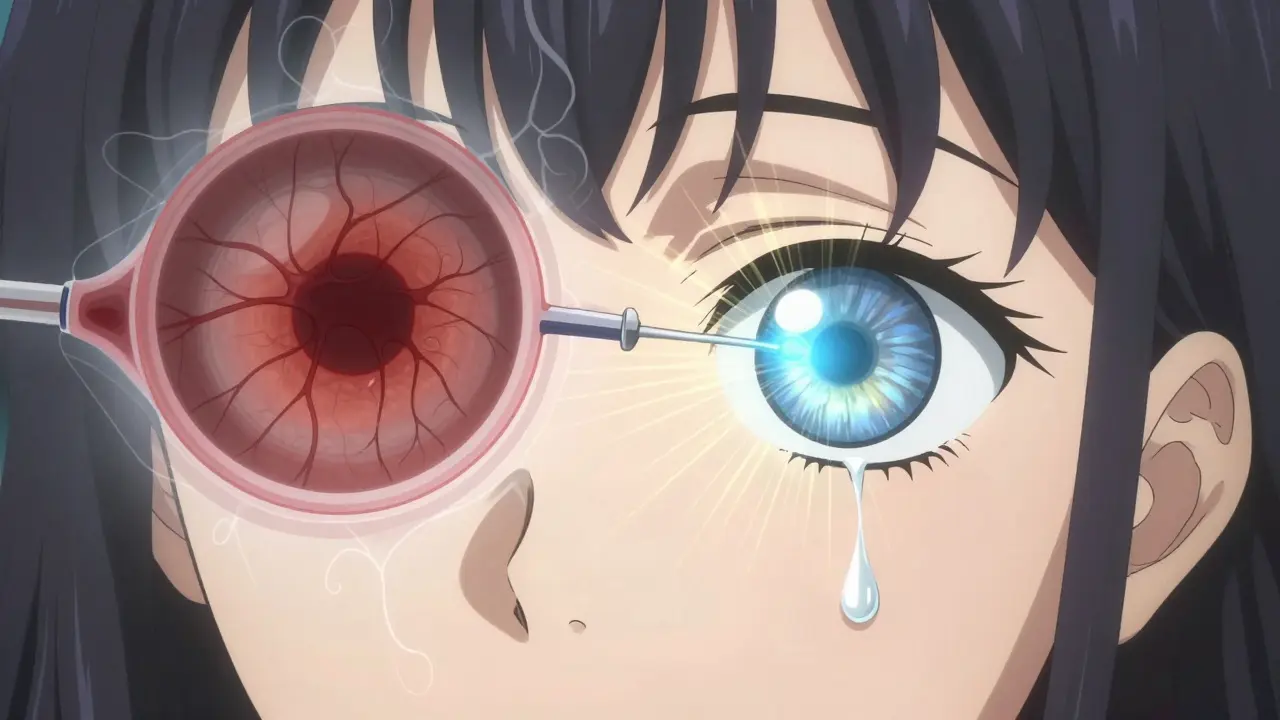
Before 2005, wet AMD meant almost certain blindness. Laser therapy existed, but it often burned the macula along with the bad vessels. Then came anti-VEGF. VEGF stands for vascular endothelial growth factor - a protein that tells blood vessels to grow. In wet AMD, it’s overproduced. The result? Leaky, chaotic vessels under the retina.
Anti-VEGF drugs block that signal. They’re injected directly into the eye - a quick, outpatient procedure. The first one approved was Lucentis. Then came Eylea, Beovu, and Vabysmo. These aren’t cures. But they’re game-changers. Studies show that after starting anti-VEGF treatment, 68% of patients stabilize or even improve their vision. One patient on Reddit shared: “After 12 injections over 9 months, my vision went from 20/200 to 20/40. Worth every uncomfortable moment.”
But here’s the catch: you can’t stop. The first few months usually mean monthly shots. Then, doctors switch to “as needed” based on OCT scans - detailed images of the retina’s layers. Miss too many appointments? You lose 30% more vision than those who stick to the schedule. That’s why adherence is just as important as the drug itself.
The Burden of Treatment
For many, the injections are a lifeline. But they’re also exhausting. Eighty-two percent of patients say frequent clinic visits are a major stressor. Traveling, taking time off work, anxiety about the needle - it adds up. That’s why new options are emerging. In 2021, the FDA approved Susvimo - a tiny port implanted in the eye that slowly releases Lucentis for up to six months. No monthly shots. Just a refill every half-year.
And Vabysmo, approved in early 2022, is the first drug that targets two pathways at once - VEGF and angiopoietin-2. That means fewer injections for some patients. The goal? Less burden, same results.

What You Can Do Now
There’s no magic pill to reverse AMD. But you can slow it down - especially if you catch it early. The AREDS2 formula - a specific mix of vitamins C, E, zinc, copper, lutein, and zeaxanthin - reduces progression risk by 25% in people with intermediate dry AMD. Talk to your eye doctor before taking any supplements. Too much zinc can cause side effects.
Use the Amsler grid at home. It’s a simple checkerboard pattern. If the lines look wavy, distorted, or missing, it could mean wet AMD is developing. Forty percent of patients spot changes this way before their next appointment.
Quit smoking. Control your blood pressure. Eat leafy greens. Wear UV-blocking sunglasses. These aren’t just “good habits.” They’re protective measures backed by decades of research.
What’s Next?
Researchers are now testing gene therapies that target the complement system - the immune pathway that goes rogue in AMD. Early trials show promise. If it works, it could stop the disease before it starts.
Right now, anti-VEGF is the gold standard. Ninety-two percent of U.S. eye doctors use it as first-line treatment for wet AMD. In 2005, that number was 15%. That’s progress.
But the real victory isn’t the drug. It’s the fact that people with wet AMD no longer have to accept blindness. With timely treatment, most can keep driving, reading, and seeing their family’s faces. That’s not just medical science. That’s dignity.
Can dry AMD turn into wet AMD?
Yes. Any stage of dry AMD can progress to wet AMD, even if you’ve had it for years with no changes. That’s why regular eye exams are critical. About 10-15% of dry AMD cases eventually become wet. There’s no way to predict when - which is why home monitoring with the Amsler grid is so important.
Are anti-VEGF injections painful?
Most patients feel only mild pressure or discomfort. The eye is numbed with drops before the injection. The needle is very thin, and the procedure takes less than a minute. Some people report a brief sting or a feeling of something touching the eye. Afterward, there may be mild redness or a scratchy sensation for a day or two. Serious pain is rare. If you feel sharp pain after the injection, call your doctor right away.
Can I drive with AMD?
It depends on how much central vision you’ve lost. In many places, you need at least 20/40 vision in one eye to drive legally. With wet AMD, anti-VEGF treatment can often preserve vision enough to keep driving. With advanced dry AMD, many people lose the ability to read road signs or judge distances. Always check with your eye doctor and local DMV. Some states allow vision aids or restricted licenses for people with low vision.
Do anti-VEGF drugs work for everyone?
No. About 10-20% of patients don’t respond well to the first anti-VEGF drug. That’s why doctors may switch to another - like going from Lucentis to Eylea or Vabysmo. Response varies based on genetics, how long the disease has been active, and how quickly treatment started. The key is not giving up. There are multiple options, and finding the right one can make all the difference.
Is there a cure for AMD?
Not yet. Neither dry nor wet AMD can be cured. But wet AMD can be managed very effectively with anti-VEGF therapy. Dry AMD can be slowed with diet, supplements, and lifestyle changes. The goal isn’t to restore lost vision - it’s to stop it from getting worse. For many, that means preserving enough sight to live independently for years.
How often should I get my eyes checked if I have AMD?
If you have early or intermediate dry AMD, annual exams are usually enough. If you have wet AMD or are being treated with anti-VEGF, you’ll need checkups every 4 to 8 weeks at first. After stabilization, your doctor may extend the interval based on OCT scans. Never skip a scheduled visit - even if your vision feels fine. Damage can happen without noticeable symptoms.




Comments (12)
Kunal Majumder
Been through this with my dad. Anti-VEGF saved his ability to see his grandkids’ faces. Yeah, the shots are weird, but it’s way better than staring at a blurry void where their smiles used to be. Don’t skip appointments. It’s not just medicine-it’s time with people you love.
McCarthy Halverson
AREDS2 works. Took it for 3 years. No progression. Simple. No hype. Just science.
neeraj maor
Let me tell you something they don’t want you to know. The FDA approved these drugs because Big Pharma realized they could charge $2,000 a shot and no one would stop them. The real cure? A diet rich in turmeric and sunlight. But you won’t hear that from your retina specialist. They’re paid by the syringe.
Dwayne Dickson
While the pharmacokinetic profile of anti-VEGF agents demonstrates statistically significant efficacy in retinal vascular permeability modulation, the adherence rates remain suboptimal due to psychosocial barriers, including transportation logistics and procedural anxiety, which collectively contribute to suboptimal visual outcomes in elderly populations.
Christine Milne
Of course Americans are obsessed with injections. In India, they just eat curry and pray. Why do we need fancy drugs when our ancestors lived to 90 without ever seeing an ophthalmologist? This is medical colonialism disguised as innovation.
Ted Conerly
For real though-use the Amsler grid every single morning. Five seconds. Could catch wet AMD before it wrecks you. I showed my mom how to do it. She’s 78. Still drives. Still reads. That’s the win.
Mario Bros
Just had my 14th injection. Still hate it. But I saw my daughter’s graduation. Worth every second of fear. 🤞
Michael Marchio
It’s fascinating how people treat AMD like it’s just an aging issue, when in reality, it’s the culmination of decades of poor dietary choices, sedentary lifestyles, and a complete disregard for ocular health. I’ve seen patients who smoked until 70 and then blamed genetics. The truth is, you’ve been slowly poisoning your retina since your twenties, and now you want a magic shot to fix it? It’s not that complicated. Eat your greens. Quit smoking. Stop staring at screens. But no, everyone wants a pill or a needle instead of taking responsibility.
chandra tan
In India, we call this ‘dhwani chhutna’-the loss of the center. Grandmas still see the edges of the world-flowers, sky, children running-but not the details. They don’t have access to Lucentis. They use home remedies: amla juice, cow urine washes, rosewater drops. Some say it helps. I don’t know. But what I do know is this: the real tragedy isn’t the disease. It’s that people who need treatment can’t get it. We talk about innovation, but half the world is still waiting.
Jake Kelly
My aunt got Susvimo last year. No more monthly trips. She’s back to knitting. That’s all I need to know. Progress isn’t always loud. Sometimes it’s just a quiet needle in the eye that lets someone keep living.
Bradford Beardall
Wait, so if anti-VEGF works for wet AMD, why isn’t it used for dry? Are we missing something? I read a paper last week about complement inhibitors in phase 3 trials. Could that be the real breakthrough? Or are we just tweaking the same system?
Jake Nunez
My dad’s been on Vabysmo for 6 months. Two shots instead of eight. He’s sleeping better. I’m sleeping better. It’s not perfect. But it’s a damn sight better than before. They’re getting closer. Keep pushing.