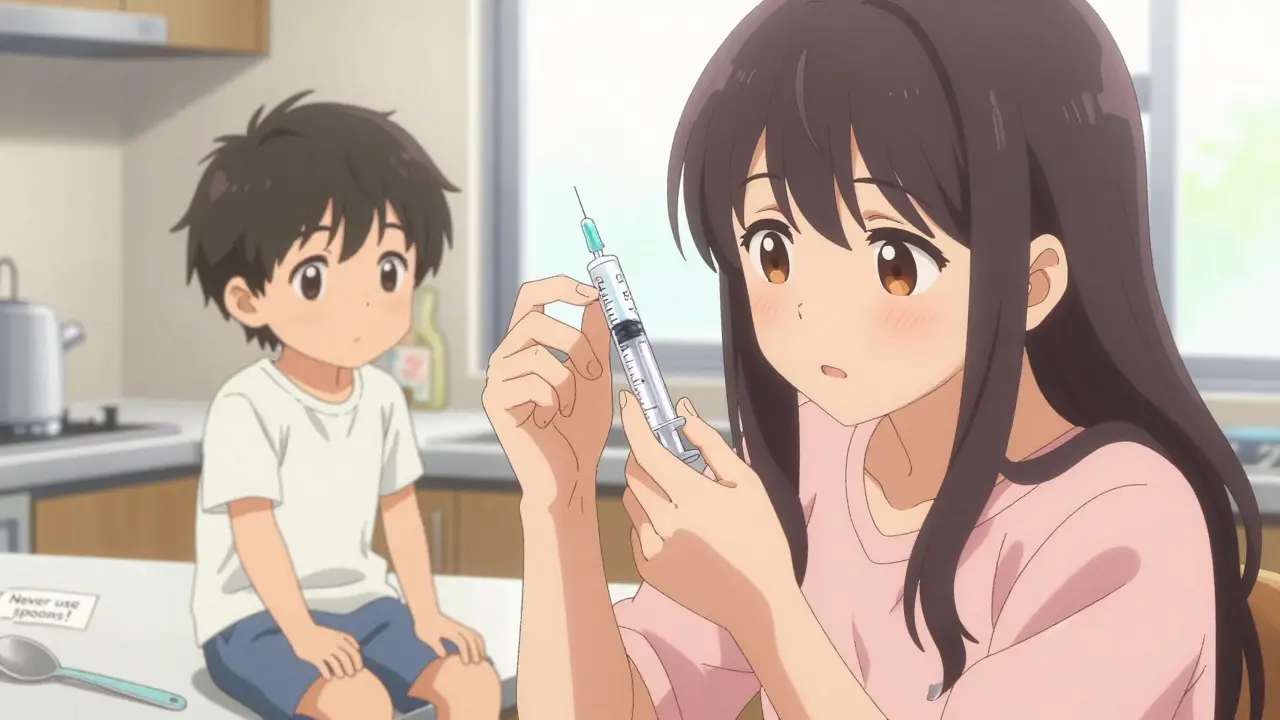
Getting the right dose of medicine into your child isn’t just about following the label-it’s about avoiding a mistake that could land them in the hospital. Too little, and the infection won’t clear. Too much, and you could cause serious harm. In fact, 7 in 10 parents mess up liquid medicine doses at home, often because they’re using the wrong tool or misunderstanding the numbers on the bottle. This isn’t about being careless-it’s about confusion. And it’s fixable.
Why Milliliters (mL) Are the Only Unit That Matters
Stop using teaspoons and tablespoons. Seriously. Even if the bottle says "1 tsp," don’t use your kitchen spoon. A real teaspoon holds anywhere from 3.9 to 7.3 milliliters, depending on the spoon. That’s a 50% error right there. For a child, that’s the difference between a safe dose and a dangerous one.The CDC, the American Academy of Pediatrics, and every major children’s hospital now agree: all pediatric liquid medications must be measured in milliliters (mL). No more tsp, tbsp, or "a capful." The old system was a recipe for disaster. A 2020 study showed that using tools marked only in mL reduced dosing errors by 42% compared to those with both metric and household units. Why? Because parents mix up "5 mL" and "0.5 mL"-and that’s a tenfold error. One is a dose. The other is a medical emergency.
Which Tool Should You Use? Not All Dosing Devices Are Equal
You’ve got options: oral syringes, dosing cups, droppers, and those little plastic spoons that come with the medicine. But not all are created equal.- Oral syringes (1-10 mL): The gold standard. They’re accurate to within 2%, even for tiny doses like 1.2 mL. Used correctly, they’re 94% accurate. They’re especially critical for doses under 5 mL-where dosing cups fail 68% of the time.
- Dosing cups: Fine for older kids who can drink from them, but only if the dose is 5 mL or more. For smaller doses, they’re a gamble. The wide mouth makes it hard to see the meniscus (the curve of the liquid), and even a slight tilt throws off the reading.
- Droppers: Good for babies or tiny doses under 2 mL, but hard to control. They’re easy to squeeze too hard or not hard enough.
- Medication spoons: Only use if they’re labeled with mL and are the one that came with the medicine. Household spoons? Never.
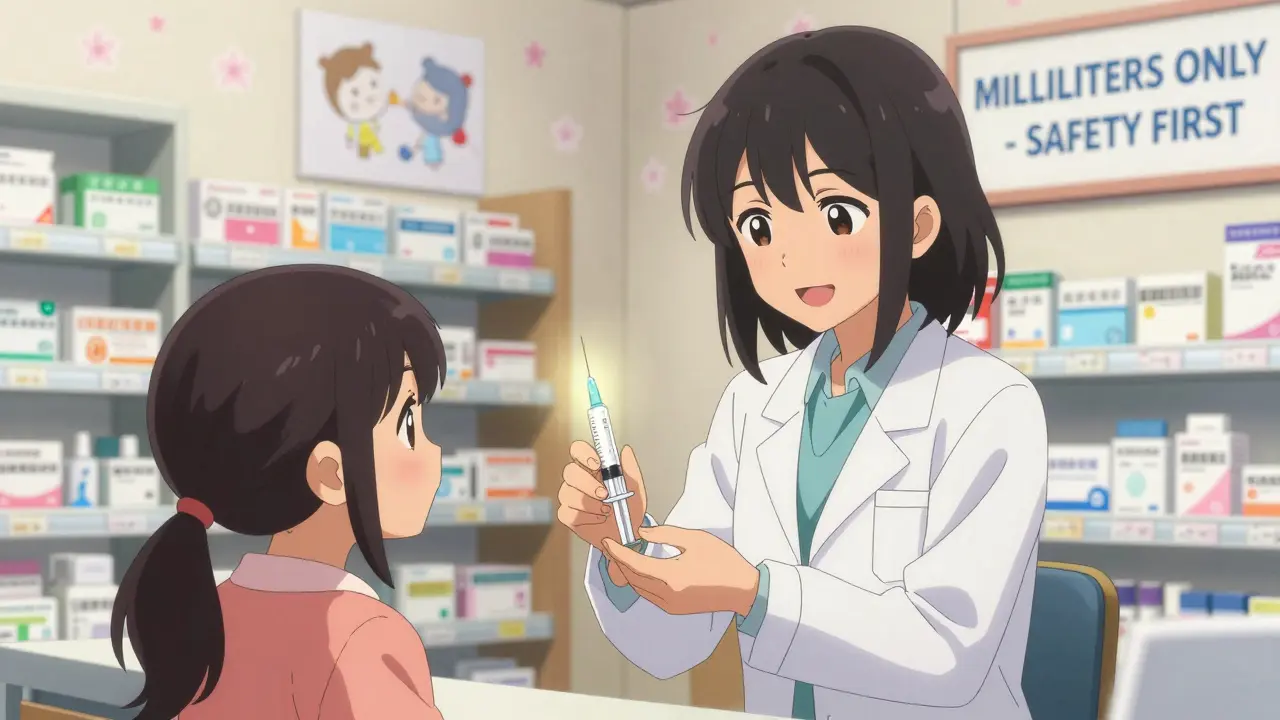
Here’s the bottom line: if the dose is less than 5 mL, use an oral syringe. Always. Even if the pharmacist hands you a cup, ask for a syringe. Most pharmacies will give you one for free.
How to Measure with an Oral Syringe (Step by Step)
It sounds simple, but most parents get it wrong. Here’s how to do it right:
- Shake the bottle well if it’s a suspension (like amoxicillin or ibuprofen). If you don’t, the medicine settles at the bottom-you’ll get too little.
- Remove the cap and insert the syringe tip into the bottle.
- Turn the bottle upside down and slowly pull the plunger to draw up the exact mL amount. Don’t guess. Read the line on the syringe.
- Hold the syringe vertically. Look at the meniscus-the curved surface of the liquid-at eye level. The top of the curve should line up exactly with your dose mark.
- Place the tip of the syringe inside your child’s cheek, not the front of the mouth. Gently push the plunger. This avoids triggering the spit reflex.
- Wash the syringe with warm water after each use. Don’t reuse it without cleaning.
Pro tip: If your child gets the same dose every day, mark the syringe with a permanent marker. Write "2.5 mL" next to the line. It helps when you’re tired or rushing.
Weight-Based Dosing: What to Do When the Label Doesn’t Tell You Enough
Many pediatric meds are dosed by weight: "5 mg per kg of body weight." That means you have to convert pounds to kilograms. If you don’t, you’ll give the wrong amount.
Here’s how:
- Divide your child’s weight in pounds by 2.2 to get kilograms.
- Example: A child weighs 22 pounds. 22 ÷ 2.2 = 10 kg.
- If the dose is 40 mg/kg/day in two doses, then: 40 × 10 = 400 mg total per day. Split into two doses: 200 mg each.
- If the medicine is 400 mg per 5 mL, then 200 mg = 2.5 mL.
Don’t guess. Write it down. Use a calculator. If you’re unsure, call your pharmacist. They’re paid to help you get this right.
Common Mistakes (And How to Avoid Them)
Parents make the same mistakes over and over. Here’s what to watch for:
- Using kitchen spoons: They’re not standardized. Ever.
- Not shaking the bottle: Especially for antibiotics. You might be giving your child half the dose.
- Confusing mg and mL: That’s one of the top causes of errors. "Give 250 mg" is not the same as "Give 2.5 mL." Always check the concentration: "400 mg/5 mL" means each mL has 80 mg.
- Using old medicine: Don’t reuse leftover antibiotics. They lose potency and can be dangerous.
- Multiple caregivers: If grandma, dad, and mom all give medicine, make sure everyone uses the same tool and writes down each dose. Use a dosing log.
One mom in Auckland told me she used a kitchen spoon for her daughter’s amoxicillin for three days-until the fever came back. The pharmacist found out: she’d been giving 1.5 mL instead of 5 mL because she thought "a spoonful" meant a kitchen spoon. Her daughter had to restart the course.

What to Do If You’re Still Confused
You’re not alone. A 2023 study found that parents with lower health literacy were twice as likely to use dosing cups instead of syringes-even though they were less accurate. That’s not ignorance. It’s a system that hasn’t been made clear.
Here’s what to do:
- Ask the pharmacist to show you how to use the syringe. Don’t be shy.
- Request a dosing syringe when you pick up the prescription-even if they don’t offer one.
- Take a photo of the label and the syringe reading. Share it with your partner or caregiver.
- Use free apps like MedSafety (from Cincinnati Children’s Hospital) that show video guides on how to measure correctly.
- If English isn’t your first language, ask for instructions in your language. Pharmacies in New Zealand are required to provide multilingual support.
What’s Changing in the Future
Good news: the system is getting better. The FDA is pushing for all pediatric liquid medications to come with a standard mL-only oral syringe by 2025. Hospitals are already giving them out at discharge. New tools like color-coded syringes (NurtureShot) and smart dosing cups (coming in 2025) are reducing errors by over 60%.
But until then, you’re the most important safety check. You don’t need to be a nurse. You just need to use the right tool, read the mL, and never trust a kitchen spoon.
Can I use a regular kitchen spoon if I don’t have a syringe?
No. Kitchen spoons vary too much in size-anywhere from 4 to 7 milliliters. A standard teaspoon is supposed to be 5 mL, but most are not. Using one can lead to under-dosing or overdosing by 20-200%. Always use the tool that came with the medicine or ask your pharmacy for an oral syringe.
What if my child spits out the medicine from the syringe?
Place the syringe tip inside the cheek, not the front of the mouth. Gently push the medicine into the side of the mouth. This avoids the tongue’s natural reflex to push things out. If your child still spits it out, try mixing the dose with a small amount of applesauce or yogurt-but only if the medication allows it. Always check with your pharmacist first.
How do I know if the medicine is a suspension that needs shaking?
Look for words like "shake well before use" on the label. Antibiotics like amoxicillin, ibuprofen, and some antifungals are suspensions. If you don’t shake them, the medicine settles at the bottom, and your child gets too little. Always shake the bottle for 10-15 seconds before each dose.
Is it safe to mix medicine with juice or milk?
Some medicines can be mixed with small amounts of juice or milk to make them easier to take, but not all. Always check with your pharmacist. Mixing with milk can interfere with antibiotics like tetracycline. Never mix a full dose into a large bottle-your child might not drink it all, and you won’t know how much they got.
What should I do if I think I gave the wrong dose?
Call your doctor or pharmacist immediately. Don’t wait for symptoms. If you gave too much, especially with acetaminophen or ibuprofen, it can cause liver or kidney damage. If you gave too little, the infection might not clear. Keep the medicine bottle and syringe handy when you call-they’ll need the details.
Why do pharmacies sometimes give dosing cups instead of syringes?
Some pharmacies still stock cups because they’re cheaper and easier to dispense. But that doesn’t mean they’re the best choice. You have the right to ask for an oral syringe. Most pharmacies will give you one at no extra cost. If they say no, ask to speak to the pharmacist. Your child’s safety is more important than their inventory.



Comments (15)
Stewart Smith
So basically, if you use a kitchen spoon, your kid might as well be playing Russian roulette with Tylenol? Yeah, I get it. I did that once. My daughter threw up for three hours. Never again. 🤦♂️
Aaron Bales
Use the syringe. Always. Even if it’s 1.2 mL. Even if you’re tired. Even if the kid is screaming. Syringe saves lives. No exceptions.
Bennett Ryynanen
I used to just eyeball it till my niece got hospitalized. Now I keep a syringe taped to the fridge. My wife laughs, but she’s the one who actually remembers to use it. Thanks for the reminder, OP.
Darren Pearson
It’s astonishing that in the 21st century, parents are still relying on antiquated, non-standardized household utensils to administer life-critical medications. The CDC’s position is not merely a recommendation-it is a clinical imperative. The persistence of this behavior reflects a systemic failure in public health communication, not parental negligence.
Retha Dungga
why do we even still use spoons?? 🤔 medicine is science not cooking 😅 maybe we need a new word for "dose" like "syringe-ml" 🤷♀️
Sara Stinnett
Of course the FDA is pushing for syringes-because they want to control everything. Who decided that parents can’t be trusted with teaspoons? My grandmother gave medicine with a spoon and we turned out fine. Maybe the real problem is over-medicalizing parenting.
Emma Hooper
Let me tell you about the time I gave my son 5 mL of amoxicillin with a soup spoon because I thought "tsp" meant teaspoon. He slept for 18 hours. I panicked. Turned out he was just exhausted. But now? I’ve got three syringes in my medicine cabinet, labeled with Sharpie, and a sticky note on the fridge that says "SYRINGE OR DIE."
Chandreson Chandreas
Bro, I’m from India and we’ve always used spoons. But after reading this, I just ordered 5 syringes online. My daughter’s on antibiotics right now. I’m gonna do this right. Thanks for the clarity, man. 🙏
Lawver Stanton
Look, I’m not a doctor, but I watched a YouTube video once where a guy said you shouldn’t use dosing cups for under 5 mL. So I’ve been using a syringe. But here’s the thing-why does the bottle even have tsp on it if it’s dangerous? Who wrote that? Who approved it? Why are we still being lied to by Big Pharma? This is a conspiracy. And I’m not the only one who thinks so.
linda permata sari
I’m from Indonesia and we use spoons too. But I saw this post and asked my pharmacist here-they gave me a free syringe AND a picture guide in Bahasa. I cried. Thank you for making me feel less alone.
Urvi Patel
Milliliters are the only unit that matters? Please. You’re just reinforcing Western medical hegemony. In my culture, we measure with the thumb and finger. It’s intuitive. You don’t need a syringe to know what a child needs. Your obsession with precision ignores the human element of care.
Joy Nickles
Okay so I used a kitchen spoon... and then I gave the same dose again because I forgot I already did... and then my kid threw up... and then I realized I’d been using the wrong syringe because I mixed up the 5ml and 10ml ones... and then I cried in the pharmacy aisle... and then the pharmacist gave me a new one and a hug... and then I bought a dosing log and a highlighter and now I have a spreadsheet... and my husband says I’m obsessive... but my kid hasn’t been sick since... so... maybe I am... 🤷♀️😂
John Chapman
OMG YES. I used to use the cap. I thought "capful" meant one full cap. Turns out my cap held 10 mL and the dose was 5. My daughter had a seizure. Not kidding. Now I carry a syringe in my purse. Like a weapon. 💪💉
Martin Viau
As a Canadian, I’m shocked the U.S. hasn’t standardized this yet. We’ve had mL-only pediatric meds since 2012. Why is this even a debate? Your healthcare system is broken if parents are still guessing doses. Get it together.
Jenny Salmingo
I’m a mom of three. I didn’t know any of this. I just followed what the bottle said. Now I know. I’m going to the pharmacy tomorrow to ask for a syringe. Thank you for telling me. I’m not alone.