Every day, millions of people in the U.S. take generic drugs without even realizing it. In fact, generic drugs make up about 90% of all prescriptions filled. But how are they actually made? And how can they cost up to 85% less than brand-name pills while working just as well? The answer lies in a tightly controlled, science-backed process that’s been refined over decades - and it’s far more complex than most people think.
What Makes a Drug ‘Generic’?
A generic drug isn’t a copy. It’s a precise replica of a brand-name drug in every way that matters: same active ingredient, same strength, same dosage form (tablet, capsule, injection), same route of administration (oral, topical, etc.), and same therapeutic effect. The FDA requires that a generic drug performs the same way in the body as the original. That means it must deliver the same amount of medicine into the bloodstream at the same rate. This is called bioequivalence.What’s different? The color, shape, flavor, or inactive ingredients (like fillers or coatings) can vary. That’s why a generic version of a blue pill might be white and oval - trademark laws prevent generics from looking exactly like the brand-name version. But the medicine inside? Identical.
The Legal Pathway: The ANDA
The entire system was built on the Hatch-Waxman Act of 1984. Before this law, companies had to run full clinical trials for every new drug - even if it was already proven safe and effective. That made generics too expensive and slow to develop.The solution? The Abbreviated New Drug Application, or ANDA. Instead of repeating clinical trials, generic manufacturers only need to prove two things: their product is bioequivalent to the brand-name drug, and they can make it consistently under strict quality rules.
That’s where the savings come from. While a new brand-name drug can cost $2.6 billion and take 10-15 years to develop, a generic typically costs $5-10 million and takes 3-4 years. The FDA reviews each ANDA in about 17 months - though complex drugs can take up to 3 years.
Step 1: Reverse Engineering the Brand-Name Drug
Before a single tablet is made, scientists have to figure out exactly what’s in the original drug. This is called analyzing the Reference Listed Drug (RLD). They break it down chemically to identify the active ingredient and every inactive ingredient - the fillers, binders, lubricants, and coatings that help the pill hold together or dissolve properly.This step isn’t just about matching ingredients. It’s about matching how they behave. For example, a coating that controls how fast a pill releases medicine in the stomach? That has to be replicated exactly. Even small changes in particle size of lactose (a common filler) can throw off dissolution rates. One pharmaceutical engineer on Reddit said: “A slight change in lactose from your supplier can completely throw off your tablet hardness and dissolution profile.”
Step 2: Designing the Formula - Quality by Design
Manufacturers don’t just guess at the formula. They use a science-based approach called Quality by Design (QbD), developed by the International Council for Harmonisation (ICH). This means they identify three key things:- Critical Quality Attributes (CQAs): What properties must the final drug have? (e.g., dissolution rate, tablet hardness, purity)
- Critical Material Attributes (CMAs): What characteristics of the raw ingredients affect those properties? (e.g., crystal form of the active ingredient, moisture content of the filler)
- Critical Process Parameters (CPPs): What settings in the machine matter? (e.g., mixing time, compression pressure, drying temperature)
Using this method, manufacturers test dozens of combinations - changing one variable at a time - until they find the exact formula and process that matches the brand-name drug’s performance. This isn’t trial and error. It’s data-driven engineering.
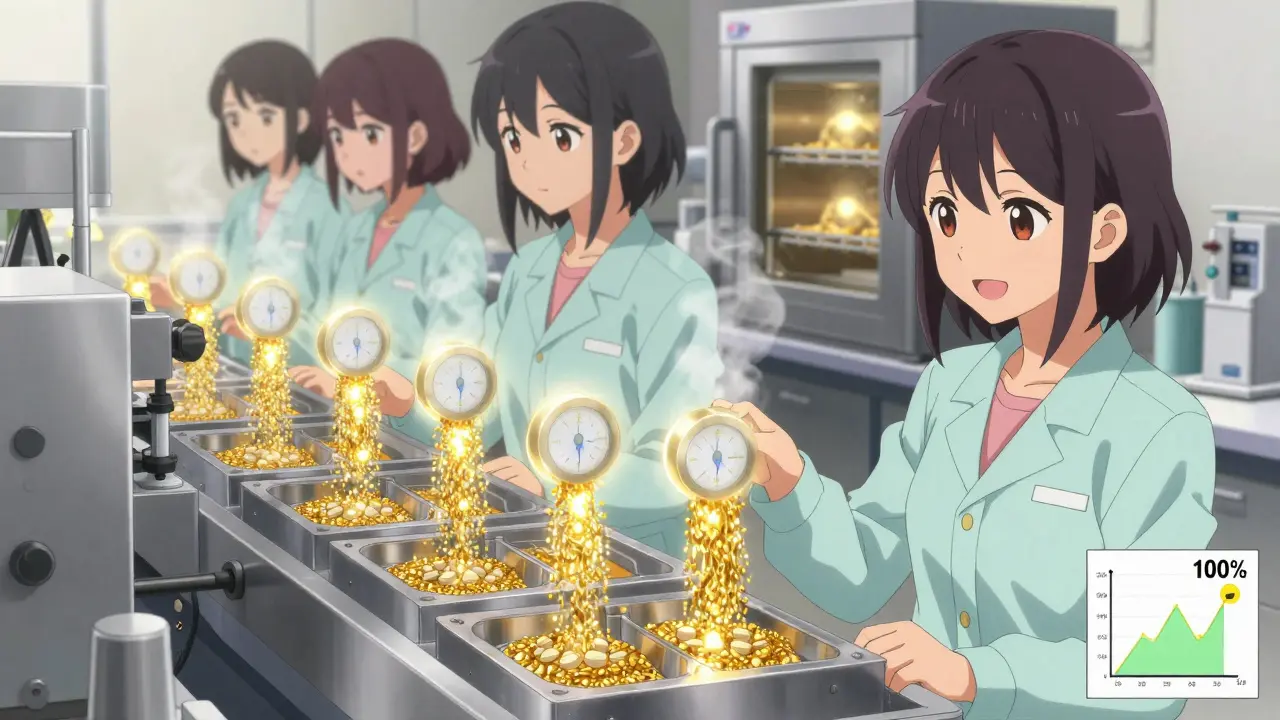
Step 3: The Manufacturing Process - Seven Key Stages
Once the formula is locked in, production begins. Here’s how a typical tablet is made:- Formulation: The active pharmaceutical ingredient (API) is weighed and mixed with excipients like starch, cellulose, or magnesium stearate. This mixture must be perfectly uniform - no clumps, no uneven distribution.
- Mixing and Granulation: The powder blend is turned into granules. This improves flow during compression and ensures consistent tablet weight. Wet granulation uses a liquid binder; dry granulation uses pressure.
- Drying: If wet granulation was used, the granules are dried in ovens at controlled temperatures. Too much moisture? The tablet can degrade. Too little? It won’t hold together.
- Compression and Encapsulation: Granules are pressed into tablets using high-speed tablet presses. For capsules, the powder is filled into gelatin or vegetarian shells. Each tablet must weigh within ±5% (for tablets under 130mg) or ±7.5% (for 130-324mg) of the target weight.
- Coating: Tablets get a thin film coating - sometimes to mask taste, protect from moisture, or control release. A delayed-release pill might have a coating that only dissolves in the intestine, not the stomach.
- Quality Control: At every stage, samples are tested. Tablets are checked for weight, hardness, thickness, and dissolution. The dissolution test is critical: it measures how quickly the drug releases from the tablet in simulated stomach fluid. The generic must release the same amount of medicine at the same rate as the brand-name drug - within the 80%-125% range.
- Packaging and Labeling: Tablets are sealed in blister packs or bottles with child-resistant caps. Labels must match the brand-name drug’s prescribing information exactly - same warnings, same dosing instructions.
Where It’s Made: CGMP and Cleanrooms
All manufacturing must follow Current Good Manufacturing Practices (CGMP), enforced by the FDA. These aren’t suggestions - they’re legal requirements.Factories must have:
- Controlled temperature (20-25°C) and humidity (45-65% RH)
- Cleanrooms with air filtration (ISO Class 5-8, depending on the step)
- Strict protocols for cleaning, gowning, and equipment sterilization
- Documentation for every batch - every weight, every test result, every deviation
Inspections happen without warning. In 2023, the FDA found the most common violations were: inadequate investigation of failed tests (37% of warning letters), poor process validation (29%), and weak quality unit oversight (24%). One major recall in 2021 involved Teva’s Puerto Rico facility, where CGMP failures led to 14 generic products being pulled from shelves.
Complex Generics: The Harder Cases
Not all generics are equal. Simple pills - like metformin or lisinopril - are easy to copy. But complex products? That’s where things get tough.Examples: inhalers, topical creams, injectables, and extended-release tablets. These don’t just need the same chemistry - they need the same physical behavior. For example, a generic asthma inhaler must deliver the exact same particle size and spray pattern as the brand. A topical cream must penetrate the skin at the same rate.
One manufacturer spent 7 years and $47 million to copy a single topical steroid. Why? Because traditional lab tests couldn’t predict how it would work on real skin. The FDA now has a Complex Generic Products Initiative with 127 product-specific guidelines to help manufacturers tackle these challenges.
Why Prices Drop - and Sometimes Crash
When a brand-name drug’s patent expires, the first generic enters the market. Often, it’s priced at 20-30% of the brand. Then others follow. Within two years, you might see 15-20 companies selling the same pill. Prices plummet - sometimes by 70-80%.But complex generics? They have fewer competitors - maybe just 2 or 3. That keeps prices higher. That’s why the market is shifting: 35% of pending ANDA applications now involve complex drugs, up from 12% in 2015.
Some brand-name companies even make their own generics - called “authorized generics.” These are identical to the brand, just sold under a different label. In 2023, they captured 23% of first-generic market share.
Are Generics Safe? The Evidence
There’s a myth that generics are “weaker” or “lower quality.” That’s not true. The FDA requires them to meet the same standards. A 2023 survey found 89% of pharmacists have high confidence in generic quality. Only 3% reported any meaningful difference in patient outcomes.There are rare exceptions - especially with drugs that have a narrow therapeutic index (like warfarin or levothyroxine). A tiny difference in absorption could matter. But even here, studies show generic versions are safe when properly manufactured. The real issue? Switching between different generic brands repeatedly. Some patients report feeling different - but that’s often due to changing fillers, not the active ingredient.
As Dr. Janet Woodcock, former FDA drug chief, said: “The ANDA pathway is one of the most successful public health initiatives in modern history.”
What’s Next? AI, Digital Twins, and Continuous Manufacturing
The industry is changing fast. The FDA now approves continuous manufacturing - where drugs are made in one unbroken flow, not in batches. Vertex used this for a cystic fibrosis drug and hit 99.98% batch acceptance - far better than traditional methods.AI is being used to spot defects in pills during packaging. Pfizer’s pilot program cut visual inspection errors by 40%. “Digital twins” - virtual models of production lines - help predict problems before they happen.
And the FDA’s new GDUFA IV rules (in effect since October 2022) mean ANDAs are reviewed faster - 90% within 10 months now, down from 17.
Final Thought: Generics Are the Backbone of Affordable Care
Generic drugs saved the U.S. healthcare system over $1.7 trillion in the last decade. That’s billions of dollars in savings for patients, insurers, and taxpayers. They’re not a compromise - they’re a triumph of science, regulation, and competition.Next time you pick up a generic pill, remember: it didn’t just appear on the shelf. It went through years of testing, millions of dollars in R&D, and strict quality checks to get there. And it works - just like the brand-name version.
Are generic drugs as effective as brand-name drugs?
Yes. The FDA requires generic drugs to have the same active ingredient, strength, dosage form, and route of administration as the brand-name drug. They must also prove bioequivalence - meaning they deliver the same amount of medicine into the bloodstream at the same rate. Studies show no meaningful difference in effectiveness for the vast majority of patients.
Why are generic drugs cheaper?
Generic manufacturers don’t have to repeat expensive clinical trials because they rely on the brand-name drug’s safety and efficacy data. They only need to prove bioequivalence and show they can make the drug consistently under strict quality standards. This cuts development time from 10-15 years to 3-4 years and reduces costs from $2.6 billion to $5-10 million per drug.
Do generic drugs have the same side effects?
The active ingredient causes the side effects, and that’s identical in generics. However, inactive ingredients (like dyes or fillers) can differ. In rare cases, someone might have a sensitivity to a filler - for example, lactose intolerance - but this isn’t a problem with the medicine itself. If you experience unusual side effects after switching to a generic, talk to your pharmacist or doctor.
How does the FDA ensure generic drug quality?
The FDA inspects manufacturing facilities without notice, enforces Current Good Manufacturing Practices (CGMP), and tests samples from the market. Every batch of a generic drug must meet strict standards for identity, strength, purity, and dissolution. In 2023, the FDA issued hundreds of warning letters for violations like poor process validation or failure to investigate failed tests.
Can I trust generics made overseas?
Yes. Over 78% of U.S. generic active ingredients come from India and China, but all foreign facilities are inspected by the FDA under the same rules as U.S. plants. The FDA has offices in India and China specifically to oversee manufacturing. A drug made overseas is held to the same standard as one made in the U.S.
What’s the difference between a generic and a biosimilar?
Generics are copies of small-molecule drugs (like pills). Biosimilars are copies of large, complex biologic drugs (like injectables made from living cells). Biosimilars require more testing because they’re harder to replicate exactly. The FDA’s Biosimilars Action Plan is expanding similar pathways for these drugs, but they’re not called generics.
Comments (15)
Trevor Whipple
so like, i read this whole thing and honestly? the FDA is basically a glorified paper pusher. they dont even test the drugs themselves, they just read the manufacturer’s paperwork. how is that ‘science’? my uncle took a generic blood pressure pill and his legs swelled up like balloons. brand-name never did that. guess the ‘bioequivalence’ is just a suggestion.
Lethabo Phalafala
OMG I JUST CRIED READING THIS. I’m from South Africa and my kid’s asthma inhaler was unaffordable until we switched to generic. I didn’t know the science behind it - but now I do. This isn’t just about money. It’s about dignity. Thank you for explaining how much heart and precision goes into these little pills. The world needs more of this.
Lance Nickie
generic = bad. brand name = good. end of story. also why is everyone so obsessed with lactose? i’m not lactose intolerant and i still hate generics.
Milla Masliy
As someone who grew up in the Philippines where generics are the only option, this article made me feel seen. My mom used to tell me, ‘If the pill looks different, it’s not the same.’ But now I know - it’s the same medicine, just dressed differently. Thanks for clarifying the science. I’m sharing this with my family.
Damario Brown
ok but let’s be real - the FDA is a corporate shill. 78% of APIs come from China and India? that’s not ‘quality control’ - that’s global supply chain roulette. and don’t even get me started on the ‘cleanrooms’ - i’ve seen videos of those factories. it’s basically a lab in a garage with a HEPA filter taped to the window. and they call it ‘CGMP’? more like ‘chill good manufacturing practices.’ the only thing that’s ‘identical’ is the profit margin for Big Pharma. also - who approved the spelling of ‘excipients’? that word looks like a typo.
sam abas
you guys are missing the real issue. the whole ANDA system is a legal loophole designed by lobbyists. Hatch-Waxman? more like Hatch-Waxman-And-Then-Everyone-Forgot-About-Post-Market-Surveillance. the FDA approves based on lab tests - but real people have real bodies. what about drug interactions? what about long-term effects when you switch between 3 different generics every year? nobody tracks that. and the ‘80-125% bioequivalence range’? that’s a 45% swing. if your blood thinner is 80% effective one month and 125% the next, you’re either overdosing or underdosing. that’s not science - that’s gambling. and now they’re using AI to inspect pills? cool. let’s just let a neural net decide if your insulin is safe. brilliant.
John Pope
think about it - a pill is a metaphysical object. it’s not just chemistry. it’s ritual. the color, the shape, the weight in your hand - these are symbols of trust. when you switch from a blue oval to a white circle, your brain doesn’t know it’s the same molecule. it knows it’s a different *experience*. that’s why some people feel worse - not because of lactose, but because the placebo effect got fired. the system treats drugs like commodities, but the human body is a temple. you can’t reduce healing to a dissolution curve. we’ve lost the sacredness of medicine. and now we’re outsourcing it to factories in Bangalore while CEOs sip kombucha in Palo Alto. the real crisis isn’t quality - it’s meaning.
Clay .Haeber
oh wow. so the government lets a bunch of Chinese factories slap a ‘generic’ label on a pill and calls it ‘bioequivalent’? how is this not just… capitalism with a lab coat? I mean, if I made a ‘generic’ Tesla and just copied the shape but used plastic wheels, would you say it’s ‘equivalent’? no. you’d call it a toy. but hey - at least it’s cheaper. so… congrats? we’ve turned healthcare into a Walmart aisle. 🤡
Priyanka Kumari
I’m a pharmacist in Delhi, and I see this every day. Patients come in scared because their new generic looks different. I show them the FDA guidelines, the bioequivalence data - and their faces change. It’s not just about price. It’s about trust. This article helped me explain it better. Thank you. And yes - the manufacturing process is *incredibly* precise. The same machines that make our insulin also make the insulin for a farmer in Rajasthan. Science doesn’t care about borders.
Avneet Singh
the entire ANDA framework is a regulatory farce. QbD? more like ‘questionable business decisions.’ and ‘continuous manufacturing’? that’s just a buzzword for ‘we’re automating away jobs.’ also, ‘digital twins’? sounds like sci-fi fanfiction. the real problem? the FDA approves generics faster than they can train inspectors. the numbers don’t lie - 37% of warning letters are for failed test investigations. that’s not oversight. that’s negligence dressed up as innovation.
Adam Vella
It is imperative to acknowledge that the structural integrity of pharmaceutical manufacturing, as delineated under CGMP, represents a non-negotiable standard in public health governance. The assertion that bioequivalence is sufficient for therapeutic equivalence is empirically supported by the FDA’s own meta-analyses. However, one must not conflate regulatory compliance with clinical infallibility. The systemic underfunding of post-market surveillance mechanisms remains an epistemological lacuna in contemporary pharmacovigilance.
Nelly Oruko
Wow. This is beautiful. I’m not a scientist, but I read this and felt… calm. Like someone finally explained why my heart meds work the same, even if they’re white instead of blue. Thank you. 🙏
vishnu priyanka
bro, i used to think generics were fake till i saw my cousin’s diabetes script cost $3 instead of $300. now i’m like - why is everyone mad? the science is solid. the factory in India? same rules as in Ohio. chill. the system works. just don’t switch brands every week, ok? your body gets confused.
Angel Tiestos lopez
just saw a guy cry in the pharmacy because his generic pill was round instead of oval. i hugged him. we need more science, less stigma. 💙💊
Alan Lin
Let me be clear: the integrity of the generic drug supply chain is not merely a regulatory concern - it is a moral imperative. The FDA’s enforcement of CGMP, while imperfect, remains the most robust global standard for pharmaceutical safety. To dismiss this system as flawed is not only irresponsible - it is dangerously naive. Millions rely on this infrastructure daily. Your skepticism, while understandable, must be grounded in evidence - not anecdote. I urge you to review the 2023 FDA Generic Drug Report before making sweeping claims. The data is unequivocal: generics save lives. Not because they’re cheap. But because they’re rigorously, meticulously, and unyieldingly safe.