When you’re scheduled for surgery, one of the most important things you can do isn’t something you do in the operating room-it’s something you do before you even get there. Talking honestly and clearly about past drug reactions can literally save your life. Many people assume that if they’ve had a bad reaction to a medication years ago, it’s not worth mentioning. Or they think, "I didn’t like how I felt after taking it," and call that an allergy. But in surgery, those distinctions matter more than you think.
Why This Matters More Than You Realize
Every year, about 4.5% of surgical complications are linked to medication errors, and roughly 1.1% of anesthesia-related deaths come from allergic or adverse drug reactions. These aren’t rare outliers. They’re preventable. The key word here is preventable. A 2021 study from Froedtert Hospital showed that hospitals with clear communication protocols cut drug-related adverse events by 37%. That’s not a small number. That’s hundreds of lives saved every year just by asking the right questions and getting honest answers.It’s not just about being allergic to penicillin. It’s about that time you broke out in hives after a dental shot. Or when you got dizzy and nauseous after taking ibuprofen. Or when your heart raced after a shot of morphine. Those aren’t just "side effects." They’re clues. And in surgery, those clues become warning signs.
What Counts as a Drug Reaction?
People often mix up side effects with true allergies. Here’s the difference:- Allergy: Your immune system reacts. Symptoms include hives, swelling, trouble breathing, low blood pressure, or anaphylaxis. These can be life-threatening.
- Adverse reaction: Your body doesn’t handle the drug well, but your immune system isn’t involved. Think nausea, dizziness, rash, or rapid heartbeat. Still dangerous in surgery, but not an allergy.
- Intolerance: You feel bad after taking it, but you’ve never had a serious reaction. Like getting sick to your stomach from aspirin.
Doctors need to know all three. Why? Because even if it’s not a true allergy, your body might react badly under anesthesia. For example, someone who gets nauseous from codeine might be at higher risk for vomiting during recovery-something that can lead to choking or pneumonia.
What to Tell Your Care Team
Don’t just say, "I’m allergic to painkillers." Be specific. Here’s what they need to know:- The drug name: Generic or brand? Both help. Say "morphine" or "MS Contin," not just "pain medicine."
- When it happened: Was it 2 years ago? 10? The timing helps determine how serious it was.
- What happened: Did you break out in hives? Stop breathing? Go into shock? Describe the symptoms in detail.
- How it was treated: Did you get epinephrine? A breathing tube? Antihistamines? This tells them how severe it was.
- Any other meds you took at the time: Sometimes it’s not the drug you think. Maybe you had a reaction because of a mix of medications.
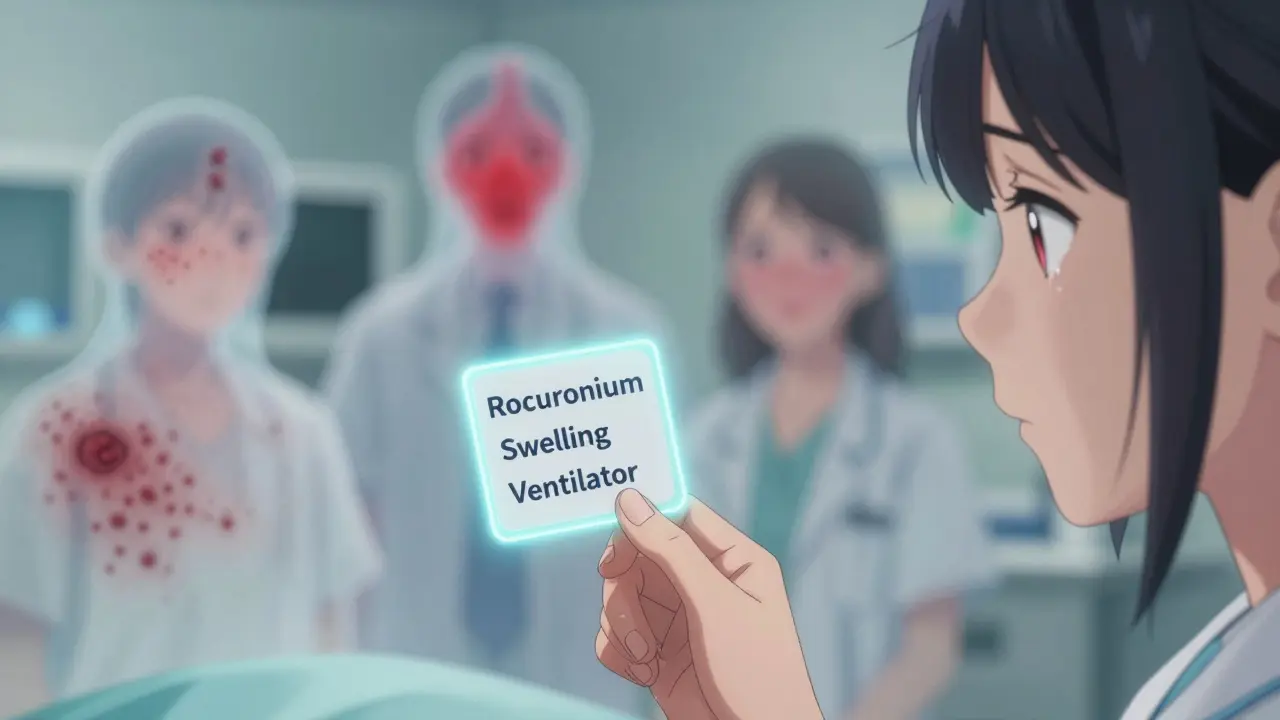
Example: "Five years ago, after a root canal, I got hives and my throat swelled up after they gave me rocuronium. I had to be put on a ventilator. I was in the ICU for two days. I’ve never had another reaction since." That’s the kind of detail that changes everything.
What About Supplements and Herbal Products?
You might think, "I don’t take drugs, just vitamins." But that’s not true. Herbal supplements like St. John’s Wort, ginkgo, garlic, and fish oil can interfere with anesthesia. They can thin your blood, raise your blood pressure, or make you more sensitive to sedatives.One patient came in for knee surgery saying she was fine-until she mentioned she took ginkgo every day for "brain health." The anesthesiologist had to delay the surgery. Why? Ginkgo increases bleeding risk. That’s not a myth. It’s documented in the Journal of Anesthesia, Critical Care & Pain Medicine. Even if you think it’s "natural," it’s still a drug your body reacts to.
When Should You Start Talking?
Don’t wait until the day of surgery. Best practice is to start this conversation at least 72 hours before your procedure. That’s when hospitals like Froedtert and Stanford require a full medication review.Here’s how it usually works:
- You get a call or email from a nurse or pharmacist asking you to list every medication you take-including what you take "as needed." That includes ibuprofen, sleep aids, cough syrup, and even CBD oil.
- You fill out a form. Many hospitals now use digital forms with drop-down menus for common reactions. But don’t rely on the form alone.
- You’ll have a 15-20 minute conversation with a pharmacist or anesthesiologist. They’ll ask follow-up questions. Listen closely. Ask questions too.
- If you’ve had a serious reaction before, they may refer you to an allergist. That’s not a delay-it’s a safety step.
Some patients get frustrated: "Why are you asking me this again? I already told the doctor." But here’s the truth: different people hear different things. A surgeon might hear "allergic to penicillin" and think, "Okay, avoid penicillin." An anesthesiologist needs to know if you’ve ever reacted to any neuromuscular blocker, which could be unrelated to penicillin. That’s why multiple checks matter.
What If You Don’t Remember the Drug Name?
You’re not alone. A 2022 study found 32% of patients couldn’t recall the exact name of the drug they reacted to. That’s okay. You can still help.Bring your pill bottles. Take a photo of your medicine cabinet. Look up your pharmacy records online-most have a history you can download. If you had a hospital stay, call the medical records department. They can send you a summary of what was given.
Even if you can’t name the drug, describe what happened. "It was a shot they gave me before surgery. I felt like I couldn’t breathe. My face turned red. I was scared I was going to die." That’s enough to trigger a red flag.
What About Emergency Surgeries?
This is the hardest part. In emergencies, there’s no time for a full review. That’s why documentation is so critical. If you’ve had a serious reaction before, ask your doctor for an allergy card. It’s a small plastic card you can keep in your wallet or phone case. It should say:- Drug(s) you reacted to
- Reaction details
- Emergency contact
87% of allergists recommend these cards, and 92% of major hospitals now have systems to scan them into electronic records. If you don’t have one, make one now. Use your phone’s Notes app. Write it out. Save it as a photo. Tell a family member where it is.
What Happens If You Don’t Say Anything?
A 2021 case reported to the Anesthesia Patient Safety Foundation involved a patient with a known vancomycin allergy. The hospital didn’t have a clear record. The anesthesiologist gave vancomycin as a pre-op antibiotic. The patient went into anaphylaxis. They survived, but barely. It took 17 minutes of emergency treatment.That patient didn’t lie. They just assumed someone else had documented it. That’s the problem. No one else is reading your mind. If you don’t speak up, no one will know.

What If You’re Nervous or Embarrassed?
Some people hesitate because they’re ashamed. Maybe they used recreational drugs. Maybe they took painkillers without a prescription. Maybe they didn’t tell anyone because they thought it was "no big deal." But here’s the truth: doctors have heard it all. They’ve seen it all. Their job isn’t to judge. It’s to keep you alive. Stanford’s guidelines say: "Framing the conversation around medical safety often encourages honesty." So say it. "I used to take oxycodone for back pain. I had a bad reaction. I don’t take it anymore, but I want you to know." They’ll thank you.What Happens After You Tell Them?
If you’ve had a serious reaction, they’ll:- Flag your chart with an allergy alert
- Ask you to meet with a pharmacist or allergist
- Delay non-urgent surgery if needed
- Use alternative drugs that are safe
- Prepare emergency meds in case of reaction
For example, if you’re allergic to succinylcholine (a muscle relaxant), they’ll use a different one. If you’re allergic to latex, they’ll use latex-free gloves and tubing. These aren’t guesses. They’re standard protocols.
Final Checklist: Before Your Surgery
Do this at least 3 days before your procedure:- Write down every medication you’ve ever taken, including supplements and herbal products
- Write down every reaction you’ve ever had-even if it was "just" nausea
- Call your pharmacy and get a printout of your medication history
- Bring your pill bottles or photos of them to your pre-op appointment
- Ask for an allergy card if you’ve had a serious reaction
- Ask: "Will someone review this with me before I go into surgery?"
That’s it. No fancy words. No complicated forms. Just clear, honest, detailed information. You’re not just a patient. You’re the most important person in the room. Your voice is the first line of defense.
What if I don’t remember the name of the drug I reacted to?
You don’t need to know the exact name. Describe what happened: when it occurred, what symptoms you had, and how you were treated. Bring your pill bottles or pharmacy records. Even vague descriptions can trigger alerts in your medical file. Hospitals have tools to cross-reference symptoms with medications, so your description matters more than the name.
Can I just tell my surgeon and not the anesthesiologist?
No. Surgeons focus on the procedure. Anesthesiologists manage your medications and breathing during surgery. They’re the ones who will give you the drugs you reacted to before. Every hospital now requires a separate review by an anesthesiologist or pharmacist. Don’t assume your surgeon passed the info along. Say it to them both.
Is it safe to stop my regular medications before surgery?
Never stop a medication without talking to your doctor. Some drugs, like blood thinners or heart medications, need to be stopped days ahead of surgery. Others, like insulin or antidepressants, must continue. Your pharmacist or anesthesiologist will give you a clear schedule based on your specific drugs and surgery type.
Do I need to see an allergist before surgery?
If you’ve had a severe reaction-like trouble breathing, swelling, or shock-you should. Allergists can confirm whether it was a true allergy or a side effect. They may do skin tests or blood tests. Most hospitals recommend this within 4-8 weeks after the reaction. Even if your surgery is months away, this step can prevent future risks.
What if I’m having emergency surgery and haven’t told anyone?
Tell the ER staff or nurses as soon as possible. Even saying, "I’ve had a bad reaction to anesthesia before," can help them choose safer drugs. If you have an allergy card, show it. If you don’t, describe the reaction in detail: what drug you think caused it, what symptoms you had, and how you were treated. Emergency teams are trained to act fast on limited info-and your words can guide them.
Next Steps
If you have surgery coming up:- Start gathering your medication history today.
- Call your pharmacy and request a printout.
- Write down every reaction you’ve ever had-even if you think it’s minor.
- Ask your doctor for an allergy card if you’ve had a serious reaction.
- Don’t wait until the day before. Start now.
Your life isn’t a guess. It’s a fact. And the more clearly you communicate it, the safer your surgery will be.




Comments (13)
Bridget Verwey
Okay but let’s be real - most people don’t even remember what they took last Tuesday, let alone that one time in 2013 when they "felt weird" after a dental shot. I had a nurse ask me if I was allergic to anything before my knee surgery. I said "no." Then I remembered I broke out in hives after a tetanus shot. I told her. She looked at me like I’d just confessed to a crime. Then she high-fived me. That’s the kind of moment that saves lives.
Andrew Poulin
Stop overcomplicating this. If you had a reaction tell them. Don’t make it a psychology session. Just say what happened. Simple. Clear. Done. No fluff. No drama. Just facts.
Vikas Verma
It is imperative to acknowledge that preoperative pharmacovigilance constitutes a critical determinant in surgical risk mitigation. The integration of structured patient-reported adverse event histories into electronic health records significantly enhances anesthetic safety protocols. Standardization of terminology across clinical domains remains suboptimal, necessitating interdisciplinary communication frameworks to reduce iatrogenic morbidity.
Sean Callahan
i just had surgery last month and i was so nervous about this whole thing i forgot to tell them about the time i took benadryl and felt like i was floating on a cloud of doom. then after they gave me the anesthetic i was like oh wait oh no no no. they had to pause and check everything. i’m fine now but wow. i’m so sorry. i’m such a dumbass. lol
Ferdinand Aton
Wait - so you’re telling me if I got a rash from ibuprofen 12 years ago, I shouldn’t just say "I’m allergic to painkillers"? What am I supposed to do, write a 10-page essay? And why do I have to tell *three* different people the same thing? This feels like bureaucratic torture.
Jeff Mirisola
I love how this post turns fear into empowerment. You’re not just a patient - you’re a co-pilot in your own survival. That’s powerful. And honestly? The fact that hospitals are now requiring these reviews? That’s progress. I’ve seen too many people get sidelined because they didn’t speak up. Don’t be one of them. Your voice matters. Say it loud.
Ian Kiplagat
Had a reaction to codeine after wisdom teeth removal. Never told anyone. Until now. 🤦♂️
Patrick Jackson
Think about it - our bodies are these fragile, beautiful machines that have memories we don’t even know we have. That time you got dizzy after a shot? That wasn’t just "bad luck." That was your body screaming, "I don’t like this!" And when you’re under anesthesia? You can’t scream. So you have to scream for them. It’s not just medical advice - it’s a sacred act of trust. Your history isn’t baggage. It’s a map. And someone’s life depends on you reading it out loud.
Adebayo Muhammad
Let me be clear: this is all part of a systemic agenda to pathologize normal human physiology. The pharmaceutical industry has spent billions to convince you that every minor side effect is a "life-threatening reaction." They want you terrified. They want you dependent. They want you to hand over your autonomy in exchange for a plastic card. Wake up. Your body is fine. You’re being manipulated.
Pranay Roy
Have you considered that maybe the real danger isn’t the drugs - but the fact that hospitals use digital systems that can be hacked? What if someone alters your allergy record? What if your "allergy card" is scanned wrong and you get the wrong drug? And what if the anesthesiologist is sleep-deprived? This whole system is built on fragile assumptions. I’ve seen the data. It’s not safe. It’s a gamble.
Joe Prism
It’s funny - we’ll spend hours researching the best restaurant or vacation spot, but when it comes to our own body’s survival, we just shrug and say "eh, they’ll figure it out." We outsource our agency. Maybe that’s the real crisis here - not the drugs, but the silence.
Amina Aminkhuslen
Oh honey. You think you’re being brave by saying "I had hives once." No. You’re being a liability. If you’ve ever felt anything weird - even if it was just "a little weird" - you owe it to your future self to write it down in blood, on a neon sign, and scream it into a microphone. If you don’t, you’re not a patient. You’re a ticking bomb.
amber carrillo
Thank you for this. I’m a nurse, and I’ve seen too many patients assume someone else documented their history. It breaks my heart. Please, speak up. You’re not being difficult. You’re being brave. And we’re here to listen - not judge.