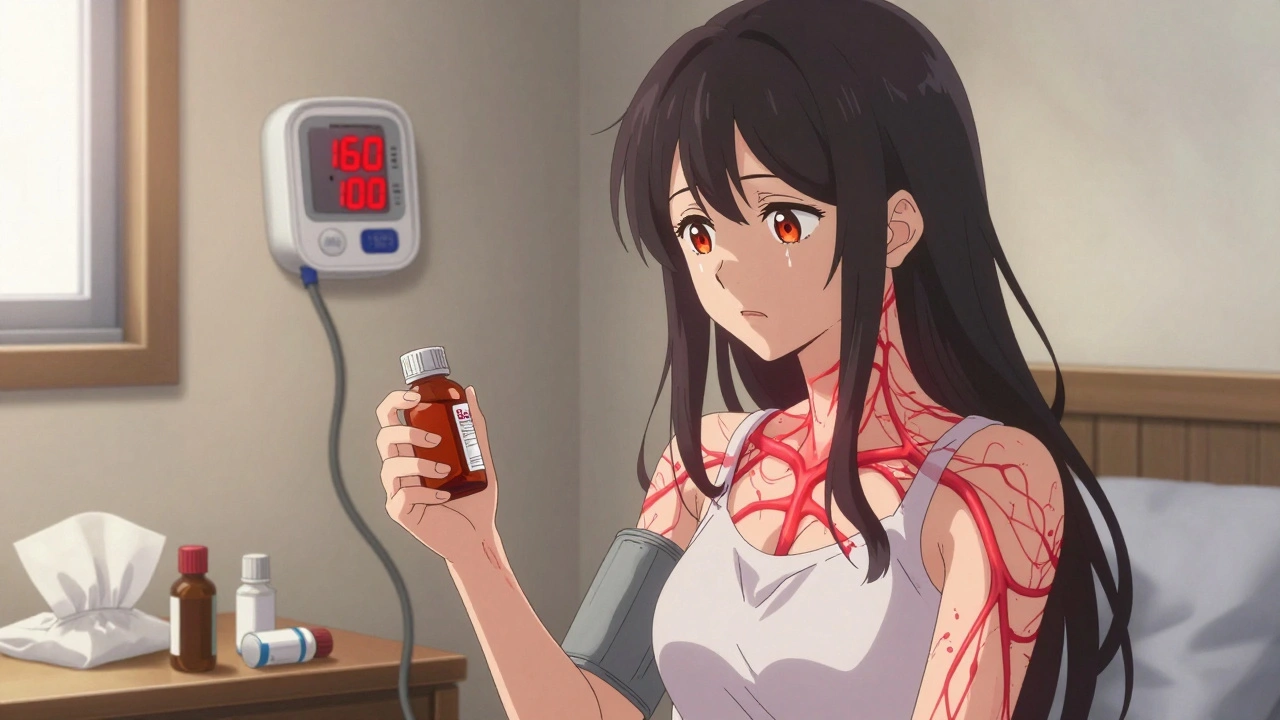
Decongestant Safety Checker
Check if decongestants are safe for you based on your blood pressure status and health conditions.
Many people reach for decongestants when they have a stuffy nose from a cold or allergies. It’s quick, easy, and available over the counter. But if you have high blood pressure, that little bottle of Sudafed or Mucinex Sinus Max could be hiding a serious risk. The truth is, decongestants don’t just clear your sinuses-they can push your blood pressure up, sometimes dangerously so.
How Decongestants Work (And Why That’s a Problem)
Decongestants like pseudoephedrine and phenylephrine work by tightening blood vessels in your nose. That reduces swelling and lets you breathe easier. But here’s the catch: they don’t stop at your nose. These drugs affect blood vessels all over your body. When your arteries narrow, your heart has to pump harder to push blood through. That raises your blood pressure.
It’s not a small change. Studies show that pseudoephedrine can raise systolic blood pressure by 2 to 5 mm Hg on average. For someone with controlled hypertension, that might seem harmless. But for others-especially those with uncontrolled high blood pressure, heart disease, or a history of strokes-it can trigger a spike that leads to heart attack, stroke, or irregular heartbeat. A case study in US Pharmacist documented a 5-year-old child whose blood pressure jumped to 135/80 after just four days of a common phenylephrine cold remedy. Her numbers returned to normal once she stopped taking it.
The Biggest Culprits
Not all decongestants are the same, but the most common ones carry the same risk:
- Pseudoephedrine (Sudafed, Claritin-D, Zyrtec-D)
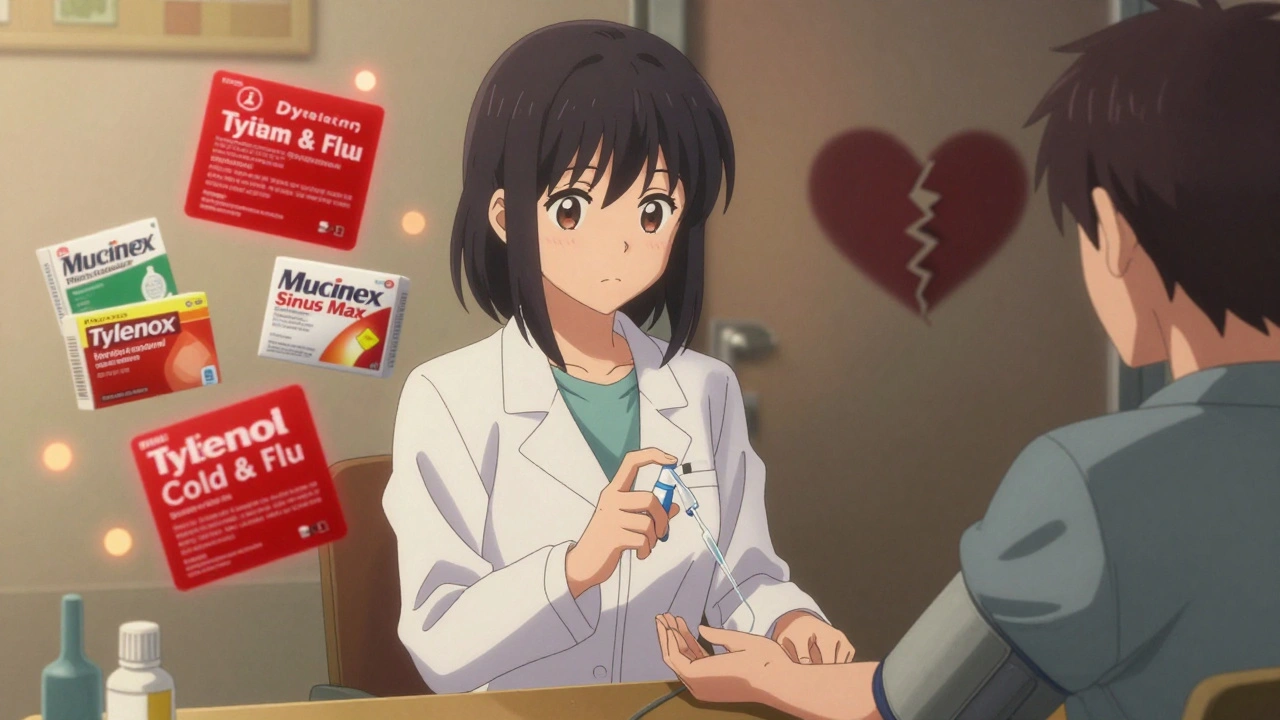
- Phenylephrine (Sudafed PE, Mucinex Sinus Max, Tylenol Cold & Flu)
- Ephedrine (rarely used now, but still in some older formulas)
- Oxymetazoline (Afrin nasal spray)
- Naphazoline (some eye drops and nasal sprays)
Even though phenylephrine replaced pseudoephedrine in many products after 2011, research shows it’s just as risky for blood pressure. The FDA still requires warning labels on all these products, but many people don’t read them. And that’s the problem-most of these ingredients aren’t sold alone. They’re hidden in multi-symptom cold and flu formulas.
Hidden in Plain Sight
You might think you’re just taking a pain reliever or an antihistamine. But look closer. Products like Tylenol Cold and Flu, Advil Multi-Symptom Cold and Flu, Benadryl Allergy Plus Congestion, and Mucinex Sinus Max all contain decongestants. Even some allergy medicines now come in “Plus” versions with pseudoephedrine or phenylephrine.
And it’s not just pills. Liquid cold remedies often contain high levels of sodium as a preservative. For people with heart failure or kidney issues, that extra salt can also raise blood pressure. One study found that a single dose of some liquid cold medicines contained over 200 mg of sodium-almost 10% of the daily limit for people with hypertension.
Who’s at Highest Risk?
Not everyone with high blood pressure will have a bad reaction. But some people are much more vulnerable:
- Those with uncontrolled hypertension (blood pressure consistently above 140/90)
- People with heart disease, including prior heart attacks or angina
- Those with arrhythmias or a history of irregular heartbeat
- Patients with Prinzmetal angina (a rare type caused by artery spasms)
- Anyone taking MAO inhibitors like Nardil or Parnate for depression
- People on tricyclic antidepressants like amitriptyline
Dr. Al-Kindi from Houston Methodist puts it simply: “The caution is for people who have a health issue that affects how well the heart and vascular system are functioning.” If your body is already struggling to manage blood pressure, adding a decongestant is like stepping on the gas while driving uphill.
What the Experts Say
The American Heart Association, Mayo Clinic, and Harvard Medical School all agree: if you have high blood pressure, proceed with extreme caution.
- The AHA says to avoid decongestants entirely if your blood pressure isn’t under control.
- Mayo Clinic advises that even those with well-managed hypertension should talk to their doctor first.
- Harvard Health notes that while most people see only a small rise in pressure, the effect varies widely-and you can’t predict who will react badly.
Pharmacists in the U.S. now keep pseudoephedrine behind the counter. You have to ask for it, show ID, and answer questions. That’s because of the Combat Methamphetamine Epidemic Act of 2005-but it also gives pharmacists a chance to screen for high blood pressure. In New Zealand, while pseudoephedrine is still available without a prescription, pharmacists are trained to ask about heart conditions and blood pressure before selling it.

What You Can Do Instead
You don’t have to suffer through a stuffy nose. There are safer options:
- Saline nasal spray-no drugs, no side effects. Just salt water to flush out mucus.
- Steam inhalation-breathe in warm steam from a bowl or shower. Helps loosen congestion naturally.
- Humidifiers-adding moisture to the air reduces swelling in nasal passages.
- Antihistamines without decongestants-like loratadine (Claritin) or cetirizine (Zyrtec) if allergies are the cause.
- Elevating your head while sleeping can reduce nighttime congestion.
Even these alternatives need caution. Some antihistamines can cause drowsiness, which may interact with other medications. Always check with your doctor or pharmacist before trying something new.
What to Do Right Now
If you have high blood pressure and are currently using a decongestant, here’s what to do:
- Check the label of every cold, flu, or allergy medicine you’re using. Look for pseudoephedrine, phenylephrine, or oxymetazoline.
- Stop using any product with those ingredients until you talk to your doctor.
- Take your blood pressure twice a day for a few days if you’ve recently used a decongestant. Note any spikes.
- Ask your pharmacist to review all your medications-prescription and over-the-counter-to spot hidden risks.
- Keep a list of your medications and conditions handy for every doctor visit.
It’s not just about avoiding one bad pill. It’s about understanding that what’s safe for one person isn’t safe for another. The FDA’s warning labels changed from “Do not use if you have high blood pressure” to “Ask your doctor if you have high blood pressure.” That shift matters. It means the risk isn’t black and white-it’s personal.
Why This Matters More Than You Think
Over 100 million Americans have high blood pressure. In New Zealand, nearly 1 in 3 adults do. And yet, a survey by the American Society of Health-System Pharmacists found that 15% of hypertensive patients still take decongestants, even after being warned. Why? Because they didn’t realize the medicine they bought had a decongestant. Or they thought “it’s just for a few days.” Or they didn’t know their blood pressure was still too high.
These aren’t rare cases. Emergency rooms see patients with sudden strokes or heart attacks after taking a cold medicine they thought was harmless. The truth is, decongestants aren’t the enemy. But they’re not harmless either. They’re powerful drugs with real risks-and if you have high blood pressure, you need to treat them like prescription medication.
The safest choice? Don’t guess. Ask. Check the label. Talk to your pharmacist. Your heart will thank you.
Can I take pseudoephedrine if my blood pressure is controlled?
If your blood pressure is well-controlled and you have no other heart conditions, your doctor may allow a low dose of extended-release pseudoephedrine for a short time. But you must monitor your blood pressure closely-twice daily-and stop immediately if it rises more than 10 points. Never take it without medical approval.
Is phenylephrine safer than pseudoephedrine?
No. While phenylephrine was marketed as a safer alternative, studies show it raises blood pressure just as much as pseudoephedrine. The FDA even questioned its effectiveness as a decongestant, but its cardiovascular risks remain the same. Avoid both if you have high blood pressure.
Can I use Afrin nasal spray if I have high blood pressure?
Oxymetazoline (Afrin) is a nasal spray decongestant that can still be absorbed into your bloodstream. Using it for more than 3 days increases the risk of rebound congestion and elevated blood pressure. It’s not recommended for people with hypertension. Stick to saline sprays instead.
What should I do if I accidentally took a decongestant?
Stop taking the product immediately. Check your blood pressure. If it’s above 160/100, or if you feel chest pain, dizziness, rapid heartbeat, or severe headache, seek medical help right away. Even if you feel fine, mention the exposure to your doctor at your next visit.
Are there any decongestants that are safe for high blood pressure?
As of 2025, there are no decongestants proven safe for people with high blood pressure. Even newer or “natural” formulas may contain hidden stimulants. The only truly safe options are non-medicated methods: saline sprays, steam, humidifiers, and elevating your head while sleeping.
Can I take antihistamines like Zyrtec or Claritin if I have high blood pressure?
Yes, antihistamines like cetirizine (Zyrtec) and loratadine (Claritin) are generally safe for people with high blood pressure-as long as they don’t contain a decongestant. Always check the label for “-D” or “Plus” versions, which include pseudoephedrine or phenylephrine.





Comments (9)
Laura Weemering
Okay, but like… why do we even still have these drugs on the shelf? It’s not like the mechanism is a secret-vasoconstriction is vasoconstriction, and your arteries aren’t some magical portal that only narrows in your nose. We’re just… letting people self-administer cardiovascular risk like it’s a snack? And don’t get me started on the labeling-‘Ask your doctor’? That’s not a warning, that’s a cop-out. We’ve outsourced responsibility to overworked GPs while corporations profit off ignorance. I mean… really?
Levi Cooper
Look, I’m all for caution, but this is why America’s falling apart. You can’t just hand out health advice like it’s a free coupon. People need to take responsibility. If you’re hypertensive, you should know better than to grab random meds off the shelf. This isn’t rocket science. It’s basic self-awareness. Stop blaming the FDA. Stop blaming Big Pharma. Start looking in the mirror.
Audrey Crothers
OMG I’m so glad this was posted!! 😭 I had no idea my ‘Advil Cold & Flu’ had phenylephrine-I’ve been taking it for 3 weeks because of my allergies!! I just checked the bottle and yep… there it is. I’m tossing it right now. Saline spray for life!! 🙌 Also, steam + humidifier = my new BFFs. Seriously, this could’ve been dangerous. Thank you for the heads up!! 💖
Reshma Sinha
As a clinical pharmacist in Mumbai, I see this daily. Patients come in with BP spikes after taking ‘cold cures’ they bought online or from street vendors. Many don’t even know what ‘pseudoephedrine’ means-they just see ‘relieves congestion’ on the box. The real tragedy? The alternatives are cheap, accessible, and safe. Saline rinses cost less than $2. Humidifiers are under $20. Yet we sell fear and convenience. We need better public health literacy-especially in low-resource settings where self-medication is the norm.
Lawrence Armstrong
Just wanted to add: if you're on MAOIs or tricyclics, you're basically playing Russian roulette with decongestants. I’ve seen patients end up in the ER with hypertensive crises over a single tablet. And yeah, phenylephrine? Totally overrated. Studies show it’s barely better than placebo as a decongestant… but still hits BP like a truck. 🚛 Stay away. Saline + steam + sleep. It’s boring, but it works. 🤫💤
Adam Everitt
so like… decongestants = bad for bp right? but what about those ‘natural’ ones? like eucalyptus or something? i heard they’re safer? or is that just hippie nonsense? idk man i just want to breathe
nikki yamashita
This is such a wake-up call! I always thought ‘non-drowsy’ meant ‘safe’-turns out it just means ‘won’t knock you out while raising your BP.’ 😅 I’m switching to saline spray and a neti pot. No more guessing games. My heart says thank you!
wendy b
It is imperative to note that the FDA’s shift in labeling from absolute contraindication to advisory language reflects a broader trend toward paternalistic healthcare governance, wherein corporate liability is minimized through obfuscation of risk. The consumer, therefore, becomes the de facto gatekeeper of pharmacological safety-an untenable paradigm given the documented prevalence of low health literacy among hypertensive populations. One must question the ethical foundations of OTC distribution of vasoactive agents.
Ashley Skipp
Just read the label dumbass