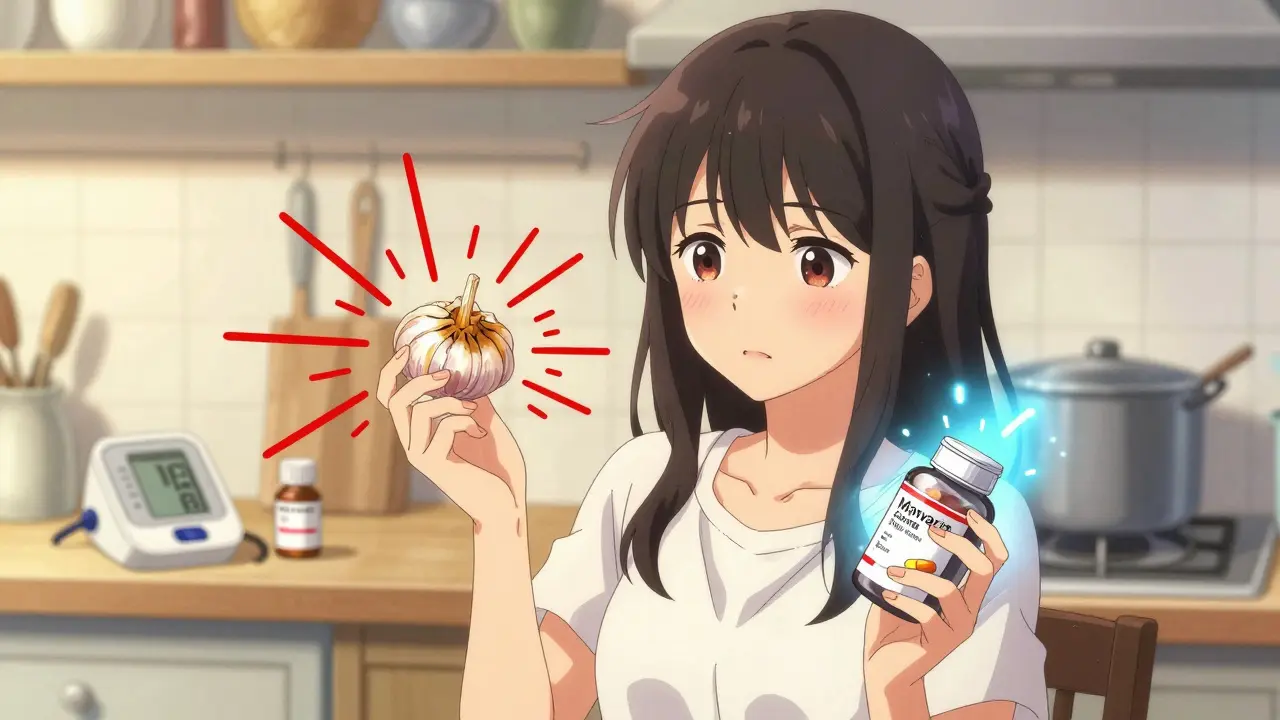
People take garlic supplements hoping to boost immunity, lower blood pressure, or improve heart health. But if you're on a blood thinner like warfarin, apixaban, or aspirin, that daily pill could be putting you at serious risk. Garlic isn't just a flavoring in your stir-fry-it's a potent substance that can interfere with how your blood clots. And unlike a missed dose of medication, this interaction doesn't always show up on routine lab tests until it's too late.
Why Garlic Supplements Are Different from Garlic in Food
Eating one or two cloves of garlic a day in your cooking is generally safe, even if you're on blood thinners. But supplements? That’s a different story. Most garlic supplements contain concentrated extracts-sometimes 600 to 1,200 milligrams per dose-that deliver far more of the active compound, ajoene, than you’d ever get from food. Ajoene is what makes garlic a blood thinner. It sticks to platelets and stops them from clumping together, which is exactly what you don’t want when you're already taking medicine to prevent clots.
Studies show that people taking aged garlic extract (240mg twice daily) had bleeding times that were nearly 50% longer than those not taking it. That’s not a small change-it’s enough to cause problems during surgery or even after a minor injury. The problem isn’t just the dose. It’s the unpredictability. One brand of garlic supplement might have 3.2mg of ajoene per pill. Another might have none at all. And most labels don’t say which.
How Garlic Interacts With Blood Thinners
Garlic doesn’t just add to the effect of anticoagulants-it can make them act unpredictably. With warfarin, the interaction can raise your INR levels, which means your blood takes longer to clot. One study of over 2,300 patients on warfarin found that those who started or stopped garlic supplements needed dose adjustments of 10% to 25% within just a few days. That’s a big swing for a medication where even a 5% change can mean the difference between a clot and a bleed.
With newer blood thinners like apixaban or rivaroxaban, the data isn’t as extensive, but the risk is still real. Case reports describe patients on DOACs who had major bleeding after starting garlic supplements. The mechanism is the same: ajoene blocks platelet function. When you combine that with a drug that already reduces clotting factors, your body loses two layers of protection against bleeding.
It’s not just about the pills you take. Garlic supplements can also interact with other medications you might be on. For example, if you’re taking a statin for cholesterol, garlic can increase the chance of muscle damage. If you’re on blood pressure meds, garlic can push your pressure too low. These aren’t theoretical risks-they’ve been documented in hospital records.
Real Cases: When Garlic Nearly Killed Someone
In 2012, two patients in England went into surgery for colon cancer. Both were healthy. Their blood tests looked normal. They weren’t on any blood thinners. But both had been taking garlic supplements daily for months. During the operation, their capillaries wouldn’t stop oozing blood. Surgeons had to abandon the planned minimally invasive procedure and switch to open surgery. One patient needed a temporary ileostomy just to survive. Neither had any history of bleeding disorders. The only common factor? Garlic supplements.
Another case involved a 72-year-old man on warfarin who took a garlic supplement for “heart health.” He developed a spontaneous brain bleed two weeks later. He didn’t fall. He didn’t hit his head. He just woke up with a headache-and died before reaching the hospital. The autopsy confirmed severe coagulopathy. His INR was off the charts. His family had no idea garlic could do this.
These aren’t rare flukes. Between 2015 and 2022, the National Institutes of Health recorded 37 case reports of serious bleeding linked to garlic supplements and anticoagulants. And that’s just what got reported. Many more likely went unnoticed.

What You Should Do If You’re on Blood Thinners
If you’re taking any kind of anticoagulant or antiplatelet drug, here’s what you need to do:
- Stop taking garlic supplements immediately. This includes capsules, tablets, oils, and extracts. Don’t wait for your next appointment.
- Don’t assume “natural” means safe. Just because it comes from a plant doesn’t mean it won’t interfere with your medicine. Turmeric, ginger, ginkgo, and fish oil are just as risky.
- Talk to your doctor or pharmacist. Bring a list of everything you take-even things you think are harmless. They need to know about the garlic pills you’ve been taking for six months.
- If you’re scheduled for surgery, stop garlic supplements at least seven days before. This isn’t a suggestion. It’s a medical requirement. The effect of ajoene lasts longer than the supplement stays in your system because it permanently changes how platelets work.
- Keep eating garlic in food. One or two cloves a day in your meals won’t raise your bleeding risk. It’s the concentrated doses in pills that are dangerous.
What Doctors Are Doing About It
Hospitals and clinics are changing their protocols because of this risk. At the University of California San Diego, patients on warfarin who take garlic supplements now get their INR checked within 48 to 72 hours after starting or stopping the supplement. Surgeons now require platelet function tests before any elective procedure if a patient admits to using garlic supplements. If the closure time on the PFA-100 test is over 193 seconds, they delay surgery and give platelet transfusions.
Surgeons in the UK now routinely ask patients: “Are you taking any herbal supplements?”-not just “Are you on any medications?” They know the answer matters. In one study of 478 surgeries, patients who stopped garlic supplements 7 days before had bleeding levels similar to those who never took them. Those who stopped within 3 days had triple the blood loss and more than three times the chance of needing a transfusion.
The American Society of Anesthesiologists, the American Heart Association, and the European Medicines Agency all now list garlic supplements as high-risk for bleeding. The FDA has updated warfarin packaging to warn about garlic. But most patients still don’t know.

The Bigger Problem: No Regulation, No Labels
Here’s the worst part: garlic supplements aren’t regulated like drugs. Manufacturers don’t have to prove they contain what they claim. A 2024 analysis of 45 garlic products found that 68% didn’t list ajoene content. Some had none. Others had enough to cause bleeding. You can’t tell by the price, the brand, or the label. You just don’t know.
Even the “standardized” products like Kyolic (aged garlic extract) vary in potency between batches. And clinical trials are still ongoing. One trial (NCT05219843) is testing how Kyolic interacts with apixaban-but results won’t be out until late 2024. Until then, the safest choice is simple: don’t take it.
What to Take Instead
Dr. Pieter Cohen from Harvard says it plainly: “I don’t know of any evidence that taking garlic supplements is better for your heart than eating garlic in food.” If you want the benefits of garlic-antimicrobial, anti-inflammatory, blood pressure-lowering-stick to the kitchen. Roast a head of garlic. Add minced cloves to soups, sauces, or roasted vegetables. You’ll get the good stuff without the risk.
And if you’re looking for heart-healthy supplements, talk to your doctor. Some options, like omega-3s from purified fish oil (not over-the-counter brands), may be safe in controlled doses. But don’t guess. Don’t assume. Ask.
The bottom line: Garlic supplements are not harmless. They’re not “natural medicine.” They’re potent biochemical agents that can interfere with life-saving drugs. And when it comes to blood thinners, the cost of a mistake isn’t just a headache-it’s internal bleeding, surgery, or death.





Comments (14)
Bryan Coleman
I took garlic pills for a year thinking they'd help my blood pressure. Turns out my INR was creeping up and my doc didn't catch it until I bruised like a grape. Never again. Just eat the garlic. 🤦♂️
Sami Sahil
Bro this is legit life saving info! I was about to start garlic caps for 'heart health' lol. Now I'm just chopping garlic in my curry and chillin. Thanks for the wake up call! 🙌
franklin hillary
Garlic supplements are not medicine they're a scam wrapped in a herbal label and sold to people who think natural means safe. The FDA doesn't regulate them because they don't want to admit that the supplement industry is a casino where the house always wins. You're not boosting immunity you're gambling with your clotting factors. And the worst part? You'll never know until you're bleeding out on an operating table because some guy in a warehouse in China dumped ajoene powder into a capsule and called it 'premium aged extract.' Wake up people.
Bob Cohen
Wow so you're saying the same thing that's in my garlic bread could kill me if I take it in pill form? That's wild. I mean I get it but also... why does this feel like a plot twist in a medical thriller? Like someone wrote this as fiction and then reality caught up. Anyway I'm done with the pills. Pass the roasted garlic.
Ishmael brown
They're hiding this on purpose. Big Pharma doesn't want you to know you can replace warfarin with garlic. 🤫💊
Aditya Gupta
Bro just stop the pills. Eat garlic. Simple. No drama. 🤙
Nancy Nino
It is truly astonishing how many individuals continue to place their trust in unregulated, unverified, and unstandardized botanical extracts-despite overwhelming clinical evidence to the contrary. This is not merely negligence; it is a systemic failure of public health literacy.
Jaden Green
Of course the people who take garlic supplements are the same ones who think 'detox teas' work and believe that if it's in a bottle with a picture of a leaf, it must be science. I mean, really-do you also swallow activated charcoal for 'digestive clarity'? At what point do we stop pretending that 'natural' is synonymous with 'therapeutic' and start treating our bodies like complex biological systems instead of garden compost piles?
Angel Fitzpatrick
This isn't about garlic. This is about the FDA's collusion with the supplement industry. They're letting companies sell concentrated ajoene because they're part of the same revolving door as Big Pharma. The real danger? They're testing this on us while they patent synthetic clot inhibitors. Wake up. The pills are the Trojan horse. The garlic? The distraction. The real enemy? The patent system.
Nidhi Rajpara
Thank you for this comprehensive and meticulously researched article. I have personally witnessed a patient on rivaroxaban experience a gastrointestinal hemorrhage after initiating a garlic supplement regimen, and it was entirely preventable. I urge all clinicians to incorporate structured herbal supplement screening into routine intake protocols.
Chris & Kara Cutler
OMG I just stopped my garlic pills!! 🙏❤️
Donna Macaranas
I’ve been eating roasted garlic with my veggies for years and never thought twice. This just confirmed I’m doing it right. No pills, just flavor. Simple.
Rachel Liew
My mom took garlic pills after her bypass and nearly bled out during a dental cleaning. She didn’t even know it could do that. Thank you for sharing this. I’m printing it out for her.
Nicki Aries
Let me be perfectly clear: if you are on any anticoagulant-warfarin, apixaban, rivaroxaban, aspirin, clopidogrel, or even low-dose baby aspirin-and you are consuming any form of garlic supplement-capsule, oil, extract, powder, or tincture-you are engaging in a potentially lethal form of self-experimentation. This is not a suggestion. This is not a recommendation. This is a medical emergency waiting to happen. Please, for the love of all that is holy, stop.