When you pick up a generic pill at the pharmacy, you probably don’t think about the fragile, high-stakes system that got it there. But behind every $0.10 tablet lies a supply chain stretched thin by price wars, global dependencies, and razor-thin profits. In 2023, the average EBITA margin for generic drug distributors was just 8%. That’s less than the profit margin on a cup of coffee. And yet, this industry must deliver over 90% of all prescriptions in the U.S. - reliably, safely, and at rock-bottom prices.
The Affordability Paradox
Generic drugs are supposed to be cheaper. That’s the whole point. But the race to the bottom has created a dangerous trade-off: the lower the price, the more likely the drug will disappear from shelves. According to Drug Patent Watch, generics priced below $5 per unit face a 73% higher risk of shortage than those priced above $10. Why? Because manufacturers can’t afford to keep backup factories, extra inventory, or multiple suppliers. When one plant in India or China shuts down for maintenance, or a shipment gets delayed by weather or politics, there’s no backup. And when that happens, patients go without.Eighty percent of the world’s active pharmaceutical ingredients (APIs) - the actual medicine in the pill - come from just three countries: China, India, and the U.S. That’s not diversity. That’s a single point of failure. And with profit margins so tight, companies have no room to build redundancy. The system works… until it doesn’t.
What Efficiency Really Means in Generic Distribution
Efficiency here isn’t about speed. It’s about doing more with almost nothing. Top performers don’t just cut costs - they rethink how they move, store, and predict demand. The most successful distributors use a model called the Efficient Chain Model: high-volume, low-variability, standardized processes. Think of it like a freight train - big, steady, and optimized for bulk movement. They avoid customization. They don’t chase niche drugs. They focus on the top 200 generics that make up 80% of volume.Take Teva Pharmaceutical. After a $28 million overhaul in 2021-2022, they cut inventory carrying costs by 32%. How? They stopped guessing. They started using the Economic Order Quantity (EOQ) formula: Q = √(2KD/G). That’s math, not magic. K = ordering cost, D = annual demand, G = holding cost per unit. Plug in real data, and you get the exact number of pills to order each time - not too much, not too little. Leading companies using this method reduced stockouts by 30-45%.
Technology Is the Only Way Out
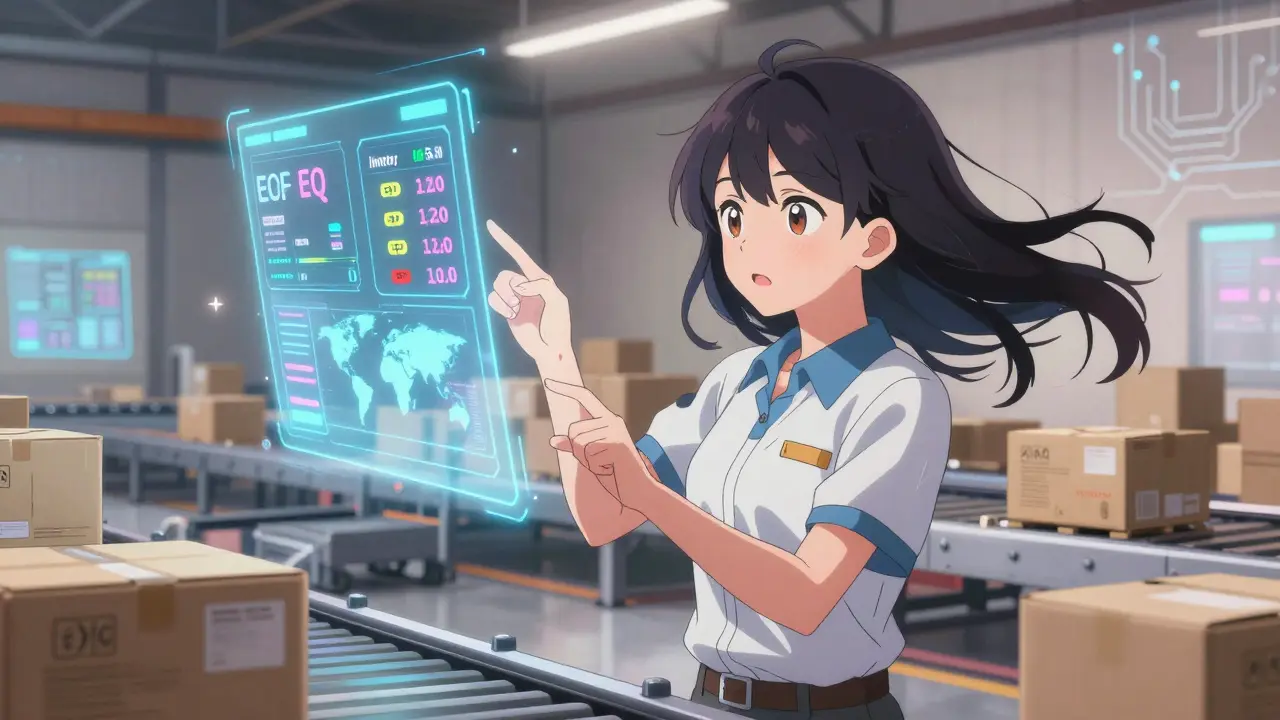
You can’t manage a $441 billion industry with spreadsheets and phone calls. The winners use cloud-based ERP systems that give real-time visibility from factory to pharmacy. IoT sensors track temperature and humidity during transport - critical because 45% of generics need climate control. If a shipment of insulin or antibiotics gets too hot, it’s ruined. And with margins this thin, losing a pallet means losing money you can’t afford to lose.AI-powered forecasting is the game-changer. Traditional models looked at last year’s sales. That’s like driving blindfolded. Modern tools analyze hospital admission trends, insurance claims, doctor prescribing patterns, and even social media chatter about drug shortages. One distributor, McKesson, rolled out their AI platform ‘DemandSignal’ in 2023 and cut forecast errors by 37%. That’s not a nice-to-have. That’s survival.
But tech isn’t cheap. Implementing a full system costs $2.5-4 million for mid-sized distributors. And integration with old systems? That adds 6-9 months to the timeline. Many smaller players just can’t afford it. That’s why the gap between leaders and laggards is widening. Top quartile distributors now hit 9.2% EBITA margins. Bottom quartile? 6.8%. That’s not a difference. That’s a chasm.

Just-in-Time vs. Just-in-Case
There’s a fierce debate in the industry: should you keep extra stock or not? Just-in-Time (JIT) means ordering only what you need, when you need it. It slashes storage costs by 22-35%. But it also raises stockout risk by 15-20% during disruptions. Just-in-Case (JIC) keeps buffers - 15-25% extra inventory. That costs more to hold, but cuts stockouts by 40-60%.Here’s the truth: the safest distributors use both. They apply JIT to low-risk, high-volume drugs. For critical meds - like antibiotics, blood pressure pills, or seizure medications - they keep JIC buffers. A 2023 Supply Chain Dive survey found that 68% of distributors who eliminated all safety stock suffered severe shortages within a year. The lesson? Don’t cut buffers where it hurts patients.
Metrics That Actually Matter
Forget vanity metrics like “number of deliveries.” Real efficiency is measured in three ways:- Overall Equipment Effectiveness (OEE) - Availability × Performance × Quality. Top performers hit 85%+. Industry average? 68-72%.
- Perfect Order Percentage - The percentage of orders delivered on time, complete, undamaged, and correctly documented. Leaders hit 95%+. Most hover around 80%.
- Customer Order Cycle Time - How long from order to delivery. Top distributors do it in under 24 hours. Others take 72+.
These aren’t KPIs for a PowerPoint. They’re survival metrics. If your perfect order rate drops below 90%, pharmacies start looking for another supplier. And in a market where three companies - McKesson, AmerisourceBergen, and Cardinal Health - control 85% of U.S. distribution, you don’t get a second chance.

The Hidden Cost of Compliance
Regulations aren’t just paperwork. They’re expensive. The FDA’s Drug Supply Chain Security Act (DSCSA) requires full electronic traceability of every pill from manufacturer to patient. By 2023, every distributor had to comply. That added 5-8% to operational costs. The EU’s Falsified Medicines Directive did the same, adding 6-10% more.Blockchain systems could help verify authenticity, but they cost $2.5-4 million to implement. Most small distributors can’t justify it. So they rely on manual checks and paper trails - slower, riskier, and more prone to error. The result? A two-tier system: big players with tech, small players with stress.
Who’s Winning - and Why
Cardinal Health invested $150 million in predictive analytics in 2022. Result? A 3.2% market share gain in one year. Teva’s efficiency push cut inventory costs by a third. These aren’t flukes. They’re strategy.Meanwhile, distributors clinging to legacy systems are losing. Their inventory turnover is 8.3x per year. The best? 12.7x. That means they turn their stock over 50% faster. More sales. Less waste. Higher margins.
Leaders aren’t just cheaper. They’re more reliable. And in healthcare, reliability is worth more than price.
What’s Next? The Digital Twin Revolution
By 2027, top distributors will run digital twins of their entire supply chain - virtual copies that simulate every movement, delay, and disruption before it happens. These models will predict demand with 95%+ accuracy and cut inventory costs by half - while keeping service levels above 99%.But that future belongs only to those who act now. The MIT Center for Transportation and Logistics says distributors who don’t hit 85% OEE and 95% perfect order rates by 2025 will lose 15-20% of their market share. And with average margins at 8%, there’s no room for error.
The era of guessing is over. The era of data is here. And in generic drug distribution, efficiency isn’t a goal. It’s the only thing keeping the system alive.
Why are generic drug shortages getting worse even though prices are lower?
Lower prices mean thinner profit margins, which forces manufacturers to cut costs everywhere - including backup factories, safety stock, and multiple suppliers. With 80% of active ingredients made in just three countries, any disruption - like a factory shutdown, shipping delay, or political issue - can cause a nationwide shortage. The system works fine until it doesn’t, and there’s no cushion left to absorb the shock.
What’s the Economic Order Quantity (EOQ) formula and why does it matter?
EOQ = √(2KD/G), where K is ordering cost, D is annual demand, and G is holding cost per unit. It calculates the ideal order size that minimizes total inventory costs. Leading generic distributors use this to avoid overstocking (which ties up cash) and understocking (which causes shortages). Companies using EOQ reduced stockouts by 30-45% and cut inventory costs by 22-35%.
Is just-in-time inventory safe for generic drugs?
It’s risky for critical medications. Just-in-time works well for high-volume, low-risk drugs like metformin or lisinopril. But for life-saving drugs like epinephrine or insulin, distributors need a 15-25% safety buffer. A 2023 survey found that 68% of distributors who eliminated all safety stock suffered severe shortages within a year. The smart approach is hybrid: JIT for volume, JIC for critical needs.
How do AI and IoT improve generic drug distribution?
AI predicts demand by analyzing hospital data, insurance claims, and prescribing trends - cutting forecast errors by 25-40%. IoT sensors track temperature, humidity, and location during transport, ensuring 45% of climate-sensitive generics stay safe. Together, they reduce waste, prevent spoilage, and ensure drugs arrive on time and in condition. McKesson’s AI platform reduced forecast errors by 37% in pilot tests.
Why are small distributors falling behind in supply chain efficiency?
Advanced systems - cloud ERP, AI forecasting, IoT sensors - cost $2.5 million or more to implement. Small distributors lack the capital, IT staff, and scale to justify the investment. Meanwhile, big players like McKesson and Cardinal Health are gaining market share by using tech to offer better service and reliability. The result? A growing divide where only the largest can afford to be efficient.
What’s the biggest operational mistake generic distributors make?
Relying on historical sales data alone to forecast demand. That’s like using last year’s weather to plan for next summer. Generic demand spikes unpredictably - due to outbreaks, policy changes, or doctor recommendations. Distributors using only old data have 30-50% higher forecast errors. The fix? Combine historical data with real-time signals like hospital admissions, insurance claims, and social trends.
Will regulation make generic distribution more expensive?
Yes - and that’s the point. FDA’s DSCSA and EU’s Falsified Medicines Directive require full electronic traceability of every drug package. That adds 5-10% to operational costs. But it’s not just a cost - it’s a safety net. It prevents counterfeit drugs from entering the supply chain. For distributors, compliance isn’t optional. It’s the new baseline.




Comments (12)
Phil Maxwell
Been watching this space for years. The real tragedy isn't the margins-it's that the system works until it doesn't, and then it's moms and grandpas skipping doses. No one talks about the human cost when the math says 'cut inventory.'
Just saw a friend's insulin go out of stock last month. No warning. No backup. Just a pharmacy clerk shrugging.
We treat medicine like widgets. It's not.
Amelia Williams
Okay but have y’all seen how wild it is that we’re relying on ONE country for 40% of our meds?? Like, imagine if your Wi-Fi router only worked if one tiny factory in China didn’t have a power outage. That’s our healthcare system.
And the EOQ formula? Mind blown. I thought supply chain was just ‘order more when we’re low.’ Turns out it’s calculus with pills. 🤯
Also-AI predicting demand from social media? That’s either genius or terrifying. Probably both.
Viola Li
Oh wow, so the solution is to make the rich even richer by letting them buy tech while the rest of us die waiting for lisinopril? Classic. You call this ‘efficiency’? I call it capitalism with a stethoscope.
Let me guess-next they’ll patent the EOQ formula and charge pharmacies for access.
Also, ‘digital twins’? Sounds like a sci-fi movie where robots deliver your blood pressure pills while your kid cries because the insulin ran out.
venkatesh karumanchi
As someone from India, I see this every day. Factories here run 24/7 making pills for the world, but workers get paid peanuts. No safety nets. No overtime. No voice.
And when a plant shuts down? We get blamed. But who’s really responsible? The US companies that demand $0.05 per pill and call it ‘affordable.’
Efficiency? Or exploitation dressed up as economics?
Vatsal Patel
Let me get this straight-you’re impressed that a company used high school math to stop over-ordering? Wow. Groundbreaking.
Meanwhile, real innovation would be making drugs profitable without turning patients into balance sheets.
But nah. Let’s keep pretending this is a math problem and not a moral one.
Also, ‘digital twin’? Sounds like a startup pitch deck written by someone who thinks blockchain fixes everything.
lol
Kat Peterson
OMG I’m literally crying rn 😭
This post is SO deep. Like, I just realized-my grandma’s blood pressure meds are basically a blockchain-powered miracle. I feel seen.
Also, EOQ? I had to Google it. But now I’m obsessed. It’s like… the universe’s way of saying ‘stop guessing, start calculating.’
Also, who’s the author?? I need to follow them. This is peak intellectual energy. 💫
Himanshu Singh
Bro, the real hero here isn’t the AI or the ERP-it’s the warehouse worker in New Jersey who stays late because he knows a diabetic patient is waiting.
Technology helps, sure. But the system runs on people who show up even when the profit margin is thinner than a pill coating.
Let’s not forget them.
Also, if you’re a small distributor reading this-you’re not behind. You’re just fighting with a rock in your shoe. Keep going. 🙏
Izzy Hadala
While the empirical evidence presented is compelling, it is imperative to contextualize the operational metrics within the broader macroeconomic framework of pharmaceutical pricing regulation. The 8% EBITA margin is not an outcome of market inefficiency per se, but rather a direct consequence of Medicare reimbursement structures and the absence of price controls on active pharmaceutical ingredients.
Furthermore, the assertion that technological adoption is the primary determinant of competitive advantage overlooks the role of regulatory arbitrage and international labor cost differentials, particularly in jurisdictions with minimal environmental and labor compliance burdens.
One must also consider the ethical implications of algorithmic demand forecasting when applied to life-sustaining therapeutics, as predictive models may inadvertently deprioritize low-volume, high-necessity medications in favor of higher-margin commodities.
Marlon Mentolaroc
Let’s be real-this isn’t about efficiency. It’s about who gets to live and who gets to wait.
McKesson’s AI cut forecast errors by 37%? Cool. But what about the 37% of patients who still couldn’t get their meds?
And don’t even get me started on ‘just-in-time’ for insulin. That’s not logistics. That’s Russian roulette with a prescription.
Also, 80% of APIs from China and India? Bro, we’re one pandemic away from a national health emergency. And we’re all just sipping coffee while it happens.
Gina Beard
Efficiency is just a fancy word for ‘we don’t care if you die.’
siva lingam
so we spent 1000 words on math and tech and still no one fixed the real problem
lol
Karen Conlin
As a nurse who’s seen patients skip doses because their $0.10 pill vanished from the shelf, I can tell you-this isn’t abstract. This is someone’s grandpa missing his heart meds because a factory in Gujarat had a monsoon delay.
And yes, EOQ and AI help. But real change? It’s policy. It’s funding small distributors. It’s requiring buffer stock for critical meds. It’s not letting profit margins dictate life or death.
And to the folks in India and China-thank you. You’re keeping the world alive. But you deserve better than being the invisible backbone of a system that treats you as disposable.
We need to stop calling this ‘efficiency.’ We need to call it what it is: a moral failure dressed in spreadsheets.
Let’s fix the system, not just the math.