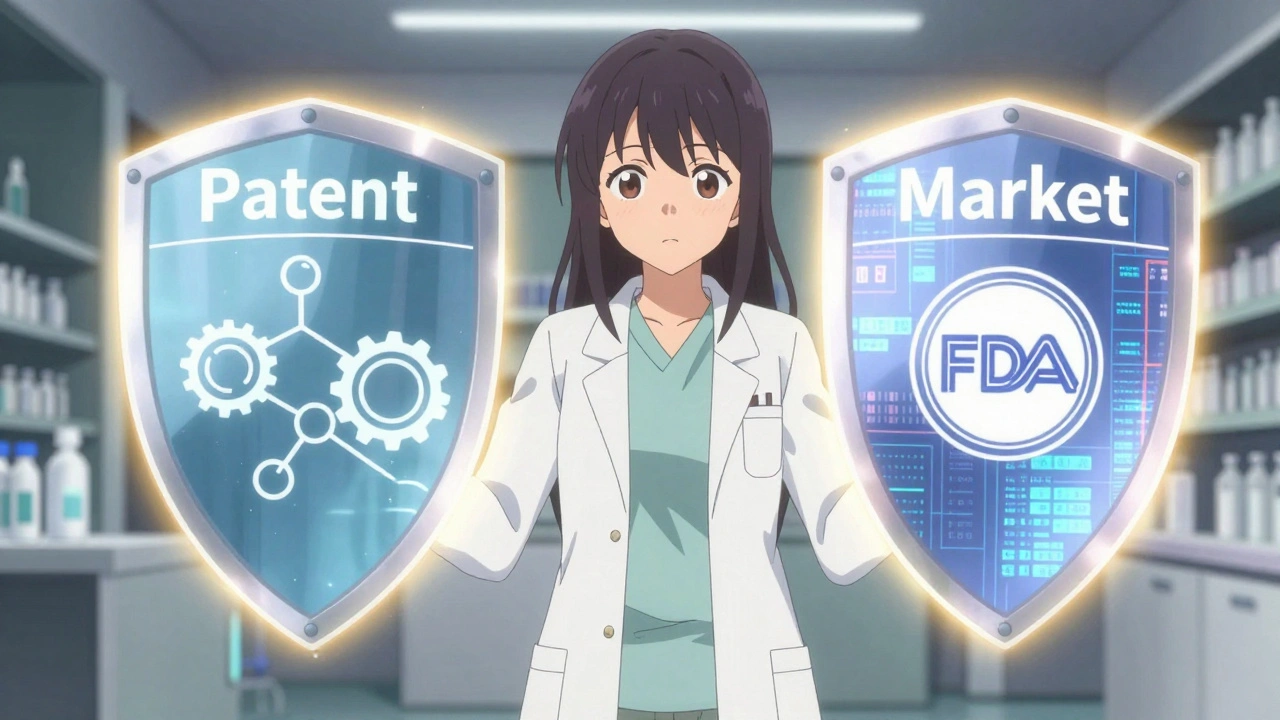
When a new drug hits the market, it doesn’t just have a patent. It has patent exclusivity and market exclusivity-two different kinds of legal shields that keep generics off shelves. Many people think they’re the same thing. They’re not. And confusing them can cost companies millions-or even delay life-saving treatments.
Patent Exclusivity: The Legal Right to Block Copies
Patent exclusivity comes from the United States Patent and Trademark Office (USPTO) the federal agency that grants patents for inventions, including pharmaceutical compounds. If you invent a new chemical compound, a new way to make it, or a new use for an old one, you can file for a patent. Once granted, you get the right to stop anyone else from making, selling, or using your invention for 20 years-from the day you filed the application.
But here’s the catch: that 20-year clock starts ticking long before the drug even reaches patients. The average drug takes 10 to 15 years to go from lab to pharmacy. That means by the time the FDA approves it, you might only have 5 to 10 years left on your patent. That’s not enough to recoup the $2.3 billion it typically costs to develop a new drug.
That’s why the law lets you extend your patent. If the FDA took too long to review your application, you can get a Patent Term Extension (PTE) a legal extension of patent life to compensate for regulatory review delays, capped at 5 years, with no more than 14 years of market exclusivity after approval. You can also get Patent Term Adjustment (PTA) compensation for delays caused by the USPTO during patent examination if the patent office dragged its feet. But even with extensions, your patent still only protects the invention-not the drug’s market.
Market Exclusivity: The FDA’s Gatekeeper Power
Market exclusivity is entirely different. It’s not about inventions. It’s about data. And it’s granted by the Food and Drug Administration (FDA) the U.S. government agency responsible for approving drugs and enforcing regulatory exclusivity periods, not the patent office.
When a company submits a New Drug Application (NDA), it includes years of clinical trial data proving the drug is safe and effective. The FDA doesn’t let other companies copy that data to get their own drugs approved. That’s market exclusivity. It’s automatic-if you meet the rules.
There are several types:
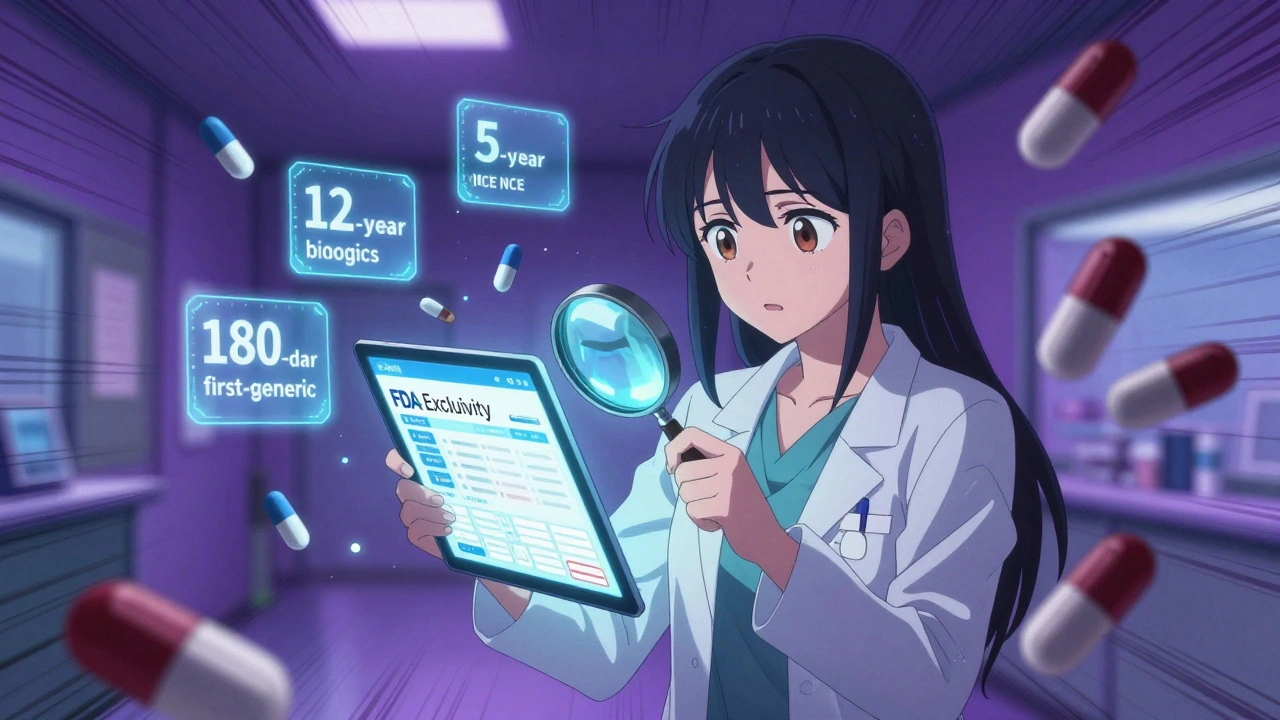
- New Chemical Entity (NCE) exclusivity: 5 years. During this time, the FDA won’t even accept an application from a generic maker. Even if your patent expired, they can’t get approved until this period ends.
- Orphan drug exclusivity: 7 years. For drugs treating rare diseases (under 200,000 patients in the U.S.). This one doesn’t care if there’s a patent. It’s a standalone shield.
- Pediatric exclusivity: +6 months. If you do extra studies on kids, the FDA adds six months to whatever exclusivity you already have-patent or regulatory.
- Biologics exclusivity: 12 years. For complex drugs made from living cells, like insulin or cancer antibodies. This was created by the Biologics Price Competition and Innovation Act (BPCIA) 2009 law that established a pathway for biosimilar drugs and granted 12 years of market exclusivity in 2009.
- 180-day exclusivity: For the first generic company that successfully challenges a patent. They get a head start on the market before other generics can enter.
Unlike patents, you don’t need to prove your drug is new. You just need to show you did the studies. That’s why a drug like colchicine an ancient remedy for gout, originally sold for pennies, received 10 years of market exclusivity in 2010 after a company submitted new clinical data-a drug used since the time of the Egyptians-got its price jumped from 10 cents to $5 a pill.
How They Work Together (or Don’t)
Patent and market exclusivity don’t always overlap. Sometimes they do. Sometimes they don’t. And that’s where things get messy.
Here’s how the FDA breaks it down based on 2021 data:
- 27.8% of drugs have both patent and regulatory exclusivity
- 38.4% have only patents
- 5.2% have only market exclusivity
- 28.6% have neither
That last group? They’re usually older drugs that never got patents, or the patents expired long ago. But even if a drug has no patent left, market exclusivity can still block generics. That’s why 78% of drugs with exclusivity but no patent still had no generic competition, according to the Congressional Research Service.
And here’s the kicker: patents protect inventions. Market exclusivity protects products. You can have a patent on a drug’s chemical structure, but if you don’t get market exclusivity, a competitor can copy your data and get approved the day your patent expires. But if you have market exclusivity, even if your patent is dead, the FDA won’t approve anyone else’s version until that clock runs out.
Why This Matters for Patients and Companies
This isn’t just legal jargon. It affects how much you pay for medicine.
Branded drugs make up only 12% of prescriptions but bring in 68% of total drug revenue-mostly because of these protections. The first year after launch? That’s when a drug earns 65% of its entire lifetime revenue, according to Evaluate Pharma.
For big pharma, it’s a game of timing. They file patents early. They apply for every exclusivity they can. They even make small changes to the drug-new dosage, new pill shape, new combination-to trigger new exclusivity periods. This is called “evergreening,” and it’s legal. But critics say it delays competition.
For generic makers, it’s a minefield. They have to check the FDA’s Orange Book the official list of approved drugs and their associated patents, maintained by the FDA for patents. They have to track exclusivity dates. And if they want to challenge a patent, they file a Paragraph IV certification. That costs, on average, $8.3 million per case. And if they win, they get 180 days of exclusive market access-worth $100 million to $500 million in extra revenue.
Small biotech firms often get burned. A 2022 survey found 43% of them mistakenly thought patent protection meant they had market exclusivity. One company spent $1.7 million developing a drug, only to realize they never applied for orphan drug exclusivity-and lost their window to block competitors.
What’s Changing in 2025?
The rules are shifting. The FDA launched its new Exclusivity Dashboard a public tool launched in September 2023 that shows real-time status of all regulatory exclusivity periods for approved drugs in September 2023. Now, anyone can see exactly when exclusivity ends on any drug. That’s good for transparency. It’s also good for generic companies looking for their next target.
And Congress is talking about change. The PREVAIL Act of 2023 proposed legislation to reduce biologics exclusivity from 12 to 10 years while strengthening data protection wants to cut biologics exclusivity from 12 years to 10. The World Trade Organization is also debating whether to extend vaccine patent waivers to other drugs.
By 2027, McKinsey predicts regulatory exclusivity will account for 52% of total market protection time for new drugs-up from 41% in 2020. Why? Because patents are getting weaker. Courts are striking down secondary patents. So companies are relying more on exclusivity to keep generics out.
What You Need to Remember
Patent exclusivity = invention protection. It’s about what you invented. It’s enforced in court.
Market exclusivity = data protection. It’s about what you proved. It’s enforced by the FDA.
One can expire and the other can still be active. One doesn’t guarantee the other. And if you’re a patient, a pharmacist, or a generic manufacturer, you need to know which one is standing in your way.
Don’t assume a drug is generic-ready just because the patent expired. Check the FDA’s exclusivity status. That’s the real gatekeeper.
Frequently Asked Questions
Can a drug have market exclusivity without a patent?
Yes. Market exclusivity is granted by the FDA based on the data submitted for approval, not on whether a patent exists. For example, orphan drugs or reformulated versions of old drugs can get 7 or 5 years of exclusivity even if no patent covers them. The 2010 colchicine case is a prime example-no patent, but 10 years of exclusivity.
Does patent extension mean longer market protection?
Not always. Patent Term Extension (PTE) can add up to 5 years to a patent, but the total market exclusivity after FDA approval can’t exceed 14 years. So if a drug was approved 12 years after the patent was filed, and you get a 2-year extension, your patent might last longer, but you still can’t block generics beyond 14 years after approval.
Why do some drugs have 180-day exclusivity?
The first generic company to successfully challenge a listed patent gets 180 days of exclusivity. This is meant to incentivize generic manufacturers to take legal risks. During that time, no other generic can enter-even if the patent is expired or invalid. It’s a big financial prize, often worth hundreds of millions in sales.
Can the FDA deny exclusivity even if the rules are met?
Rarely, but yes. The FDA can deny exclusivity if the applicant didn’t submit the required clinical data, if the drug was approved based on fraudulent information, or if the exclusivity claim was filed incorrectly. About 12% of exclusivity determinations require correction due to incomplete paperwork.
How do I check if a drug still has exclusivity?
Use the FDA’s Exclusivity Dashboard, launched in September 2023. It shows all active exclusivity periods for approved drugs. You can search by drug name or active ingredient. The Orange Book lists patents, but the Exclusivity Dashboard shows the FDA’s regulatory protections-what actually blocks generics.



Comments (12)
मनोज कुमार
Patent vs market exclusivity? Patent is legal fiction market exclusivity is FDA’s real power. No data no approval. Simple.
Paul Keller
Let’s be clear-this isn’t just regulatory nuance, it’s corporate strategy disguised as innovation. Companies file patents the moment they synthesize a molecule, then spend the next decade lobbying for every possible exclusivity extension. The 12-year biologics shield? That’s not science, it’s a financial engineering play. And don’t get me started on evergreening-changing the pill color and calling it a ‘new formulation’ just to reset the clock. Patients pay the price while shareholders celebrate. The system is rigged to maximize profit, not public health.
dave nevogt
It’s fascinating how we’ve built an entire economic architecture around the idea that life-saving drugs must be locked behind legal barriers to be worth anything. We treat medical innovation like a private commodity rather than a public good. The 20-year patent clock starting before clinical trials even begin feels like a cruel joke-like giving someone a head start in a race they’re already running blindfolded. And yet, without these protections, would we have any new drugs at all? Or are we just rationalizing a broken system with legal jargon? Maybe the real question isn’t how to extend exclusivity, but whether we should be building a system where exclusivity isn’t necessary in the first place.
Arun kumar
man i always thought patent = monopoly on drug but nooo its more like patent = right to say u invented it market exclusivity = FDA says u did the work so no one else can copy ur data till 5-12 years. colchicine thing blew my mind. ancient drug gets 10yrs exclusivity just cuz someone did new trials. capitalism is wild.
Zed theMartian
Oh please. You’re all acting like this is some revolutionary revelation. The FDA’s exclusivity regime is a state-sanctioned cartel. The 180-day generic window? That’s not incentive-it’s a bribe to turn generic manufacturers into corporate hitmen who litigate against their own potential customers. And the biologics exclusivity? Twelve years? In a world where CRISPR can edit genes, we’re still letting corporations lock down protein therapies for over a decade? This isn’t innovation-it’s feudalism with a FDA stamp.
Ella van Rij
soo... i read all this and still dont know if my insulin is gonna cost $500 or $1000 next month? lol. also typo in ‘bipologics’ 😅
ATUL BHARDWAJ
India knows this well. We make generics but still wait for exclusivity to expire. FDA rules affect global access. Patents are US. Exclusivity is global.
Steve World Shopping
Most of you are missing the point. This isn’t about fairness-it’s about ROI. The cost of R&D is not a myth. The 2.3B number? Real. If you don’t protect returns, innovation dies. You want cheap drugs? Then fund public research. Stop expecting private firms to be charities. This system works. It’s not perfect, but it’s the only one that delivers new drugs.
Rebecca M.
OMG I just realized my antidepressant has orphan drug exclusivity? So it’s not just me who’s suffering-it’s the whole system that’s gaslighting me into paying $800 for a pill that’s basically sugar with a fancy label? 😭
Lynn Steiner
THIS IS WHY I CAN’T AFFORD MY MEDS. 🤬 I work 3 jobs and still pay $1200/month for my autoimmune drug. They’re not protecting innovation-they’re protecting greed. And the FDA? Just the bank’s bouncer. I’m so done.
Alicia Marks
Good breakdown. For anyone confused-think of patent as the recipe, market exclusivity as the kitchen being locked for a while. Both matter. Check the FDA dashboard before assuming a drug’s generic-ready.
Shannara Jenkins
Thank you for writing this. So many people think ‘patent expired = generics available’ and get burned. The Exclusivity Dashboard is a game-changer-use it. If you’re a patient, a pharmacist, or just someone who hates surprise bills-know your rights. This stuff matters more than you think.