Generic drugs make up roughly 90% of all prescriptions filled in the United States. When you pick up a medication at your local pharmacy, it is highly likely to be a generic version of a brand-name drug. But how do we know these cheaper alternatives are just as safe and effective? The answer lies in a complex web of regulations, inspections, and scientific testing managed by the U.S. Food and Drug Administration (FDA). This system isn't perfect, but it is rigorous. Understanding how the FDA oversees generic drug manufacturing helps explain why these medications are trusted by millions of patients every day.
What is the legal basis for generic drug approval?
The foundation is the Hatch-Waxman Act, formally known as the Drug Price Competition and Patent Term Restoration Act of 1984. This law created the Abbreviated New Drug Application (ANDA) pathway. Instead of requiring new clinical trials, manufacturers must prove their drug is bioequivalent to an existing brand-name drug, known as the Reference Listed Drug (RLD).
The Foundation: Hatch-Waxman and Bioequivalence
To understand the oversight, you first need to understand the shortcut. Brand-name drugs go through years of expensive clinical trials to prove they work and are safe. Generic manufacturers don't repeat this entire process. That would be redundant and prohibitively expensive. Instead, they rely on the FDA’s prior determination that the original drug is safe and effective.
Under the Hatch-Waxman Amendments, a generic manufacturer submits an ANDA. The core requirement is Bioequivalence, which means the generic drug must deliver the same amount of active ingredient into a patient's bloodstream within the same timeframe as the brand-name version. The FDA requires the generic to fall within a strict range of 90% to 110% compared to the reference drug. If it meets this standard, the FDA assumes it will have the same therapeutic effect and safety profile.
This doesn't mean generics are "close enough." It means they are pharmaceutical equivalents. They must match the brand name in dose, strength, route of administration, safety, and intended use. The Center for Drug Evaluation and Research (CDER), specifically the Office of Generic Drugs (OGD), handles these reviews. Established in 1989, OGD acts as the central hub, coordinating with other offices to ensure quality before a single pill hits the market.
Pre-Approval: The Manufacturing Inspection Process
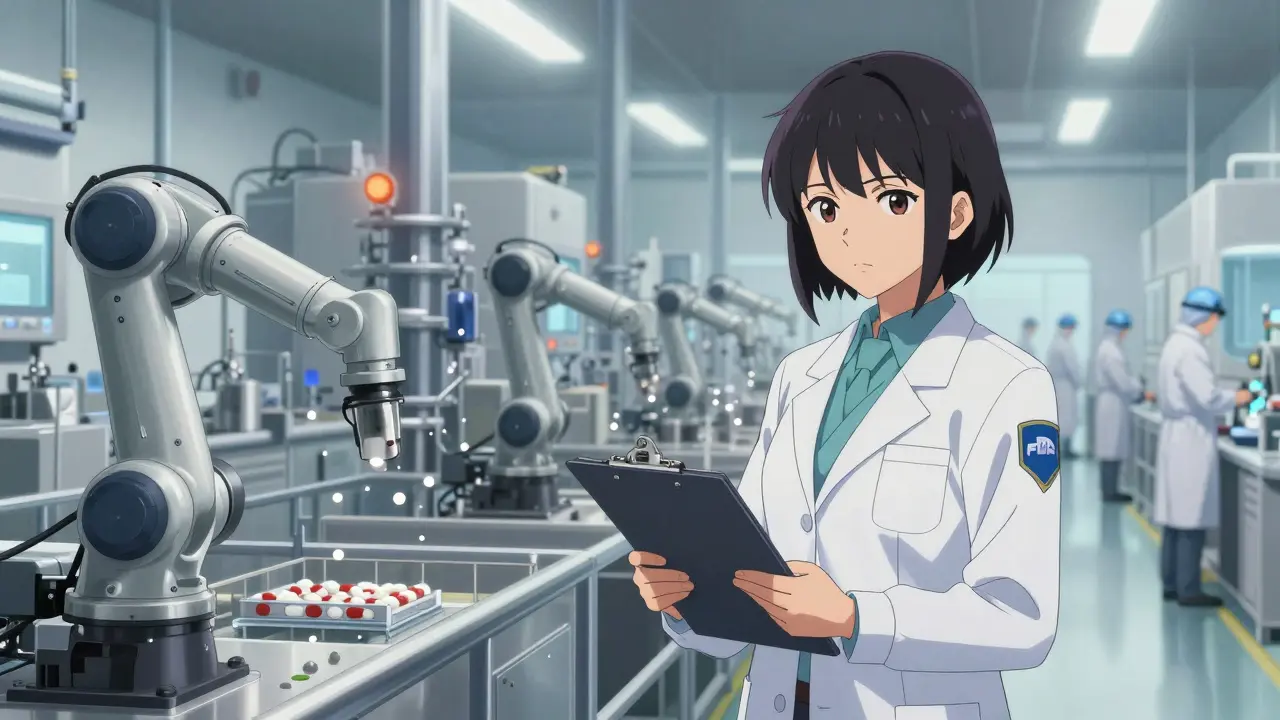
Proving bioequivalence in a lab is only half the battle. The FDA needs to ensure that every batch produced in a factory maintains that quality. This is where manufacturing oversight comes in. Before approving an ANDA, the FDA typically inspects the facility where the drug will be made.
These inspections check for compliance with Current Good Manufacturing Practices (cGMP). cGMP rules cover everything from the cleanliness of the facility to the training of the workers. Manufacturers must implement three critical control systems:
- Material Control: Strict tracking of raw materials from receipt to storage to prevent contamination or mix-ups.
- Process Control: Written procedures for every step of production, monitoring critical parameters like temperature and mixing time.
- Quality Testing: Rigorous laboratory testing of raw materials, in-process samples, and finished products using validated methods.
If a facility fails to meet these standards, the FDA can refuse to approve the drug application. In fact, the FDA has tightened its "refuse to receive" criteria since 2016. If an application lacks basic information or shows obvious deficiencies, it won't even enter the review queue. This saves time for both the agency and the manufacturer.
GDUFA: Funding Better Oversight
Historically, the FDA struggled with resources. Review times for generic applications averaged around 30 months. Inspections were often delayed, especially for foreign facilities. To fix this, Congress passed the Generic Drug User Fee Amendments (GDUFA) in 2012.
GDUFA allowed the FDA to collect fees from generic drug manufacturers to fund additional staff and modernize review processes. The results have been significant. Since 2012, the FDA has increased its application review capacity by 75%. Today, 95% of standard original ANDAs are reviewed within 10 months. GDUFA III, implemented in October 2022, commits $1.1 billion in user fees through 2027. This funding specifically targets enhanced foreign inspection capabilities and real-time data monitoring.
| Metric | Pre-GDUFA (Before 2012) | Post-GDUFA (Recent Years) |
|---|---|---|
| Average Review Time | ~30 months | 10 months (for 95% of apps) |
| Foreign Inspection Rate | Lagging behind domestic | 74% met performance goals (2021) |
| Review Capacity | Baseline | Increased by 75% |
Global Challenges: Foreign Facility Inspections
A major challenge for the FDA is that many generic drugs and their active pharmaceutical ingredients (APIs) are manufactured abroad. In 2019, the FDA identified quality issues in 15% of foreign generic drug facilities inspected, compared to 8% of domestic ones. This gap highlights the difficulty of overseeing global supply chains.
To address this, the FDA has shifted toward a risk-based inspection scheduling system. Facilities with higher compliance risks are prioritized. Commissioner Robert Califf stated in 2023 that enhancing oversight of foreign manufacturing remains a top priority. The goal is to increase annual foreign inspections to 1,500 by 2025. This involves not just physical visits but also leveraging international partnerships and remote monitoring technologies where possible.
Post-Market Surveillance: Catching Issues Early
Oversight doesn't stop after approval. The FDA continuously monitors approved generic drugs throughout their lifecycle. This post-market surveillance. This includes tracking adverse events reported through MedWatch, which processes about 1.3 million reports annually. The Division of Clinical Safety and Surveillance (DCSS) analyzes these reports to detect any unexpected safety signals.
If a problem arises, such as a contamination issue or unexpected side effects, the FDA can take action. This might involve voluntary product recalls, updating labeling, or issuing Dear Healthcare Provider Letters to alert doctors and pharmacists. The Drug Safety Oversight Board (DSB), mandated by the FDA Amendments Act of 2007, provides independent advice on handling emerging safety issues across all drug categories, including generics.
Supply Chain Security and Tracking
Beyond safety and efficacy, the FDA ensures the integrity of the supply chain. The Drug Supply Chain Security Act (DSCSA), fully implemented between 2015 and 2023, requires electronic tracking of prescription drugs. This system helps prevent counterfeit or tampered drugs from entering the market. Manufacturers, wholesalers, and pharmacies must exchange transaction information to verify the legitimacy of each product.
This layer of security complements the traditional quality controls. Even if a drug is perfectly made, it must reach the patient without being compromised. The combination of cGMP enforcement, bioequivalence testing, and supply chain tracking creates a multi-layered defense against unsafe medications.
Cost vs. Quality: The Economic Reality
Why does this matter to you? Cost. Generic drugs save the U.S. healthcare system approximately $313 billion annually. Bringing a generic to market costs between $1 million and $5 million, compared to over $2.6 billion for a brand-name drug. However, this lower cost doesn't come at the expense of quality. The regulatory hurdles remain substantial. Manufacturers face complete response letters if their data is insufficient, forcing them to redo studies or improve processes.
The FDA’s strategy is clear: maintain high scientific standards while streamlining administrative processes. By focusing on bioequivalence and manufacturing quality rather than duplicative clinical trials, the agency ensures access to affordable medicines without compromising patient safety. As long as the FDA continues to invest in inspections and modernize its review tools, the promise of generic drugs-safe, effective, and affordable-will remain intact.
Are generic drugs exactly the same as brand-name drugs?
They are pharmaceutical equivalents, meaning they have the same active ingredient, dose, strength, and route of administration. They may differ in inactive ingredients like fillers or dyes, which generally do not affect performance. The FDA requires them to be bioequivalent, ensuring they work the same way in the body.
How does the FDA inspect foreign manufacturing facilities?
The FDA conducts on-site inspections of foreign facilities, though historically there have been delays. Under GDUFA III, the agency is increasing its capacity for foreign inspections. They use a risk-based approach to prioritize facilities with higher compliance risks and are exploring remote monitoring technologies to supplement physical visits.
What happens if a generic drug fails safety checks?
If pre-approval checks fail, the FDA can reject the application or issue a complete response letter requiring more data. Post-approval, if safety issues arise, the FDA can mandate recalls, update labels, or issue warnings to healthcare providers. The Drug Safety Oversight Board helps guide these decisions.
What is bioequivalence?
Bioequivalence is a measure of the rate and extent to which the active ingredient in a generic drug becomes available at the site of drug action. The FDA requires generic drugs to demonstrate that their bioavailability falls within 90-110% of the reference brand-name drug, ensuring comparable therapeutic effects.
How much do generic drugs save the healthcare system?
According to the Association for Accessible Medicines, generic drugs save the U.S. healthcare system approximately $313 billion annually. They account for 90% of prescriptions dispensed but only 23% of total drug expenditures.


Comments (15)
Anthony Padilla
so the whole point is that they dont do new clinical trials? thats kinda wild to think about when you consider how much money goes into testing brand names. i guess bioequivalence is the key here but it feels like a huge shortcut if you ask me. also the typo in my head was supposed to be 'kinda' not 'kinda' lol.
Elizabeth Fandry
One must ponder the philosophical implications of regulatory capture within the pharmaceutical industrial complex 🧐. The notion that a mere statistical range of 90-110% constitutes therapeutic equivalence is, quite frankly, an affront to the rigorous scientific method one would expect from such esteemed institutions. It suggests a commodification of health where profit margins inevitably supersede the nuanced biological realities of individual patients. We are essentially gambling with our physiological integrity under the guise of economic efficiency 📉. The Hatch-Waxman Act, while ostensibly designed for accessibility, appears to have created a loophole large enough to drive a hearse through. One wonders if the FDA’s oversight is truly independent or merely a rubber stamp for corporate interests seeking to maximize shareholder value at the expense of public trust. This is not merely a matter of policy; it is a crisis of ethics disguised as bureaucratic procedure. The elitist perspective demands we question whether 'good enough' is ever truly acceptable when human life hangs in the balance ⚖️.
Madeline Petes
i mean its actually pretty cool that they can save so much money without skimping on safety too much! the gdufa funding seems like a solid move to keep things moving faster. im just glad we have options now instead of paying hundreds for name brands that work the exact same way. lets hope the foreign inspections stay tight tho!
Ramanath Rao
You people in the US are naive if you think this system is perfect. In India, we manufacture some of the best generics in the world and yet your FDA treats our facilities with suspicion while ignoring local quality standards that are often superior. The bias against foreign manufacturing is evident in the inspection failure rates cited. You claim risk-based scheduling but it looks more like geopolitical posturing. Wake up and realize that global supply chains are interdependent and your arrogance will eventually backfire.
irine sabrina
I appreciate the detailed breakdown of the GDUFA impact! It is wonderful to see how user fees have streamlined the process, reducing review times significantly. However, I worry about the stress this might put on smaller manufacturers who may struggle with the compliance costs. We should celebrate the progress while ensuring inclusivity for all players in the market. Let us remain hopeful that transparency will continue to improve patient outcomes globally. Your insights are very helpful in understanding these complex mechanisms. Thank you for sharing this information with such clarity and care.
Gary Helminiak
As someone who has worked in pharma QA for over fifteen years, I can tell you that the cGMP requirements are no joke. They cover everything from the HVAC systems in the clean rooms to the calibration logs of every single piece of analytical equipment used in testing. When the FDA says they check material control, they mean they trace every kilogram of active pharmaceutical ingredient back to its source lot number. If there is any deviation in temperature during storage or mixing, the entire batch is quarantined and investigated. This level of scrutiny is why generic drugs are safe. The bioequivalence studies are statistically robust and designed to detect even minor differences in absorption rates. So yes, they are cheaper, but the cost savings come from skipping redundant clinical trials, not from cutting corners on manufacturing quality. Trust the science. 🧪💊
dane thorp
The distinction between pre-approval inspections and post-market surveillance is critical here. Many people conflate the two, but they serve different purposes. Pre-approval ensures the facility is capable of producing compliant product consistently. Post-market surveillance catches rare adverse events that might not appear in smaller BE study populations. Both are necessary layers of defense. Ignoring either creates vulnerability.
Michael Schurmann
It is amusing how everyone blindly trusts the FDA. The agency is understaffed and overwhelmed. They inspect foreign facilities rarely, if at all, due to budget constraints and logistical nightmares. Meanwhile, domestic plants get preferential treatment. The whole system is a facade maintained by industry lobbying. Don't believe the propaganda about 'rigorous oversight.' It is a free-for-all where the highest bidder gets their drugs approved fastest. Typical American hypocrisy.
Christina Mitchell
There is a certain beauty in the efficiency of the Hatch-Waxman framework. It balances innovation with access, allowing society to benefit from both new discoveries and affordable treatments. While critics focus on the gaps, one must acknowledge the monumental success of making healthcare sustainable. The cultural shift towards accepting generics has saved billions, which can be redirected to other societal needs. Perhaps we should view this not as a compromise, but as a pragmatic evolution of medical ethics. The dialogue around safety is healthy, but let us not lose sight of the collective good achieved.
Christopher Laver
Boring read. Just take the pill and stop worrying.
Russell Russell
We need to empower ourselves with knowledge rather than fear. Understanding the regulatory landscape helps us make informed decisions. The FDA's role is pivotal, but citizens must also advocate for better resources and transparency. Let us motivate each other to engage with these issues constructively. Change happens when we educate ourselves and demand accountability. Stay curious and stay proactive.
Naresh Chandra
It is truly heartening to see the emphasis on patient safety!!! The MedWatch program allows ordinary citizens to contribute to this vast database of safety signals!!! Every report matters!!! It shows that the system is responsive to real-world experiences!!! We must encourage everyone to report side effects!!! It is a collaborative effort!!!
Cyburg Adeoye
From a pharmacovigilance standpoint, the integration of DSCSA tracking with traditional cGMP enforcement represents a paradigm shift in supply chain integrity. The electronic interoperability required by the Drug Supply Chain Security Act ensures end-to-end visibility, mitigating risks associated with counterfeit infiltration. Furthermore, the utilization of risk-based scheduling algorithms for foreign inspections optimizes resource allocation, targeting high-probability non-compliance vectors. This strategic alignment enhances overall ecosystem resilience. We must recognize the synergistic effect of these regulatory frameworks in safeguarding public health infrastructure. It is imperative that stakeholders embrace these technological advancements to maintain trust in the generic drug marketplace.
Joseph Teichman
the key is consistency. if the factory follows the rules the drug is fine. simple as that. dont overthink it.
Angela Niculescu
Actually, the 90-110% rule is arbitrary and scientifically flawed. Bioequivalence does not account for individual metabolic variations or long-term cumulative effects of inactive ingredients. The assumption that therapeutic effect is identical ignores the complexity of human physiology. Generic drugs are not equivalent; they are approximations. The FDA is selling us a lie wrapped in statistics. Wake up.