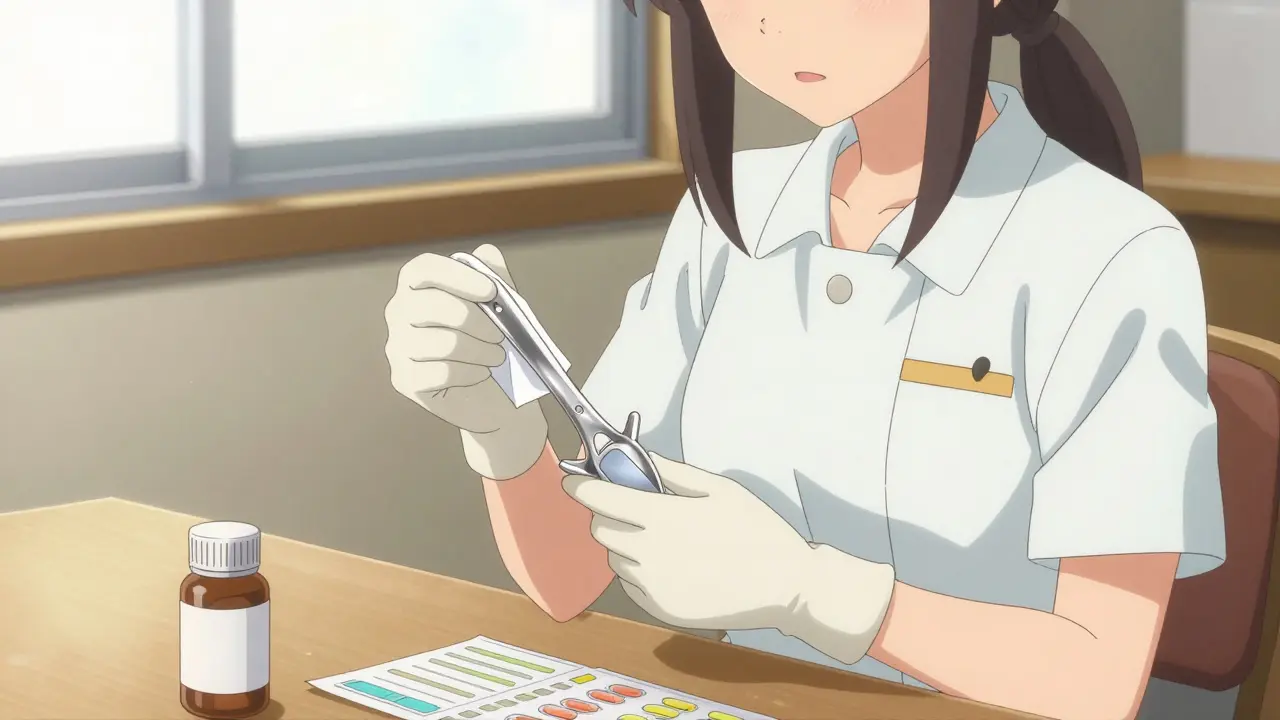
Splitting or crushing pills might seem like a simple fix-maybe you’re trying to save money, make it easier to swallow, or adjust a dose. But if you do it wrong, you’re not just risking an ineffective dose. You could be exposing yourself or someone else to dangerous contamination. This isn’t just a theory. Real people have gotten sick because of it. In one case in 2023, 14 residents in a care home were accidentally exposed to warfarin from a shared pill splitter that wasn’t cleaned between uses. That’s not rare. It happens more often than you think.
Why Contamination Matters More Than You Think
When you split or crush a pill, you’re not just breaking a tablet. You’re releasing its active ingredients into the air, onto surfaces, or into other medications. Some pills contain powerful drugs-like chemotherapy agents, blood thinners, or hormones-that can be harmful even in tiny amounts. A single particle of cyclophosphamide, a common cancer drug, can be toxic if inhaled or absorbed through the skin. Studies have found levels of these drugs on gloves and countertops after improper crushing, sometimes exceeding safety limits set by OSHA. The problem gets worse when you reuse equipment. A pill splitter used for one medication, then another without cleaning, can transfer residue. That’s called cross-contamination. And it doesn’t just happen in hospitals. Home caregivers, family members helping elderly relatives, and even patients doing it themselves are at risk. A 2023 survey found that 41.7% of home caregivers didn’t know cross-contamination was even a possibility.Which Pills Should Never Be Split or Crushed
Not all pills are made the same. Some are designed to release medicine slowly over hours. Others have a protective coating to prevent stomach irritation or ensure the drug is absorbed in the right part of the gut. Crushing or splitting these destroys that design. Here’s what you should never touch:- Enteric-coated pills - These have a shiny outer layer that prevents them from dissolving in the stomach. Examples: enteric-coated aspirin, omeprazole.
- Sustained-release or extended-release tablets - These are marked with SR, ER, XL, or XR. Crushing them releases the full dose at once, which can be deadly. Think: metformin ER, oxycodone ER.
- Capsules - Even if they look like pills, don’t open them unless your pharmacist says it’s safe.
- Hazardous drugs (HDs) - These include chemotherapy agents, immunosuppressants, and some hormone therapies. NIOSH lists over 200 of these. Crushing them can aerosolize toxic particles.
The Right Tools for the Job
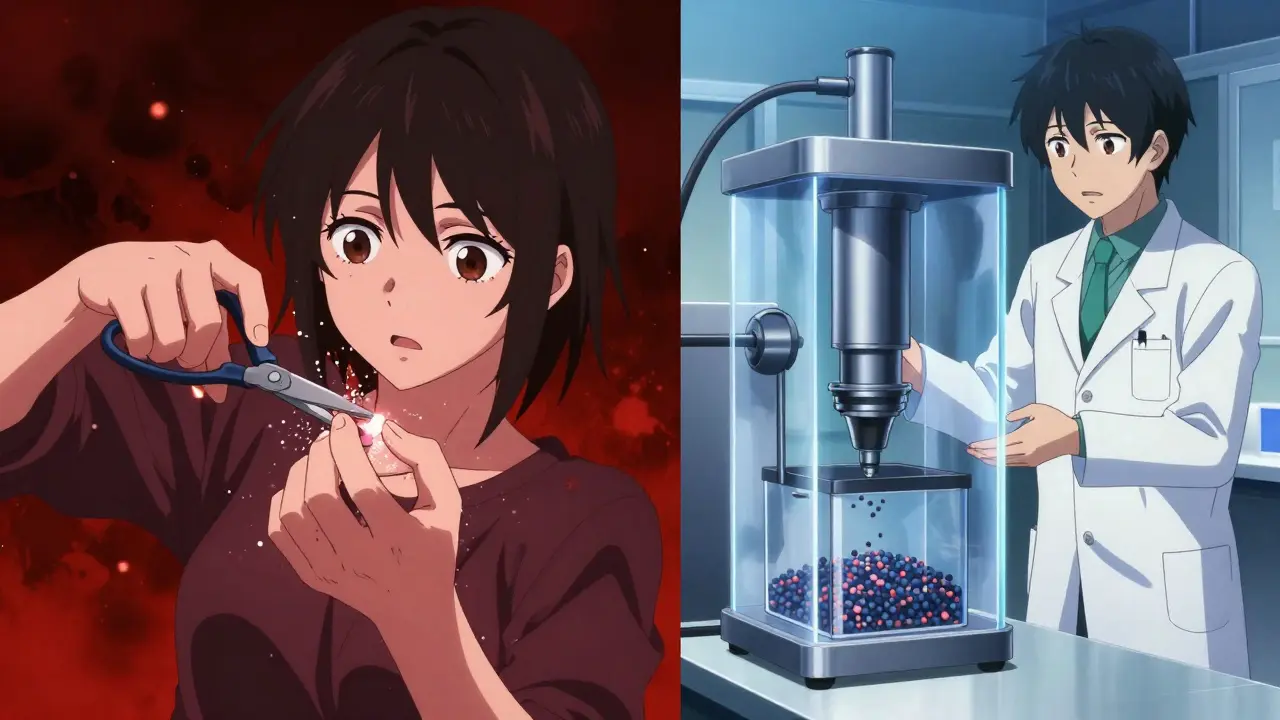
Using a knife, scissors, or your fingers to split a pill is dangerous. It’s messy, inaccurate, and spreads contamination. The only safe way is with a proper pill splitter or closed-system crusher. Pill splitters should have:- A stainless steel blade with a 0.05mm tolerance for even cuts
- A v-shaped holder to keep the pill steady
- A retractable blade to reduce exposure
Step-by-Step: How to Split or Crush Safely
Follow these steps every single time. No shortcuts.- Wash your hands thoroughly with soap and water. Then put on disposable nitrile gloves.
- Check the medication label. Look for "DO NOT SPLIT" or "DO NOT CRUSH." If it’s not clear, call your pharmacist.
- Use only one pill at a time. Never pre-split a week’s supply. Splitting changes how the drug breaks down. Storing split pills can make them less effective or unstable.
- Clean your equipment with a 70% isopropyl alcohol wipe before and after each use. Don’t just rinse it. Wipe it down. Let it air dry.
- Use a dedicated splitter for each person if possible. If you share equipment, clean it between every single medication-even if they’re for the same person.
- Administer immediately. Don’t store split or crushed pills. Use them right away.
- Dispose of gloves and wipes in a sealed bag. Don’t toss them in the regular trash if you’ve handled hazardous drugs.
What Happens If You Skip These Steps
Skipping cleaning or using the wrong tool isn’t just careless-it’s dangerous. - A 2021 study found that splitting pills with scissors resulted in dose variability of up to 36%. That means one half could have 120% of the dose, the other half only 40%. That’s enough to cause a heart attack or overdose. - In a 2019 study, healthcare workers handling crushed cyclophosphamide without proper equipment had detectable levels of the drug on their gloves-4.7 nanograms per square centimeter. That’s above the safety threshold. - Shared splitters in care homes led to 14 residents in one facility getting unintended warfarin exposure. One had a major bleed. Others needed emergency treatment. These aren’t hypotheticals. They’re documented cases.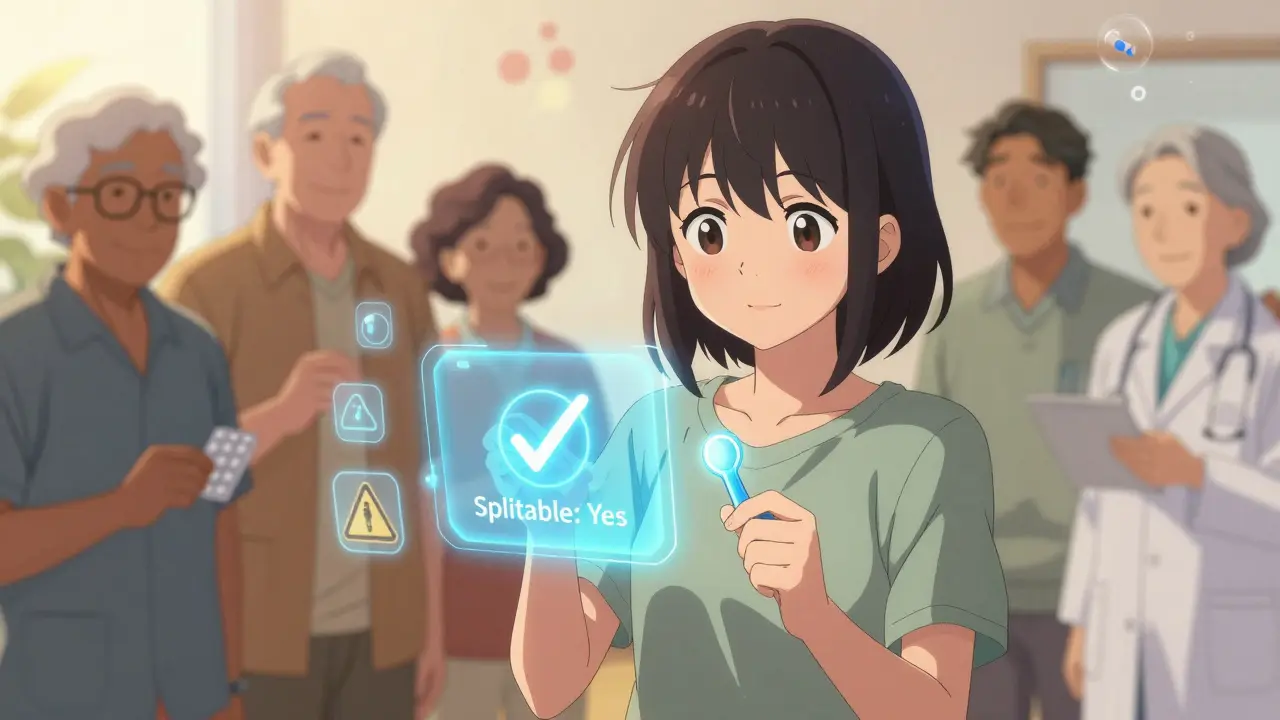
Who’s Responsible? Pharmacies, Caregivers, and You
Pharmacies are required to flag "DO NOT SPLIT" in electronic records. But if you’re taking a pill home, you’re the last line of defense. Don’t assume the label is enough. Ask questions. - If your doctor prescribes a split dose, ask: "Is this pill safe to split?" and "Do I need a special tool?" - If you’re helping someone else, ask the pharmacist for a demonstration. A 2022 study in JAMA Internal Medicine showed that when pharmacists educated Medicare patients on proper splitting, errors dropped by 58.3%. That’s huge. And if you’re in a care home or facility: push for dedicated splitters for each resident. The cost is low. The risk of not doing it? Life-threatening.What’s Changing in 2025 and Beyond
The FDA is now requiring all scored tablets to be tested and labeled for splitability by the end of 2026. That means clearer labels: "Splitable: Yes/No," with instructions on how. New smart splitters are also coming out-devices like Med-Engage’s FDA-cleared model that verify the dose before splitting and alert you if the pill isn’t meant to be cut. Early trials show they reduce errors by nearly half. But until those are everywhere, you still need to do it right.When in Doubt, Don’t Do It
If you’re unsure whether a pill can be split or crushed, don’t guess. Call your pharmacist. Bring the bottle. Show them the pill. Ask: "Is this safe to split? What’s the safest way?" Most pharmacies will give you a free pill splitter if you need one. Some even offer training. Remember: you’re not saving money if you end up in the hospital. You’re not helping someone if you accidentally poison them. The right tool, the right technique, and the right mindset make all the difference.Medication safety isn’t about being perfect. It’s about being careful. Every time.
Can I split a pill with a knife or scissors?
No. Knives and scissors are unsafe for splitting pills. They don’t cut evenly, which leads to uneven doses. They also spread medication residue, increasing contamination risk. Always use a dedicated pill splitter with a stainless steel blade and v-shaped holder. Improvised tools can cause accidental overdoses or underdoses.
Is it safe to crush pills for someone who can’t swallow them?
Only if the pill is specifically approved for crushing and you use a closed-system crusher. Most extended-release, enteric-coated, or hazardous drugs (like chemotherapy) must never be crushed. Crushing them can release toxic particles into the air or cause a dangerous dose spike. Always check with your pharmacist first. For those who struggle to swallow pills, ask about liquid formulations or dissolvable tablets instead.
How often should I clean my pill splitter?
Clean your pill splitter with a 70% isopropyl alcohol wipe before and after every use-even if it’s the same person taking different medications. Residue from one drug can contaminate another. For example, splitting a blood thinner and then a thyroid pill without cleaning could cause dangerous interactions. Never rinse it under water alone; alcohol wipes are required to kill residues.
Can I pre-split a week’s worth of pills to save time?
No. The FDA explicitly advises against pre-splitting pills. Once a tablet is split, its stability changes. Moisture, air, and light can degrade the medication, making it less effective or even unsafe. Always split pills right before taking them. If you need help managing daily doses, ask your pharmacist about blister packs or pill organizers designed for whole tablets.
What should I do if I accidentally crush a pill that shouldn’t be crushed?
Stop immediately. Do not take the crushed medication. Wash your hands and clean all surfaces with alcohol wipes. Contact your pharmacist or healthcare provider right away. If the pill was a hazardous drug (like chemotherapy), avoid inhaling dust or touching your face. If you’ve already taken it, seek medical advice. Even if you feel fine, the dose may be too high or too unpredictable to be safe.
Are there any pills that are always safe to split?
Yes-but only if they have a score line and aren’t coated or extended-release. Common examples include some statins (like atorvastatin), certain blood pressure pills (like lisinopril), and some antidepressants (like sertraline). But even these should only be split with a proper splitter, not by hand. Always confirm with your pharmacist before splitting any pill, even if it looks safe.
Can I reuse the same pill splitter for multiple people?
Only if you clean it thoroughly with alcohol wipes between every single use-and even then, it’s not ideal. Cross-contamination risk increases with every person. The safest approach is to assign a dedicated splitter to each individual, especially in care homes or households with multiple users. Sharing equipment without proper cleaning is a leading cause of medication errors in institutional settings.
How do I know if a pill is hazardous?
Hazardous drugs include chemotherapy agents, immunosuppressants, and certain hormones. The National Institute for Occupational Safety and Health (NIOSH) publishes a list of over 200 hazardous drugs. If you’re unsure, ask your pharmacist: "Is this on the NIOSH hazardous drug list?" If it is, you must use a closed-system crusher and wear gloves. Never crush these at home without professional guidance.


Comments (13)
Janelle Moore
They’re lying about the pill splitters. I saw a documentary-big pharma plants those ‘safe splitter’ ads so you don’t realize they’re poisoning you with micro-doses of aluminum dust from the blades. They’ve been doing it since 2018. You think that ‘70% alcohol wipe’ does anything? Nah. It’s just a placebo. The real danger is the nanochips in the pills that activate when you split them. They’re tracking you. I’ve got proof. Ask me how.
Henry Marcus
Ohhhhh, so now we’re supposed to believe that a $12 plastic gadget with a ‘stainless steel blade’ is gonna stop cancer drugs from becoming airborne?? 😂😂😂 Meanwhile, the FDA’s been quietly approving ‘smart splitters’ that sync with your smart fridge and whisper your dosage into your ear while you sleep. They’re not protecting you-they’re conditioning you. And don’t get me started on the glyphosate in the alcohol wipes. I’ve got a cousin who works at a lab-he says it’s all a cover-up for the 5G pill-tracking program. You think you’re safe? You’re just the next data point.
Carolyn Benson
There’s a metaphysical dimension to pill-splitting that no one dares to name. The act of breaking a tablet is not merely pharmacological-it is existential. You are severing the unity of intention, the sacred contract between molecule and body. The pill, once whole, carries the silent promise of healing. Once fractured, it becomes a symbol of our fractured relationship with medicine, with authority, with trust. The alcohol wipe? A ritualistic gesture. A futile attempt to cleanse the soul of contamination. We don’t need better tools-we need to stop seeing pills as objects to be manipulated. They are not tools. They are echoes of our desperation.
Chris porto
I used to crush my meds because I was tired of swallowing pills. Then I read this and realized I was being reckless. I bought a proper splitter. Cleaned it after every use. Started asking my pharmacist questions. It felt weird at first-like I was admitting I didn’t know enough. But now I feel more in control. Not because I’m smarter, but because I stopped pretending I didn’t need help. Small changes matter. You don’t need to be perfect. Just careful. And willing to learn.
William Liu
This is the kind of info everyone needs to hear. I’m glad someone took the time to lay it out so clearly. If you’re caring for an elderly parent or helping a loved one with meds, this could literally save their life. Don’t wait for a tragedy to learn this stuff. Share it. Talk about it. Knowledge is the best safety net.
Aadil Munshi
Wow, 97.8% of pills shouldn’t be crushed? That’s a stat that sounds made up. Did you even check the source? FDA doesn’t have a 97.8% figure-it’s a cherry-picked number from a 2017 study on 47 tablets. Meanwhile, 70% of people in India crush pills daily with zero issues. Maybe your fear is more toxic than the residue. Also, ‘closed-system crusher’? That’s a $300 device most people can’t afford. So what? Just don’t do it? That’s not a solution. That’s privilege wrapped in a lab coat.
Frank Drewery
My mom used to split her blood pressure pills with a knife. I didn’t know any better until I saw this post. I bought her a splitter last week. She cried. Said she felt like she’d been doing something wrong all these years. I told her she wasn’t wrong-she just didn’t know. That’s the whole point. We need more of this. Not fear. Just facts. And kindness.
Danielle Stewart
Hey, if you’re reading this and you’ve been splitting pills without a splitter-you’re not a bad person. You’re just doing your best with what you’ve got. The fact that you’re here means you care. Start small. Get a $7 splitter. Wipe it down once. Ask your pharmacist one question. That’s enough. Progress, not perfection. You’ve got this.
mary lizardo
The author’s use of the phrase ‘real people have gotten sick’ is a rhetorical fallacy-appeal to anecdote. Furthermore, the statistical claims lack peer-reviewed citations. The FDA does not regulate pill splitters as medical devices, and OSHA’s 2025 Hazardous Drugs Standard does not yet exist. This article reads like a marketing brochure for Med-Plus Pro. The grammar is inconsistent, the structure is unscientific, and the tone is alarmist. One would expect better from a platform that purports to offer ‘practical safety guidance.’
jessica .
they want you to think its safe to split pills but its all a scam to sell you those fancy splitters so they can track your meds and control your mind through the chip in the blade they put there after 911 when they realized people were getting too smart
Ryan van Leent
Who cares? I’ve been crushing my meds for years. I’ve never had a problem. You’re all overreacting. If you’re that scared of a little powder, maybe you shouldn’t be taking pills at all. This whole thing feels like a nanny-state panic. Stop treating adults like children. My grandma crushed her pills with a spoon and lived to 92. You want to live longer? Stop worrying so much.
Sajith Shams
You say ‘don’t crush’ but you don’t mention that in rural India, pharmacists routinely crush and mix pills for elderly patients who can’t swallow. No splitters. No alcohol wipes. No OSHA. Just a mortar and pestle. And yet, mortality rates from medication errors are lower than in the U.S. Why? Because we trust the patient. We trust the caregiver. You’re not protecting people-you’re infantilizing them. Safety isn’t about tools. It’s about respect.
Adrienne Dagg
Okay but like… I just found out my mom’s been splitting her pills with a butter knife for 5 years 😭 I’m so mad at myself for not knowing. I just ordered a splitter and some alcohol wipes. Thank you for this. 💙