Medication Interaction & Side Effect Checker
Select a medication or supplement below to view its regulatory status, side effect predictability, and common dangerous interactions.
Click an item on the left to see details.
Common Interactions & Risks
You just picked up your prescription. The pharmacist hands you a bottle with a different label than the one you had last month. It’s cheaper, sure, but is it the same? Or maybe you started taking St. John’s Wort for mood support while continuing your antidepressant, only to feel jittery and hot. These aren’t rare edge cases; they are everyday realities of navigating modern healthcare. Understanding alternative medication classes-from generics to herbal supplements-is crucial because each class carries a distinct profile of potential side effects and interactions. Ignoring these differences can turn a helpful remedy into a health hazard.
The Regulatory Gap: Why "Natural" Isn't Always Safe
Most people assume that if it comes from a plant or isn’t strictly regulated like a prescription pill, it’s harmless. That’s a dangerous myth. Prescription drugs and over-the-counter (OTC) medications undergo rigorous testing by the U.S. Food and Drug Administration (FDA). They must prove safety and efficacy before hitting the shelf. Herbal supplements and vitamins, however, fall under the Dietary Supplement Health and Education Act of 1994. This law doesn’t require pre-market approval. Manufacturers don’t have to prove their product works or is safe in the same way pharmaceutical companies do.
This regulatory disparity creates a blind spot. You might think Echinacea is just a gentle immune booster. In reality, it has been associated with more than 20 types of adverse reactions, including asthma attacks, hives, and swelling. Feverfew, often used for migraines, can trigger uterine contractions, posing serious risks for pregnant women. Because these products lack the same level of oversight, side effect profiles are less predictable. Medical News Today highlights that natural medicines can cause poisoning at incorrect dosages, mirroring the risks of conventional drugs but without the same safety net.
Generic Drugs: Same Active Ingredient, Different Experience?
When your insurance pushes for a generic version of your heart medication, you might worry about quality. The FDA mandates that generics contain the same active ingredients as brand-name counterparts and demonstrate bioequivalence within an 80-125% range of absorption. Research shows the actual difference in absorption between generics and brands is often around 3.5%, which is clinically acceptable. For most conditions, this means generics work just as well. A major analysis of cardiovascular drugs found no evidence of brand-name superiority, with clinical equivalence documented in nearly all randomized controlled trials for beta-blockers and statins.
But here’s the catch: inactive ingredients differ. Fillers, binders, and dyes vary between manufacturers. If you’re lactose intolerant, a generic using lactose as a filler could cause gastrointestinal distress, even if the active drug is identical. Conversely, some patients react poorly to dyes in brand-name versions and tolerate generics better. The issue isn’t usually the drug itself, but how your body handles the delivery system.
| Feature | Prescription Drugs | Generic Drugs | Herbal Supplements |
|---|---|---|---|
| Regulation | Rigorous FDA approval | FDA approved (bioequivalence) | DSHEA (post-market monitoring) |
| Side Effect Predictability | High | Moderate-High | Low |
| Inactive Ingredients | Standardized per brand | Vary by manufacturer | Often undisclosed or variable |
| Interaction Risk | Well-documented | Similar to brand | High & unpredictable |
Narrow Therapeutic Index Drugs: Where Small Changes Matter
For most medications, a slight variation in blood concentration doesn’t matter much. But for drugs with a narrow therapeutic index (NTI), the window between a helpful dose and a toxic one is tiny. Examples include levothyroxine (for thyroid issues) and warfarin (a blood thinner). With these drugs, even minor variations in absorption can lead to serious outcomes. Switching from brand-name Synthroid to a generic levothyroxine, or from Coumadin to generic warfarin, requires careful monitoring.
A 2008 study noted that patients switching to generic antiepileptic drugs experienced more side effects and higher costs due to extra doctor visits. While many generics are equivalent, NTI drugs demand consistency. Pharmacists often advise sticking to the same manufacturer for these specific medications to minimize variability. If you take warfarin, changing brands without consulting your doctor could throw off your INR levels, increasing bleeding risk or clotting danger.

Dangerous Interactions: When Herbs Meet Pills
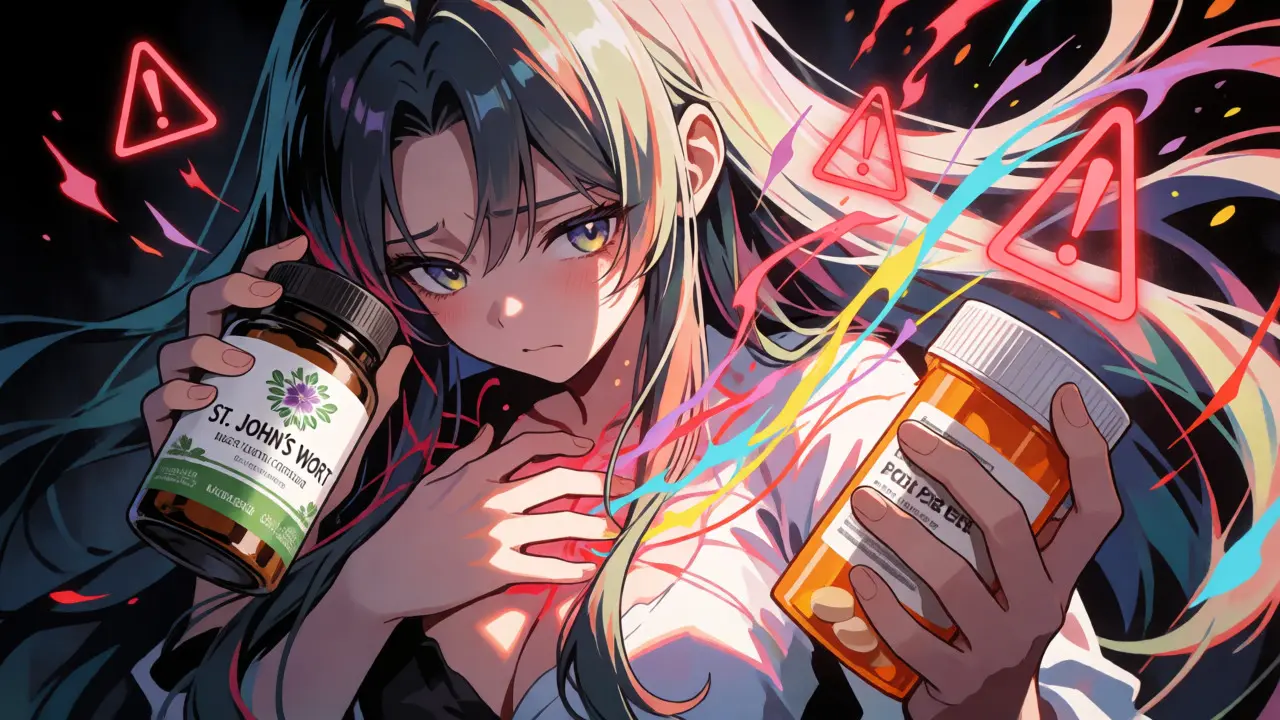
One of the biggest risks with alternative medication classes is interaction. Patients often forget to tell their doctors about supplements, assuming they’re harmless. But herbs can alter how your body processes prescription drugs. St. John’s Wort is notorious for inducing liver enzymes that metabolize other drugs faster, rendering them less effective. More dangerously, it increases serotonin levels. Combined with SSRIs (common antidepressants), it can cause serotonin toxicity-a life-threatening condition marked by tremors, high fever, and low blood pressure.
Blood thinners face similar threats. Ginkgo biloba, feverfew, and chamomile all have mild blood-thinning properties. Take them alongside aspirin or warfarin, and your bleeding risk spikes. A nosebleed might become a hospital visit. Alcohol adds another layer of complexity. It interacts with certain antibiotics, causing flushing and nausea, and can stay in your system for hours after consumption, requiring extended caution beyond the immediate drinking period.
Managing Side Effects: Practical Steps for Patients
So, how do you navigate this landscape without becoming a pharmacologist? First, treat supplements like drugs. Read labels. Check for inactive ingredients if you have known allergies (like sulfites or aspartame). Second, maintain a single source of truth for your medication list. Include everything: prescriptions, OTC painkillers, vitamins, and herbs. Bring this list to every appointment.
Third, monitor changes closely when switching medication classes. If you move from brand to generic, or start a new herb, watch for subtle shifts in how you feel. Fatigue, rash, or digestive upset are early warning signs. Fourth, ask your pharmacist. They are your best resource for checking interactions between your specific combo of meds and supplements. Finally, never stop a prescription abruptly because a supplement seems to be working. Tapering off under medical supervision prevents withdrawal symptoms and rebound effects.
Are generic drugs less effective than brand-name drugs?
Generally, no. Generic drugs must contain the same active ingredient and demonstrate bioequivalence within 80-125% of the brand-name drug's absorption rate. Studies show the average difference is about 3.5%, which is clinically insignificant for most conditions. However, inactive ingredients may differ, potentially affecting those with specific allergies or sensitivities.
Can herbal supplements cause serious side effects?
Yes. Herbal supplements are not regulated as strictly as prescription drugs. For example, Echinacea can cause allergic reactions, and St. John’s Wort can lead to serotonin toxicity when combined with antidepressants. Supplements can also interact with prescription medications, altering their effectiveness or increasing side effects.
What is a narrow therapeutic index drug?
A narrow therapeutic index (NTI) drug has a small difference between the dose that provides treatment and the dose that causes toxicity. Examples include warfarin and levothyroxine. Small variations in absorption, such as those that might occur when switching between different generic manufacturers, can significantly impact safety and efficacy, requiring close monitoring.
Why do I need to check inactive ingredients in medications?
Inactive ingredients, such as fillers, dyes, and preservatives, vary between brand-name and generic versions. Patients with allergies or intolerances (e.g., to lactose, gluten, or sulfites) may experience side effects from these components even if the active drug is the same. Checking labels helps avoid unnecessary adverse reactions.
How does alcohol affect medication side effects?
Alcohol can interact with many medications, including antibiotics and pain relievers, leading to increased side effects like drowsiness, stomach upset, or liver damage. Since alcohol remains in the system for several hours, its effects can persist beyond the time of consumption, potentially compounding medication risks throughout the day.



Comments (9)
Neil Sahli
Oh, fantastic. Because nothing says "trust me" like a product that doesn't have to prove it actually works before hitting the shelf. 🙄 But hey, at least we can all feel superior about our liver enzymes processing St. John's Wort while our antidepressants quietly leave the building. Keep up the good fight against the FDA, everyone!
Pramay Dattani
You americans always complain but dont know how to do things right. In India we use ayurveda for thousands of years and no one dies from turmeric unlike your pills which kill people every day. Your FDA is just big pharma tool trying to stop natural medicine. We are better than you with our herbs and spices. Go back to eating junk food.
Mary Tait
The United States sets the global standard for pharmaceutical regulation, and frankly, other countries should be grateful for our oversight. The DSHEA act was a necessary compromise, not a failure. To suggest that unregulated supplements are equivalent to rigorously tested American drugs is an insult to our scientific infrastructure. We protect consumers better than anyone else in the world, period.
Aurelio Haney
Most people are too lazy to read labels or check interactions, so they suffer. :/ It’s simple: if you don’t know what’s in it, don’t put it in your body. Pharmacists exist for a reason. Use them. Stop treating your body like a chemistry experiment gone wrong. >:(
Louis Tarro
I must confess, the sheer magnitude of this regulatory chasm leaves me rather breathless. It is truly disheartening to witness the populace stumbling blindly through a thicket of botanical uncertainties, mistaking ignorance for immunity. One ought to approach these matters with the solemnity of a surgeon and the caution of a diplomat. To neglect such vigilance is akin to sailing without a compass in a storm-tossed sea. :-)
Amy B
Wait, seriously? I had no idea Echinacea could cause asthma attacks! 😲 That is wild. I’ve been popping those lozenges like candy whenever I feel sniffly. Do you think it’s worth switching to something else, or is it only bad if you’re already sensitive? Also, does anyone else find it weird that we trust a pill bottle more than a plant leaf just because of paperwork? 🤔
Falgun R Patel
It is fascinating how fear often clouds our judgment regarding health choices. Perhaps the issue is not merely regulation, but our fundamental misunderstanding of nature as inherently passive. When we view supplements as inert, we ignore their active biological potential. A balanced perspective might involve respecting both the precision of modern science and the complexity of natural compounds, finding harmony rather than opposition between them. Let us seek understanding over alarm.
Rebecca Makayla Crane
Ugh, finally someone said it. 💅 The whole 'natural = safe' thing is so last decade and honestly kind of embarrassing for adults who should know better. Like, do you really think a random herb from a gas station aisle has the same QC standards as a Pfizer drug? Please. 🙄 Just because it didn't come in a blister pack doesn't mean it won't wreck your serotonin receptors. Educate yourself, besties. ✨
Jim Bisesi
This is all so exhausting. Why does everything have to be so complicated? I just want to take my pill and go to sleep. Now I have to worry about fillers and dyes and whether my tea is interacting with my heart meds. It’s a nightmare. I’m probably going to get sick anyway. :(