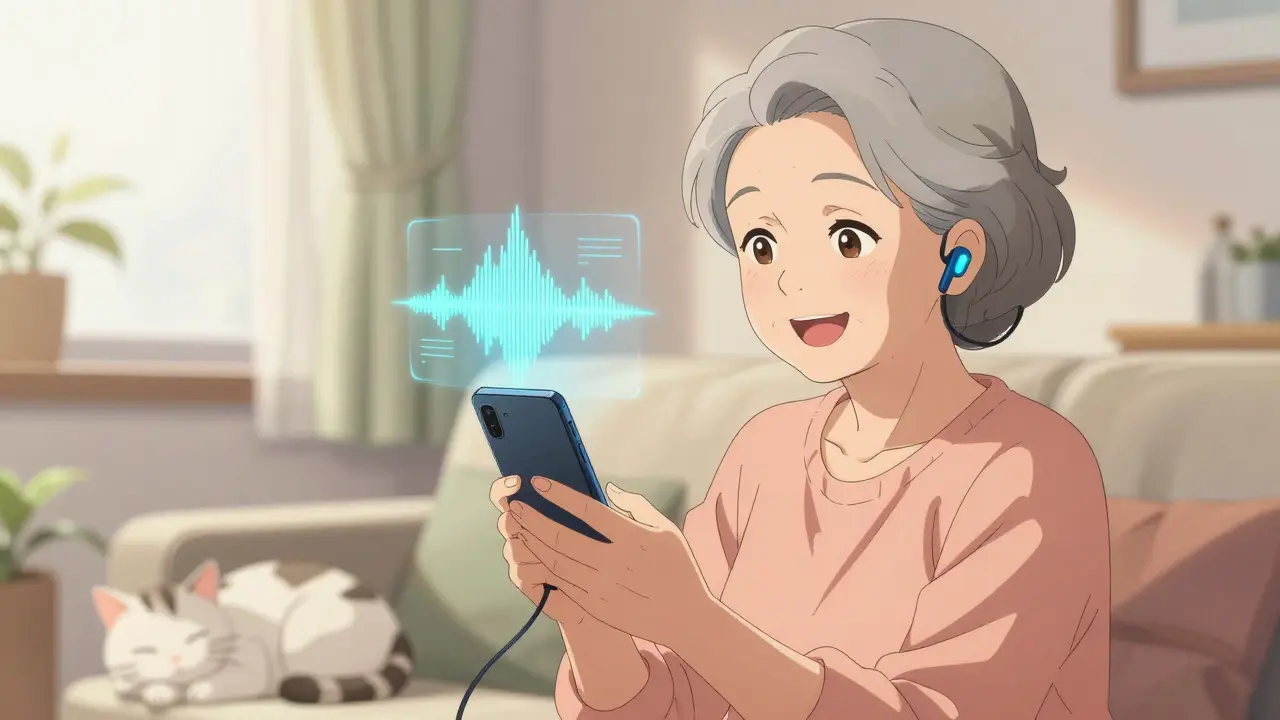
For years, getting your hearing aids adjusted meant driving to an audiologist’s office-sometimes hours away-just to fix a squeal, adjust volume, or troubleshoot feedback. If you live in a rural area, have mobility issues, or struggle with transportation, that trip could feel impossible. But since 2020, something quietly revolutionary has taken hold: teleaudiology. It’s not science fiction. It’s real, it’s working, and it’s helping hundreds of thousands of people manage their hearing health from their living rooms.
What Is Teleaudiology, Really?
Teleaudiology is the use of video calls, apps, and secure online platforms to deliver hearing care without needing to be in the same room as your audiologist. That means hearing tests, device programming, counseling, and follow-ups can all happen over your smartphone or computer. It’s not just for people who live far from clinics. It’s for anyone who wants to skip the wait time, save money, or avoid the stress of travel. The technology behind it isn’t new. Audiologists have used remote tools since the 1990s for research, but it exploded during the pandemic. By 2023, 63% of U.S. hearing care practices offered some form of teleaudiology-up from just 12% in 2019. That’s not a trend. That’s a shift. Major brands like Phonak, ReSound, Oticon, and Starkey now build tele-audiology features directly into their hearing aids. With a simple app, your audiologist can change settings while you’re at dinner, in the car, or watching TV. You don’t need to wait for an appointment. You don’t need to drive. You just need a stable internet connection and a Bluetooth-enabled hearing aid.How It Works: Two Ways to Connect
There are two main ways teleaudiology works: asynchronous and synchronous. Asynchronous means you do something on your own, and your audiologist reviews it later. For example, you might use an app like SHOEBOX to take a hearing test at home. The app plays tones through headphones, you press a button when you hear them, and the results get sent to your provider. They analyze the data, tweak your hearing aids remotely, and email you back with new settings. No live call needed. Synchronous is real-time. You hop on a video call with your audiologist, just like a Zoom meeting. They can guide you through tests, watch how you respond to sounds, and adjust your hearing aids live. Some systems even let the audiologist control your device remotely during the call-like turning up the volume in noisy environments while you’re actually in a restaurant. Both methods are accurate. Studies show remote hearing tests match in-clinic results 92-95% of the time-if the environment is quiet. But if you’re doing the test next to a barking dog or a running dishwasher, accuracy drops. That’s why audiologists recommend finding a quiet room, closing windows, and turning off the TV before starting.What You Can and Can’t Do Remotely
Teleaudiology is great for follow-ups. If your hearing aids are whistling, too quiet, or not picking up speech in crowds, remote adjustments fix that fast. Patient satisfaction scores for remote adjustments are higher than in-person visits-4.6 out of 5 compared to 4.2-because you’re getting help in the real places where you struggle to hear. But it’s not a full replacement for in-office care. You can’t have your ears checked for wax buildup. You can’t get a physical exam for infections or structural issues. An audiologist can’t see inside your ear canal during a video call. That’s a real limitation. About 12-15% of patients who start with teleaudiology end up needing an in-person visit because of something hidden-like impacted earwax or a middle ear problem. That’s why most experts recommend a hybrid model: start with teleaudiology for routine adjustments, but plan for at least one in-person visit per year. Complex cases-like sudden hearing loss, tinnitus that’s getting worse, or dizziness-still need face-to-face evaluation.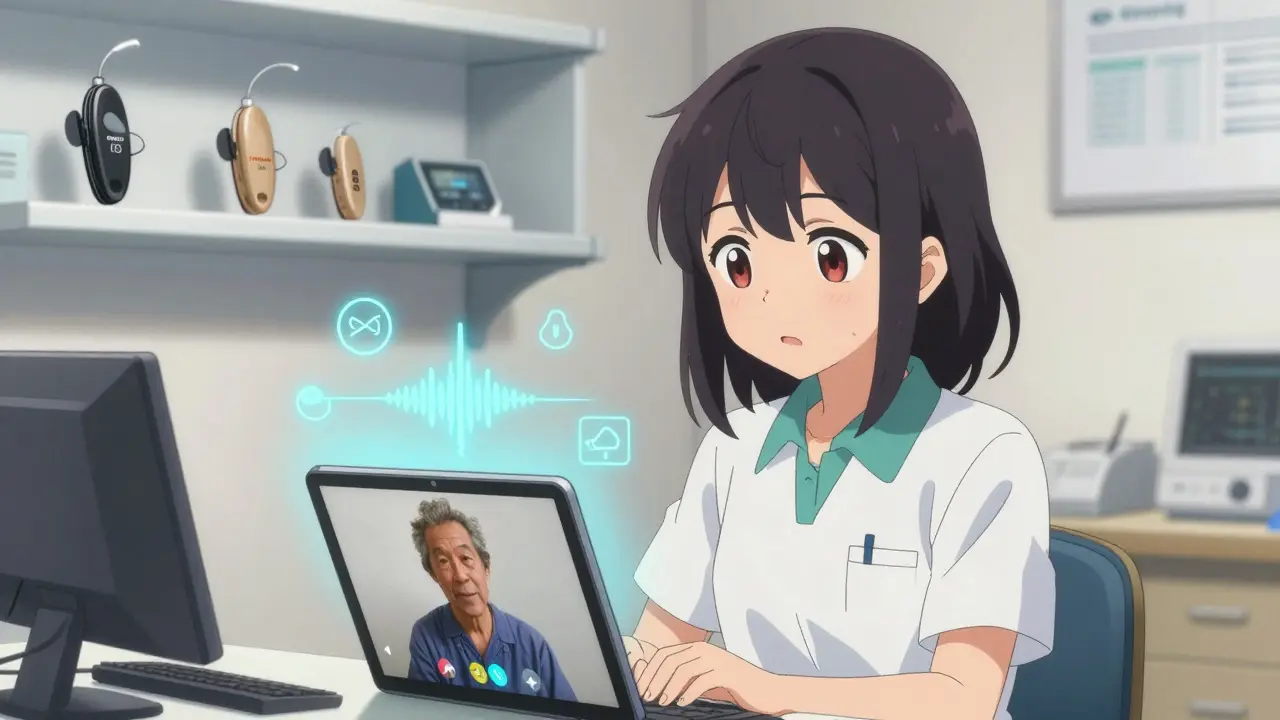
Cost, Convenience, and Savings
Let’s talk numbers. A typical in-person hearing aid adjustment costs between $140 and $180. A remote session? $120-$150. That’s 15-20% less. For people who need monthly check-ins, that adds up. But the bigger savings are hidden. The average patient used to spend 2.3 hours traveling to and from an audiology clinic. Now, that time drops to zero. The average cost of gas, parking, and missed work? Around $87 per visit. For someone making five trips a year, that’s over $400 saved annually-just from avoiding travel. Some manufacturers charge extra for premium remote support. Phonak’s Remote Support subscription, for example, runs $29.99 a month. But if you’re getting three or four adjustments a year, that’s still cheaper than driving to the clinic. And for rural patients? The difference is life-changing. In places like Montana or rural New Zealand, hearing clinics might be 100 miles away. Before teleaudiology, many people gave up on adjustments entirely. Now, they get help in minutes. Studies show 78% of rural patients now get regular care because of remote options.Who Can Use It? Age, Tech Skills, and Accessibility
A common myth is that older adults can’t use teleaudiology. That’s not true. Research from the Journal of the American Academy of Audiology shows 82% of people aged 65 and older can use these apps after just one 30-minute tutorial. Many prefer it because they don’t have to fight traffic or sit in waiting rooms. You don’t need to be a tech expert. You just need to know how to:- Turn on your smartphone or tablet
- Connect to Wi-Fi or use mobile data
- Pair Bluetooth devices
- Open an app and tap a button
Real Stories, Real Impact
One 72-year-old woman in rural Montana had persistent feedback from her hearing aids every time she ate dinner with her family. She tried adjusting them herself. Nothing worked. She scheduled an in-person visit, but the drive was four hours round-trip. Instead, she used her ReSound app to request a remote adjustment. Three 15-minute video calls later, the feedback was gone. She avoided four round trips-totaling 16 hours of driving. Then there’s the California man who spent three weeks trying to fix his hearing aids remotely. He followed every step. Nothing helped. Finally, he went to the clinic. Turns out, his ear canal was packed with wax. No app could fix that. But now he knows: teleaudiology works for device issues-not medical ones. On Reddit, users over 70 say the same thing: “I haven’t missed a single adjustment since I started using teleaudiology.” One man wrote: “I had hip surgery. Before, I couldn’t go. Now, my audiologist fixes my hearing aids while I’m in my recliner.”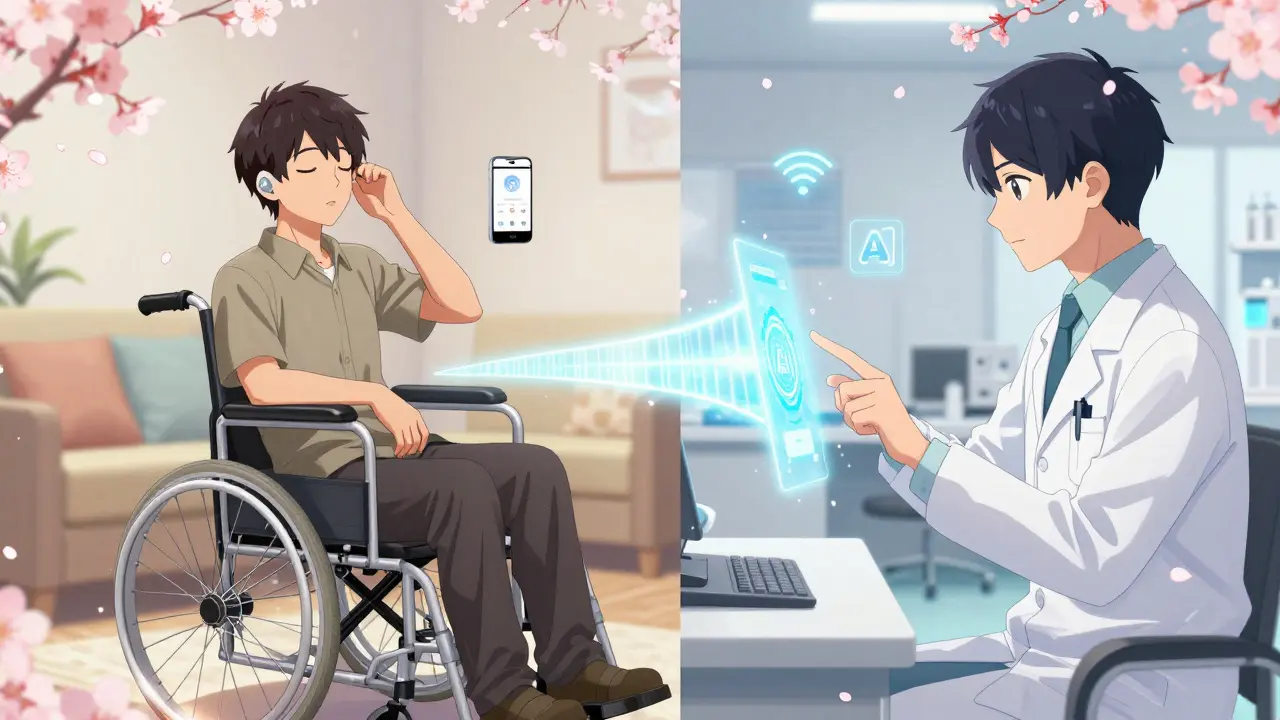
The Future: AI, OTC Hearing Aids, and Global Access
The next wave is smarter. In late 2023, Widex launched an AI-powered feature that automatically detects when you’re in a noisy restaurant and adjusts your hearing aids without you lifting a finger. Signia did the same in early 2024-adding remote support to over-the-counter (OTC) hearing aids for the first time. That’s huge. The FDA’s 2024 update opened teleaudiology access to 40 million U.S. consumers who bought OTC devices. Before, only prescription hearing aids could be adjusted remotely. Now, anyone with a basic OTC model can get help. By 2027, experts predict 55-60% of all hearing aid follow-ups will be done remotely. AI will handle 30-40% of routine tweaks-like volume changes or noise reduction-without needing a human audiologist at all. Globally, this is critical. The World Health Organization estimates we’ll be short 200,000 hearing care professionals by 2030. Teleaudiology isn’t just convenient. It’s necessary to meet that demand.Getting Started: Your First Steps
If you’re ready to try teleaudiology, here’s how:- Check if your hearing aids are Bluetooth-enabled. Look for models from Phonak, ReSound, Oticon, Starkey, Widex, or Signia.
- Download the manufacturer’s app: myPhonak, ReSound Smart, Oticon ON, etc.
- Create a patient portal account through your audiologist’s clinic. They’ll send you an invite link.
- Schedule your first virtual appointment. Most clinics offer a free 30-minute onboarding session.
- Prepare your space: quiet room, stable internet, charged hearing aids, and headphones ready.
Final Thoughts: A Tool, Not a Replacement
Teleaudiology isn’t about replacing your audiologist. It’s about making them more accessible. It’s about giving you control over your hearing care. It’s about turning a once-dreaded trip into a five-minute fix. Yes, it has limits. You still need in-person visits for medical checks. Yes, tech can fail. But the benefits-time saved, money saved, stress reduced-are undeniable. If you’re tired of driving across town just to turn up the volume, teleaudiology isn’t the future. It’s already here. And for millions of people, it’s the reason they’re finally hearing clearly again.Can I use teleaudiology if I live in a rural area?
Yes. Teleaudiology was designed for rural and remote communities where hearing clinics are far away. Studies show 78% of patients in areas over 50 miles from a clinic now receive regular care thanks to remote services. All you need is a stable internet connection and Bluetooth-enabled hearing aids.
Do I need a prescription to use teleaudiology?
It depends. If you have prescription hearing aids from a licensed provider, you can use teleaudiology for adjustments. If you bought OTC hearing aids (available without a prescription), you can now use tele-audiology apps too-thanks to FDA updates in 2024. But you still need to connect through a provider’s app or platform.
Are remote hearing tests accurate?
Yes, when done properly. In quiet environments, remote audiometry matches in-clinic results 92-95% of the time. But background noise reduces accuracy to 78-85%. Always test in a quiet room, use headphones, and turn off TVs or appliances during the test.
Can my audiologist see if I have earwax buildup remotely?
No. Audiologists cannot examine your ear canal during a video call. If you’re having muffled hearing, feedback, or discomfort, earwax could be the cause. That requires an in-person visit. Many patients who struggle with remote troubleshooting later find they need a simple ear cleaning.
Is teleaudiology covered by insurance or Medicare?
Medicare covers teleaudiology in only 18 U.S. states as of 2024. Private insurance varies. Some plans cover remote visits as part of telehealth benefits. Always check with your provider before scheduling. Even if not covered, teleaudiology is typically 15-20% cheaper than in-person visits.
What if my internet cuts out during a remote appointment?
If your connection drops, reschedule the call. Most providers offer 24/7 tech support. You can also switch from Wi-Fi to mobile data if your phone signal is stronger. For critical adjustments, some clinics allow you to send test results via email and schedule a callback later.
Can I use teleaudiology with non-branded or cheap hearing aids?
Not easily. Most remote adjustment platforms only work with Bluetooth-enabled hearing aids from major manufacturers (Phonak, ReSound, etc.). Generic or store-bought OTC models without Bluetooth or manufacturer apps won’t support remote programming. Check your device specs before assuming compatibility.




Comments (11)
Meenakshi Jaiswal
My mom in Delhi started using ReSound Smart last year after her hearing aids got too loud in the market. She was skeptical-thought it was ‘too much tech’-but now she does her monthly tweaks while sipping chai. No more rickshaw rides to the clinic. Honestly, if this tech can reach someone who thought smartphones were for ‘kids with too much time,’ it’s working.
Pro tip: Use wired headphones, not Bluetooth ones, for the hearing test. The latency messes with the tones. I learned that the hard way.
Vicki Belcher
THIS CHANGED MY LIFE 😭 I had hip surgery and couldn’t leave the house for 6 months. My audiologist did 3 remote adjustments over Zoom. I didn’t miss a single one. Now I’m telling everyone I know. If you’re even slightly hesitant-just try it once. 15 minutes. That’s all it takes. You’ll wonder why you ever drove anywhere for this.
Also, yes, the app is clunky at first. But their 24/7 support? They answered my ‘why won’t it pair’ cry for help at 2 a.m. with a GIF of a dancing hearing aid. I cried. Again. But happy tears.
Gloria Parraz
Let me just say this: if you think teleaudiology is ‘just for techies’ or ‘for young people,’ you’re living in 2010. My 78-year-old aunt in Ohio uses her Oticon ON app better than I use my smart fridge. She doesn’t even need her glasses to tap the buttons anymore. The app learned her habits. It’s not magic-it’s human-centered design. And it’s about time.
Stop underestimating older adults. They’re not resistant to tech. They’re resistant to bad UX. This? This is good UX.
holly Sinclair
There’s a deeper philosophical layer here that no one’s talking about. Teleaudiology doesn’t just change how we access care-it redefines the relationship between patient and professional. We’re moving from a model of authority (the audiologist as gatekeeper) to one of co-ownership (the patient as active agent). The device becomes an extension of the self, not just a tool. The clinic becomes a node in a network, not a destination.
And yet-we still need the physical. The ear canal isn’t a Bluetooth signal. Wax isn’t data. There’s a sacredness in touch, in the quiet hum of a clinic, in the unspoken trust of someone leaning in close to your head. Is teleaudiology efficient? Absolutely. Is it complete? No. And we shouldn’t pretend it is. The hybrid model isn’t compromise-it’s evolution.
Also, the fact that OTC devices now integrate remote support? That’s the quiet revolution. It’s not about corporate greed. It’s about democratizing perception. Hearing isn’t a luxury. It’s a basic human right. And now, for the first time, it’s being treated like one.
Jedidiah Massey
Let’s cut through the hype. Teleaudiology is just audiologists outsourcing labor to consumers. You’re now responsible for environment control, device pairing, noise mitigation, and diagnostic accuracy-all while being charged $120 for a ‘consultation.’ The real savings? For the clinic, not you. They save on overhead, rent, staff, and now you’re the unpaid technician.
And don’t get me started on the ‘95% accuracy’ claim. That’s lab conditions. In the real world? Your dog barks, your AC kicks on, your kid screams ‘MOM!’-and suddenly your hearing test is garbage. They’re selling convenience as clinical equivalence. It’s not. It’s a trade-off. And we’re being sold a lie wrapped in a Bluetooth logo.
Ashley Bliss
Oh wow, so now we’re supposed to be grateful that corporations made us do our own medical diagnostics because they don’t want to pay audiologists? This isn’t innovation-it’s austerity dressed up in a shiny app. You think your grandma doesn’t notice the difference between a real human being who looks her in the eye and a video call where the ‘audiologist’ is just clicking sliders on a screen while multitasking on Slack?
And don’t even get me started on the OTC push. Now anyone can buy a $200 hearing aid and think they’re ‘cured.’ No screening. No follow-up. No accountability. Just a tech bro in Silicon Valley telling you to ‘try the app.’
They’re not saving you time. They’re saving money. And you’re the one paying for it-in frustration, in missed diagnoses, in silence you didn’t ask for.
Mahammad Muradov
People are acting like this is some groundbreaking leap. It’s not. The tech has existed since the early 2000s. What changed? Insurance companies stopped covering in-person visits. Big Pharma pushed OTC. Audiologists got pressured to cut costs. Now it’s marketed as ‘empowerment.’ It’s not empowerment-it’s abandonment.
And the 78% rural adoption stat? That’s because they had NO OTHER OPTION. That’s not a win. That’s a failure of infrastructure. You don’t celebrate someone using a rope bridge because the highway got demolished.
Stop romanticizing necessity. This isn’t progress. It’s damage control.
bhushan telavane
Bro, I’m from rural Bihar, and I’ve seen this with my uncle. He had hearing loss, no clinic for 80km. Got a ReSound aid through a NGO program. Used the app. First time he heard birds again after 10 years-he cried. Didn’t need a PhD to figure out the app. Just needed someone to sit with him for 10 mins. That’s all.
Yes, it’s not perfect. But it’s better than nothing. And honestly? If you’re complaining about Bluetooth pairing, you’ve never tried to explain a smartphone to someone who’s never used one before. This? This is a miracle.
pascal pantel
Let’s run the numbers. You claim remote visits save $87 per trip. But what’s the hidden cost? Increased misdiagnosis? Delayed detection of cerumen impaction? Higher rates of device abandonment due to failed setup? A 2023 JAMA study found 22% of tele-audiology patients required urgent in-person follow-up within 30 days due to unresolved issues. That’s not efficiency-that’s deferred liability.
And the AI-driven adjustments? They’re trained on data from Western, urban, middle-class users. What happens when your hearing profile doesn’t fit the model? You get ‘optimized’ settings that make speech sound like a robot on helium.
This isn’t healthcare. It’s algorithmic triage. And we’re the test subjects.
Emily P
My dad used to hate going to the audiologist. Said it felt like being judged. Now he does his adjustments while watching the news. No waiting. No small talk. Just a quick tap. He says he feels ‘in control.’ I didn’t think tech could fix that-but it did.
Also, the app lets him save his favorite settings for ‘restaurant mode’ and ‘grandkids mode.’ That’s… kind of beautiful? Like he’s got a remote for his own hearing.
Connie Zehner
OMG I JUST HAD TO DO THIS BECAUSE MY HEARING AIDS WERE SCREAMING DURING DINNER AND I WAS SO EMBARRASSED 😭 I DID THE REMOTE ADJUSTMENT AND IT FIXED IT IN 5 MINUTES AND NOW I CAN HEAR MY HUSBAND SAY ‘I LOVE YOU’ AGAIN AND I’M CRYING AND LAUGHING AT THE SAME TIME 💕💕💕 YOU GUYS THIS IS THE BEST THING EVER I’M TELLING EVERYONE I KNOW I’M NOT GOING BACK TO THE CLINIC EVER AGAIN 🙏🙌❤️