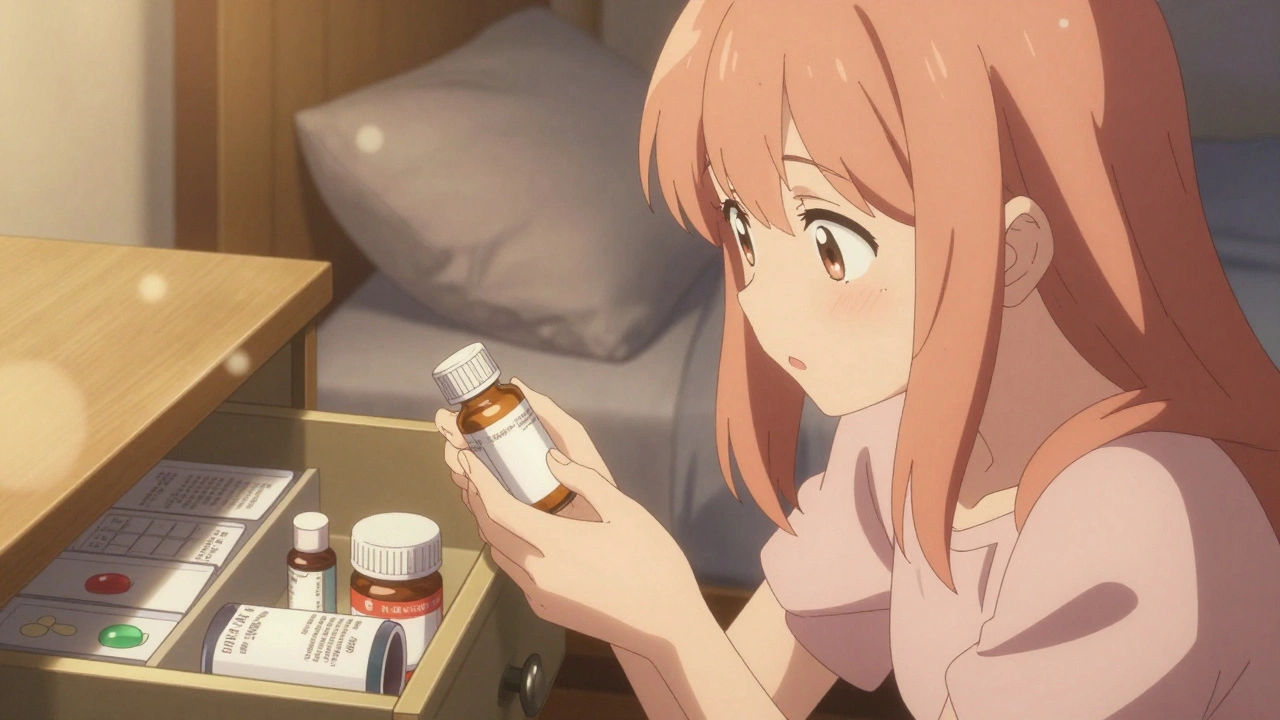
Have you ever opened a medicine bottle and wondered, Do I keep this in the fridge or on the shelf? It’s not just a small detail-it’s the difference between your medicine working as it should and becoming useless-or even dangerous.
Every pill, liquid, inhaler, or patch you take has specific storage needs. These aren’t suggestions. They’re science-backed rules written into the label so your medicine stays safe, strong, and effective. But most people miss them. They toss meds into the bathroom cabinet, leave them in the car, or shove them into the fridge door without thinking. And that’s a problem.
Where to Find Storage Instructions on the Label
Look past the big font that says ‘Take one tablet daily.’ The storage info is hiding in plain sight. On over-the-counter medicines, check the Drug Facts label. Scroll down past the active ingredients, uses, warnings, and directions. Right at the bottom, under Other information, you’ll find it. It might say:
- Store at room temperature
- Protect from light
- Keep dry
- Refrigerate
For prescription meds, the label might not be as standardized. But you’ll still find it-usually in a section called Storage and Handling or How Supplied. If you’re unsure, flip to the printed insert that came with your bottle. That’s where the full details live.
Some labels use codes you might not recognize. For example, controlled room temperature doesn’t mean your living room. It means 20°C to 25°C (68°F to 77°F)-the temperature range your kitchen or bedroom is likely to stay in. Anything hotter or colder than that can damage the medicine.
What ‘Refrigerate’ Really Means
If your label says refrigerate, don’t just toss it in the fridge door. That’s the warmest part. The door opens and closes constantly, letting in warm air. Temperature swings there can hit 10°C (18°F) in a single day. That’s enough to ruin insulin, liquid antibiotics, or certain biologics.
Instead, store refrigerated medicines on a middle shelf-away from the door, where it’s coldest and most stable. Keep it between 2°C and 8°C (36°F to 46°F). If your fridge doesn’t have a thermometer, buy one for under $10. It’s cheaper than replacing a spoiled bottle of medicine.
Some liquid medicines, like amoxicillin suspension, need refrigeration after opening. The unopened bottle might be fine on the shelf, but once you mix it with water, it becomes a breeding ground for bacteria unless kept cold. Most of these expire within 10-14 days once mixed. Check the label for that expiration date-it’s not the same as the original bottle date.
Why ‘Protect from Light’ Matters
Light isn’t just for photos. It breaks down chemicals. Medicines like nitroglycerin (used for chest pain), certain antibiotics, and thyroid pills degrade quickly when exposed to sunlight or even bright indoor lighting. That’s why they come in dark bottles.
But if you transfer them to a clear pill organizer, you’re undoing the protection. Keep them in their original container. If you need to carry them around, use a small opaque case-not a clear plastic one. Even a dark sock or a small pouch works better than leaving them exposed.
And don’t store them near windows. A sunny windowsill in Auckland might look nice, but it’s a science experiment gone wrong. UV rays and heat from the sun can turn your medicine into something your body doesn’t recognize.
Why the Bathroom Is the Worst Place
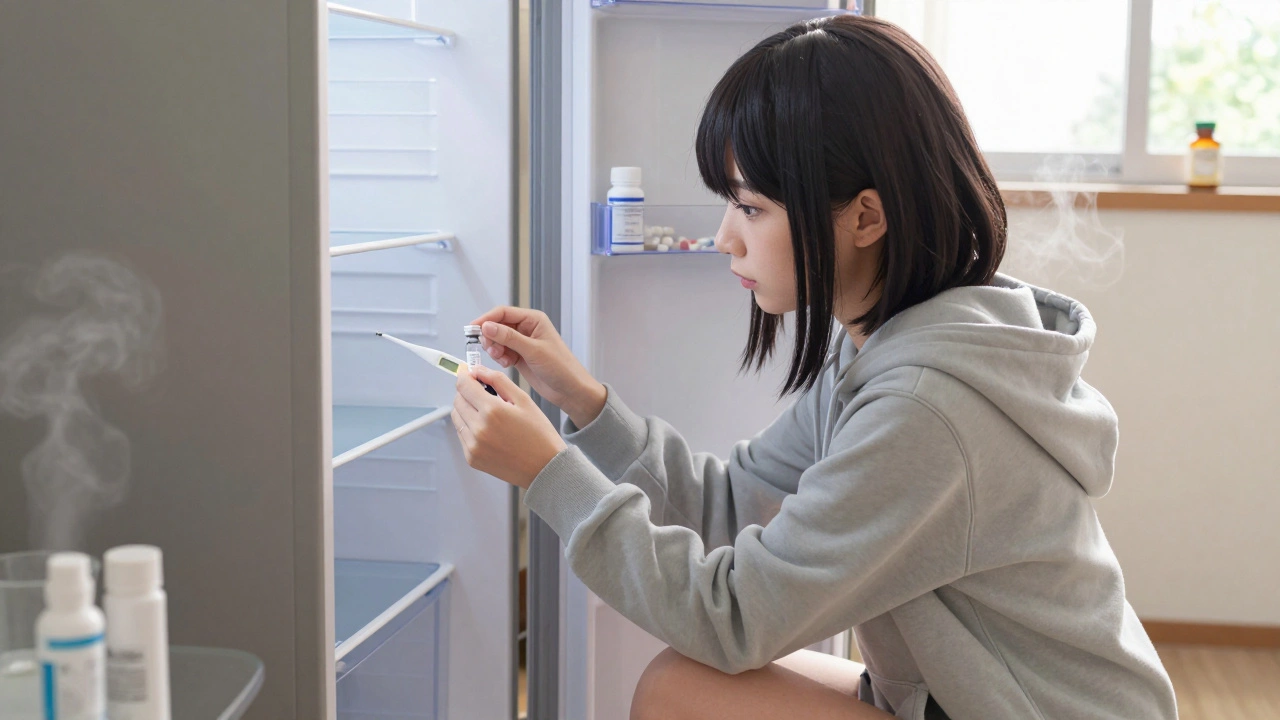
It’s the most common mistake. You’ve got the medicine cabinet right there. Convenient. But here’s the truth: bathrooms are humid. Showers create steam. That moisture gets into pill bottles, even if they’re sealed. Moisture causes pills to crumble, capsules to stick together, and liquids to grow mold.
A 2023 survey found that 42% of people store their meds in the bathroom. That’s nearly half. And it’s not just inconvenient-it’s risky. Medications like aspirin, epinephrine auto-injectors, and even some antidepressants can lose potency faster in humid environments.
Find a dry spot instead. A bedroom drawer. A kitchen cabinet away from the sink. A locked box on a high shelf if you have kids or pets. The goal is cool, dry, and out of reach.
What Happens When You Ignore the Instructions
It’s not just about your medicine not working. It’s about safety.
Take acetaminophen, for example. If it degrades because it’s been stored too hot or too humid, it can break down into a toxic compound called NAPQI. That’s the same chemical that causes liver damage in overdose cases-but here, it’s happening slowly, over weeks, because you kept it in the car.
Insulin? If it gets too warm, it loses its ability to lower blood sugar. A person with diabetes might not realize their insulin is dead until they’re in crisis.
Nitroglycerin tablets? They’re used during heart attacks. If they’ve been exposed to heat or moisture, they might not work when you need them most. That’s not a hypothetical risk-it’s been documented in FDA reports.
Between 2020 and 2022, storage-related errors contributed to 1.2% of all medication errors reported to the FDA. That number is likely way higher because most people never report it. They just think, ‘The medicine didn’t work,’ and stop taking it.
And here’s the kicker: when people store meds correctly, adherence improves by nearly 19%. That’s not just about safety-it’s about getting the full benefit of your treatment.
Traveling With Medication
Going on a trip? Don’t just pack your meds in your suitcase. If you’re flying, keep them in your carry-on. Checked luggage can sit in cargo holds where temperatures drop below freezing or spike over 50°C (122°F).
For temperature-sensitive meds like insulin, epinephrine, or certain biologics, use a small insulated cooler with a cold pack. Don’t let the medicine touch the ice directly-it can freeze. Wrap it in a towel first. Some pharmacies sell travel kits with temperature indicators that change color if the medicine got too hot or cold.
And if you’re crossing time zones? Don’t skip doses just because the time changed. Set alarms. Keep your meds with you. The label doesn’t say ‘take at 8 a.m. local time.’ It says ‘take once daily.’
What to Do When Instructions Confuse You
What if your insulin says ‘refrigerate’ but your thyroid pill says ‘store at room temperature’? What if your child’s antibiotic says ‘discard after 14 days’ but the bottle says ‘expires in 2 years’?
That’s when you call your pharmacist.
Pharmacists aren’t just people who hand out pills. They’re trained to interpret these labels. They know that ‘refrigerate’ can mean different things depending on the formulation. They know that some meds are stable at room temperature for short periods, even if the label says to refrigerate.
Don’t guess. Don’t Google it. Call your pharmacy. Ask: ‘Is this safe to store at room temperature for a week?’ or ‘Can I leave this in my bag during the day?’ Most pharmacies will answer for free, even if you didn’t fill the prescription there.
Future Changes Coming to Labels
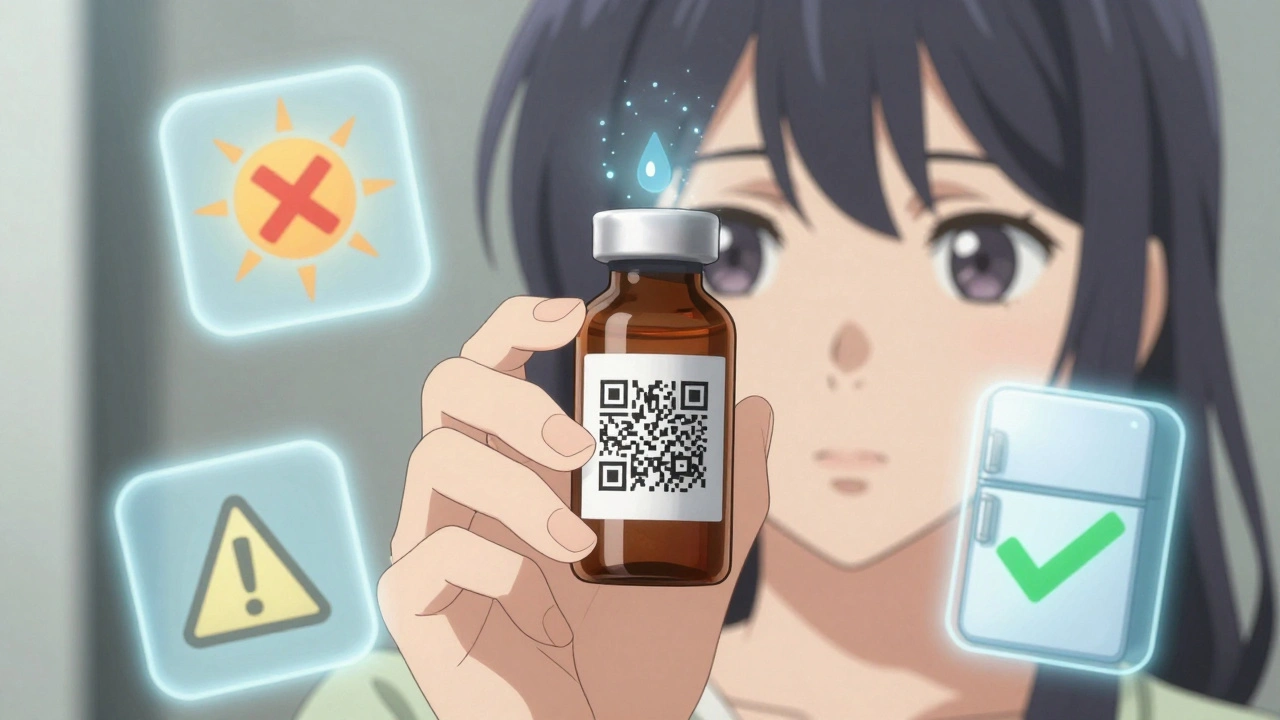
Things are changing. In 2024, CVS and Walgreens started testing QR codes on medication labels. Scan it, and you get real-time storage advice based on your location and the current weather. If it’s 35°C outside in Auckland, the app might tell you to keep your insulin in a cooler-even if the label says ‘room temperature.’
By 2030, experts predict most high-risk medications will have smart packaging. Tiny sensors inside the bottle will detect if the medicine got too hot, too cold, or too damp. Your phone will get a warning if your insulin has been compromised.
But for now? The label is your only guide. And it’s written in plain language. You just have to read it.
Quick Checklist: Storage Do’s and Don’ts
- Do: Store most medicines in a cool, dry place away from sunlight
- Do: Use the middle shelf of your fridge for refrigerated meds-not the door
- Do: Keep meds in original containers with labels intact
- Do: Ask your pharmacist if you’re unsure
- Don’t: Store in the bathroom, glove compartment, or car
- Don’t: Transfer to clear pill organizers unless the label says it’s safe
- Don’t: Keep expired or unused meds-dispose of them properly
Proper storage isn’t about being perfect. It’s about being aware. One small change-moving your meds from the bathroom to a drawer-could mean the difference between a medicine that works and one that fails when you need it most.
What does ‘store at controlled room temperature’ mean?
It means keeping the medicine between 20°C and 25°C (68°F to 77°F). This is the standard temperature range for most medications. Your bedroom or kitchen, away from direct heat or sunlight, is usually ideal. Avoid places like near the stove, radiator, or in direct sunlight.
Can I store medicine in the fridge if it doesn’t say to?
No. Refrigerating a medicine that doesn’t require it can damage it. Some pills and capsules become brittle or break down when exposed to cold and moisture. Always follow the label. If it doesn’t say ‘refrigerate,’ keep it at room temperature.
How do I know if my medicine has gone bad?
Look for changes: pills that are discolored, cracked, or sticky; liquids that are cloudy, have particles, or smell odd; inhalers that feel lighter than usual or don’t spray properly. If you see any of these signs, don’t use it. Contact your pharmacist.
What if my home doesn’t have air conditioning or refrigeration?
Talk to your pharmacist. Some medications come in alternative forms that are stable at higher temperatures. For example, certain insulin products are now available in formulations that don’t require refrigeration until opened. Your pharmacist can help you switch to a more suitable option if your living conditions make standard storage difficult.
Can I store different medicines together in one container?
Only if they all have the same storage requirements. Mixing a refrigerated insulin with a room-temperature blood pressure pill can compromise both. Use separate containers or labeled compartments. If you use a pill organizer, make sure each compartment is for meds that can be stored together.



Comments (15)
Chase Brittingham
Man, I used to keep my insulin in the bathroom till I read this. Now it’s in a drawer with a silica gel packet. Best decision ever. My sugar’s been stable for months.
Jordan Wall
Let’s be real - most people don’t read labels because they’re written like regulatory Kafkaesque nonsense. 'Controlled room temperature'? Who even defines that? 🤦♂️ I just keep mine next to my coffee maker. It’s warm, sure - but it’s also *accessible*. Priorities, people.
Also, QR codes? Please. That’s just Big Pharma’s way of making us dependent on apps. Next they’ll charge us $4.99/month for 'Medication Temperature Alerts Pro'.
Martyn Stuart
Actually, Jordan - 'controlled room temperature' is defined by the USP (United States Pharmacopeia) as 20°C–25°C, with excursions permitted between 15°C–30°C for short durations. It’s not jargon - it’s science. And yes, storing meds near a coffee maker? That’s 50–60°C during brewing - you’re essentially pasteurizing your pills.
Also: silica gel packets? Brilliant idea. I keep them in every medicine box. Cheap, effective, and reusable. Just pop them in the oven for 10 minutes every few months to reactivate.
And no - QR codes aren’t Big Pharma manipulation. They’re a response to decades of preventable errors. The FDA estimates 1.3 million adverse events annually due to improper storage. This isn’t marketing - it’s harm reduction.
Ollie Newland
My pharmacist told me last week that 70% of antibiotics lose potency if stored above 25°C for more than a week. I used to keep mine in my gym bag - now I have a tiny insulated pouch with a temp strip. Worth the $8. Also - don’t trust the fridge door. I tested mine with a thermometer. It swings 8°C in 20 minutes. That’s not storage - that’s a rollercoaster.
Dematteo Lasonya
My grandma used to say 'if it looks weird, don’t take it.' She was right. I once found a bottle of amoxicillin that had turned yellow and smelled like wet socks. Threw it out. Called the pharmacy. They gave me a new one for free. Always ask.
Isabelle Bujold
It’s fascinating how something so simple - storage - becomes this complex web of chemistry, environmental science, and behavioral psychology. People don’t ignore instructions because they’re lazy; they ignore them because they’re overwhelmed. The system doesn’t help. Labels are cluttered, inconsistent, and often contradictory. And then we’re expected to be experts? No wonder so many of us just shrug and hope for the best. Maybe the real issue isn’t the patient - it’s the design.
Also, I’ve started putting my meds in a small metal tin with a foam insert. It blocks light, insulates against heat, and looks like a vintage camera case. It’s weirdly satisfying. And safe. And yes, I’m aware this is probably overkill.
Ben Choy
Just moved my meds to the bedroom drawer and I feel like a responsible adult for the first time 😊
Emmanuel Peter
So let me get this straight - you’re telling me that millions of people are dying because they didn’t read a tiny line on a bottle? That’s not negligence. That’s systemic failure. Who approved these labels? Why isn’t the FDA mandating color-coded icons? Why are we still using text? This is 2025. We have emojis. We have AR. We have AI. And we’re still trusting people to read 12-point font in a dim bathroom? This is criminal.
Ashley Elliott
I used to keep my thyroid meds in the kitchen cabinet - right next to the stove. One day I noticed they were sticking together. I threw them out. Got a new prescription. The pharmacist asked if I’d been storing them near heat. I said no. She smiled and said, 'You’re not the first.' I didn’t even know that was a thing. Now they’re in a drawer with a note: 'NO STOVE.' Simple. Effective.
Augusta Barlow
They’re hiding the truth. The real reason they want you to refrigerate is so they can sell you special coolers. And the QR codes? They’re tracking your usage. Your phone knows when you open the bottle. They’re building a profile. They know if you’re taking your meds. They know if you’re skipping. And then? Insurance rates go up. Or your employer finds out. This isn’t about safety - it’s about control. The government, Big Pharma, the data brokers - they’re all in on it. You think you’re being helped? You’re being monitored.
Also, the FDA reports? Fake. They’re underfunded. They don’t even track half the cases. And those sensors? They’re just to make you paranoid so you buy more stuff. Don’t fall for it.
Rachel Bonaparte
Wow. So now I’m supposed to buy a thermometer, a silica gel packet, a metal tin, an insulated cooler, and a QR scanner just to keep a pill from turning into poison? And if I don’t? I’m a danger to society? I’m exhausted. I just want to take my medicine without becoming a storage engineer. Can’t we just make the pills stable? Why is everything so fragile? Why can’t science fix this? Why is it always the patient’s fault?
Scott van Haastrecht
THIS IS WHY PEOPLE DIE. You think your aspirin is safe? It’s probably degrading into NAPQI right now in your bathroom cabinet. You’re slowly poisoning yourself. And you’re too lazy to read a label. Congratulations. You’re not just irresponsible - you’re a walking public health liability.
Michael Feldstein
One thing I learned the hard way: if you’re traveling and your meds are temp-sensitive, call your pharmacy before you leave. They’ll often give you a letter explaining what you’re carrying - and sometimes even a travel-sized cooler. I’ve had them send me a vial with a temp monitor built in. It beeped when my bag got too hot on the tarmac. Saved my insulin. You’d be surprised how helpful pharmacists are - if you ask.
jagdish kumar
The label is a mirror. It reflects your relationship with your own body. To ignore it is to reject care. To follow it is to choose life - quietly, daily, without applause.
zac grant
My dad used to keep his nitroglycerin in his wallet. Said it was 'quick access.' I found out he’d had two angina episodes where it didn’t work. Turned out the heat from his pocket had ruined it. We switched to the spray form - no refrigeration needed. Now he’s alive. Simple fix. Big difference. Always ask your pharmacist. Seriously.